Back to top

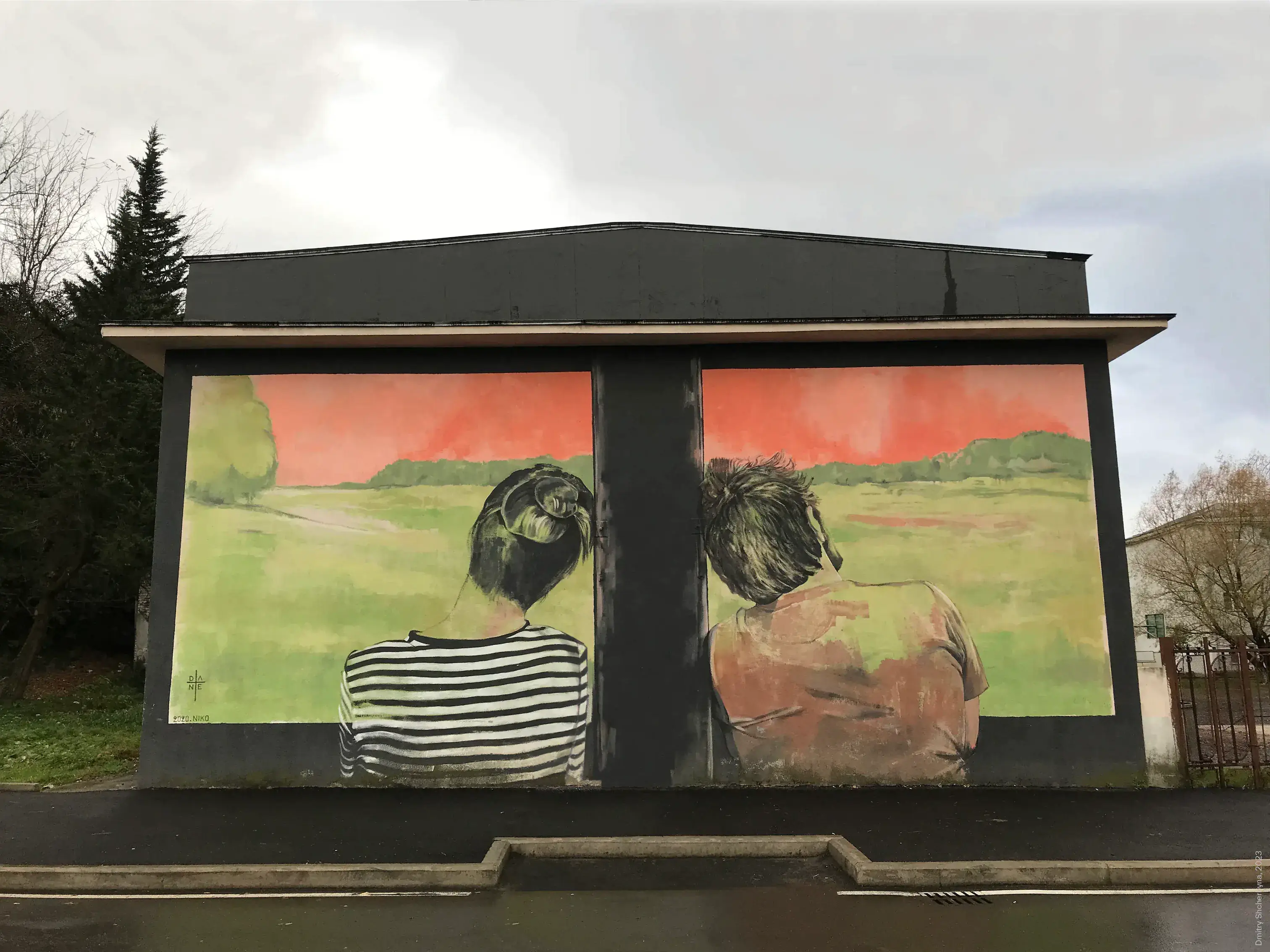
A mural painted on a small building shows the backs of a woman and a man gazing out at a green field. Their views are separated so each see their own picture.

Archive of selected Georgian street art works. 2021-2023.

The modern subculture of tagging gained prominence in the mid-1960s, first emerging in Philadelphia and then moving to New York before eventually spreading worldwide.
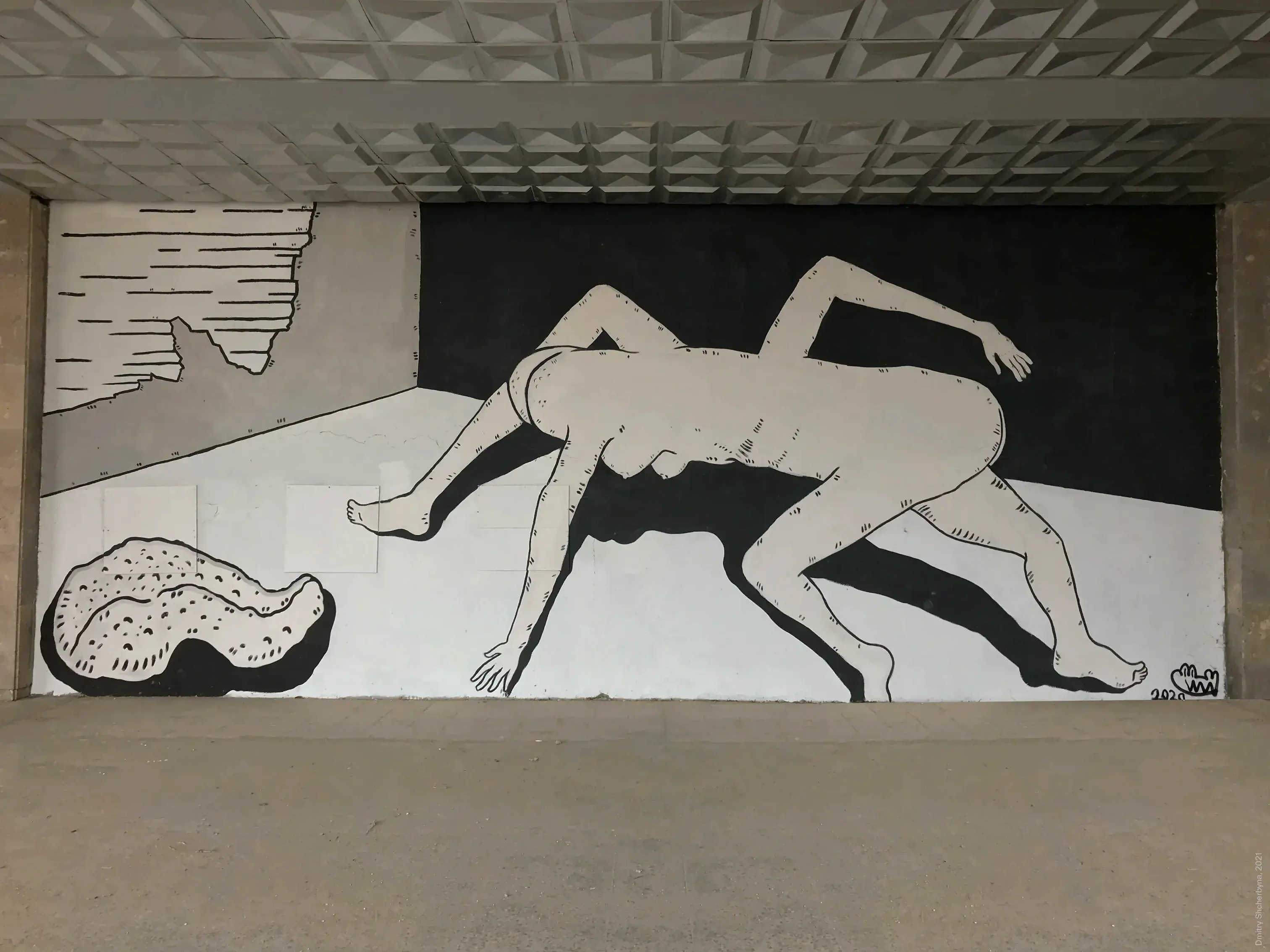
A black-and-white mural in an underpass shows a headless human figure crawling forward on all fours, casting a dark shadow.
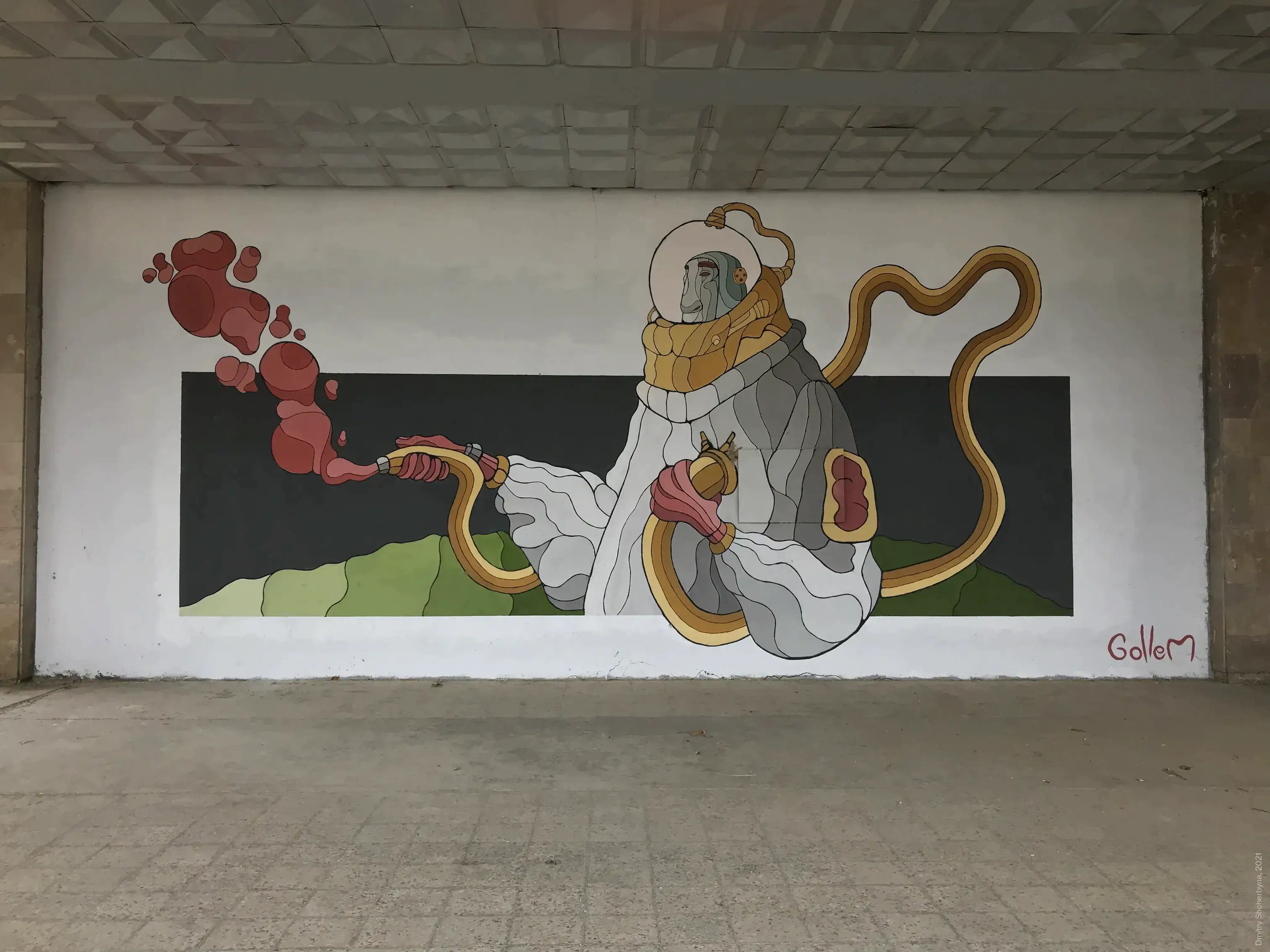
A mural depicting a robed figure wearing a round helmet or diving bell. He is holding a hose that is connected to the heart and emitting red bubbles.
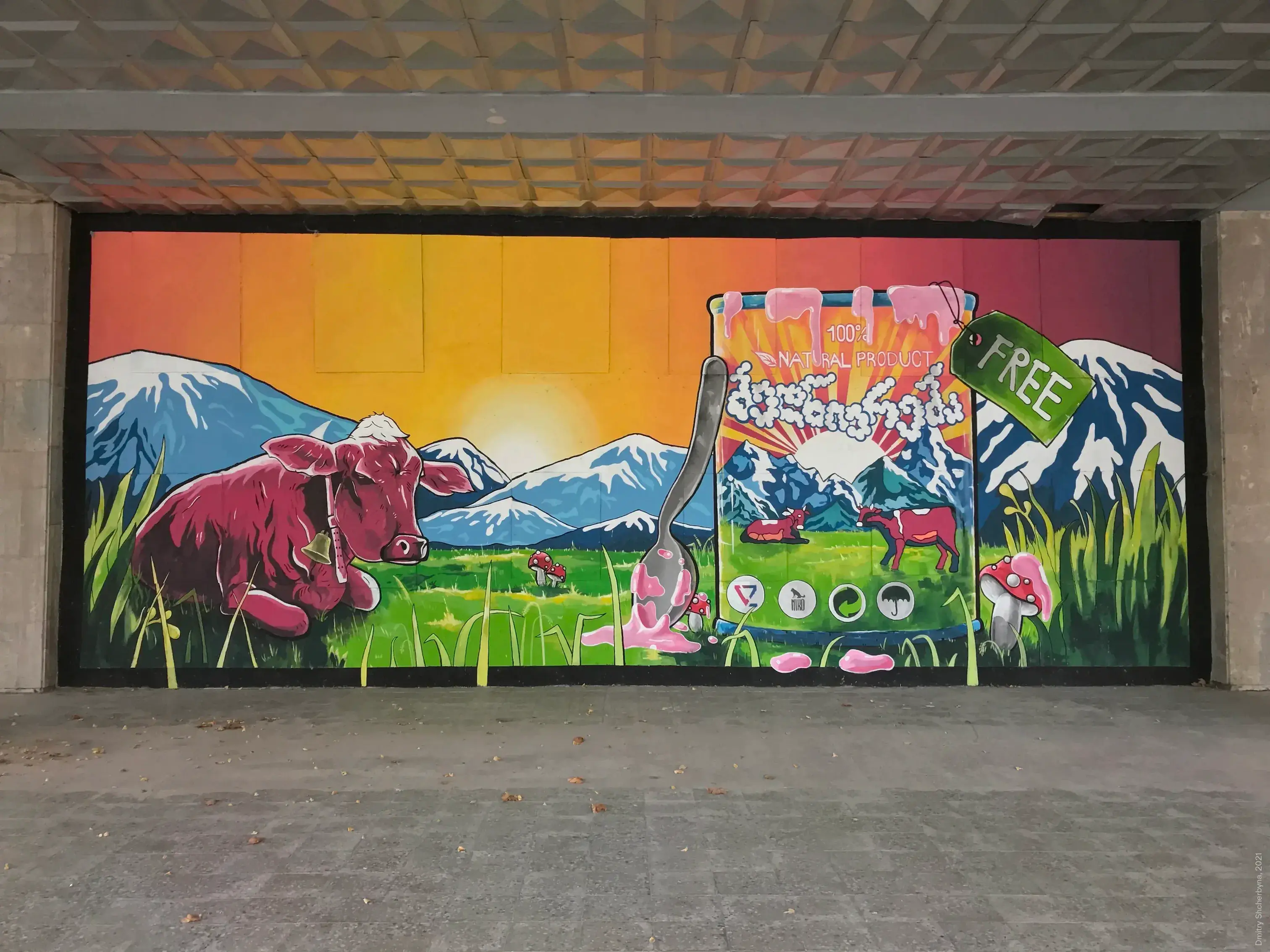
A mural depicting a pink cow resting in a green alpine meadow before snow-capped mountains and a sunset sky. Next to it sits a giant yogurt container labeled "100% Natural Product" in Georgian script, with a spoon, a "FREE" price tag, and mushrooms scattered around.
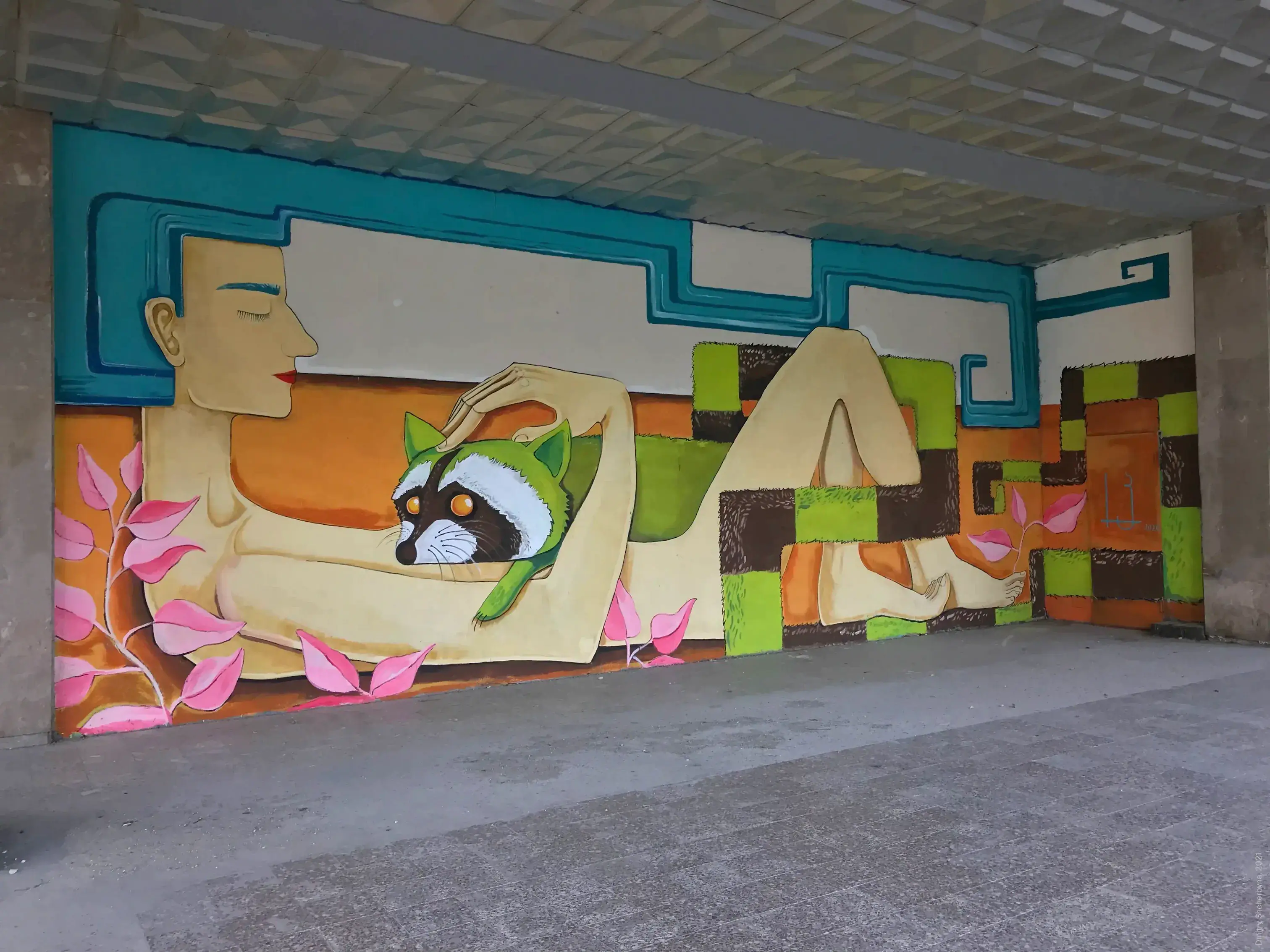
Mural of a stylized reclining figure with closed eyes, cradling a raccoon wearing a green hoodie, set against a background of colorful geometric blocks.

During the early 1980s, galleries began embracing graffiti-inspired work, with artists like Keith Haring and Jean-Michel Basquiat bringing street aesthetics into the mainstream art world. The actual term “street art” entered broader usage from the late 1980s onward, by which time various styles of the practice had already appeared. Today, it is a powerful movement with a wide range of techniques practiced by a multitude of artists working around the globe.

Nowadays, street art methods of expression are acknowledged as a full-fledged form of modern culture, but the level of formal acceptance varies widely worldwide. More than half a century has passed since the rise of name-based tagging, pioneered by Darryl McCray — better known as “Cornbread.” What began on city walls has now entered galleries and museums, contributing to its establishment as a distinct and complex contemporary art form.
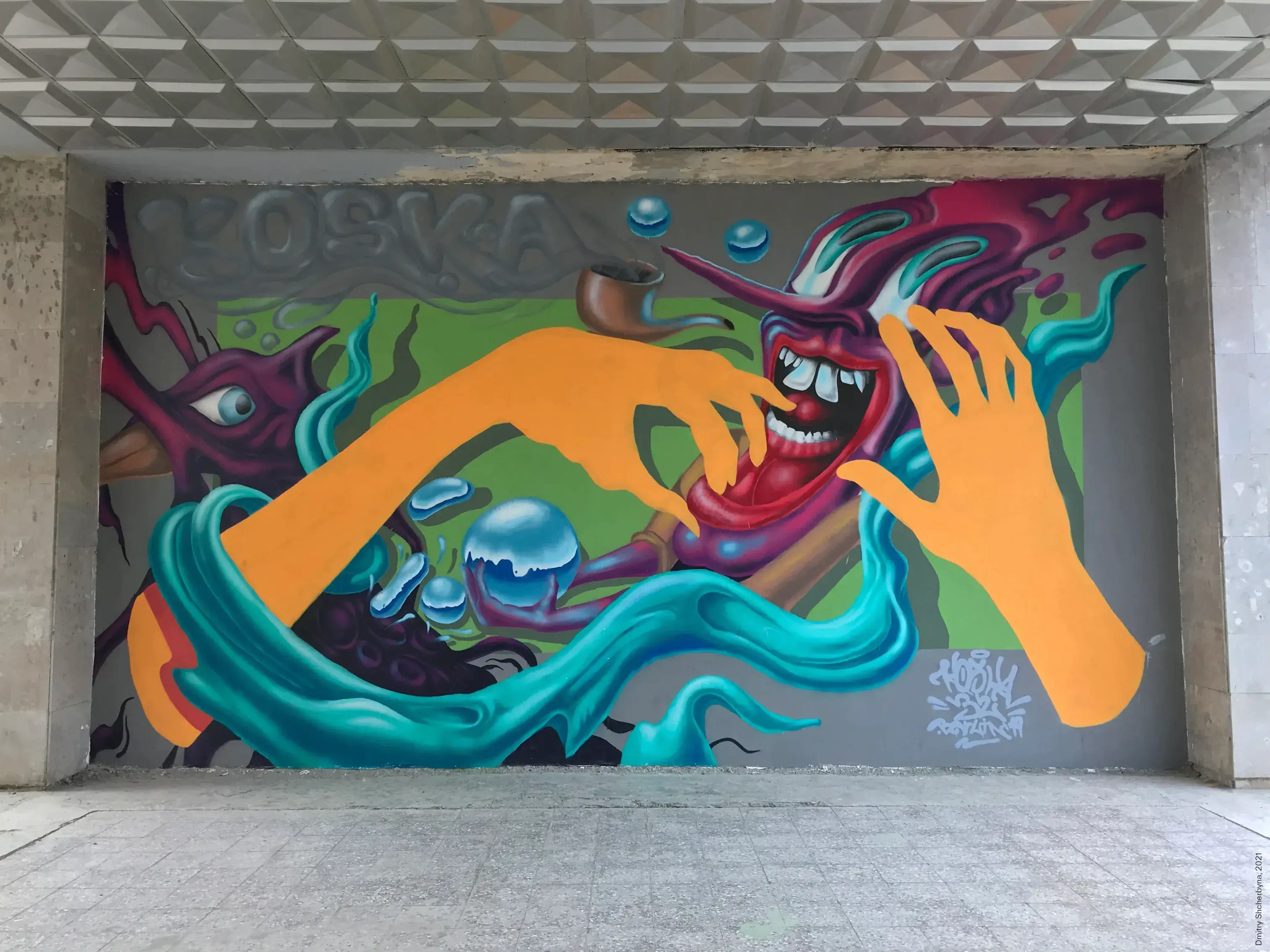
A mural showing a grinning disembodied red mouth with smoking pipe, flanked by long orange arms and hands surrounded by swirling teal shapes, floating blue orbs and a purple creature with single eye.

Until recently, little known to the global street art world, Georgia has built a scene with a full range of contemporary techniques. Abstract lettering and stencil work, murals, optical illusions, digitized video projection, and various figurative techniques are part of the ways Georgian artists diversify the urban environment. Mostly through a mix of murals, graffiti, and stencil art, city streets are actively showcasing their constantly evolving visual identity.

Mural painting is popular in Georgia, and many works are large-scale murals that cover entire buildings. Artists approach each facade thoughtfully, considering the surface, the structure, and the context of the surrounding neighborhood.

The stencil art technique involves creating cut templates made out of different materials: paper, cardboard, or other media, and then using spray paint or roll-on paint. Sometimes, multiple layers of stencils are used to add color or an illusion of depth.

Graffiti is writing, drawing, or other markings made on surfaces using spray paint or markers, though it can also be scratched or etched. It appears unexpectedly in public spaces and on the daily routes of city residents — ranging from simple inscriptions to large paintings. It serves different purposes: tagging, territorial marking, political and social commentary, or can be used to convey what simply can't be said politely and feels urgent or personal.

Murals contribute to the evolving visual identity of the city, adding new symbolic and aesthetic layers to its urban fabric. Many reflect broader societal changes and ongoing challenges within contemporary society. The city increasingly becomes a space where artists articulate their distinct visions. Some subtly reinterpret the boundary between public and private, framing the city as a shared cultural space, while others are simply trying to find the wall. In Tbilisi, that surface is often the side of a Soviet-era residential block — utilitarian and repetitive.
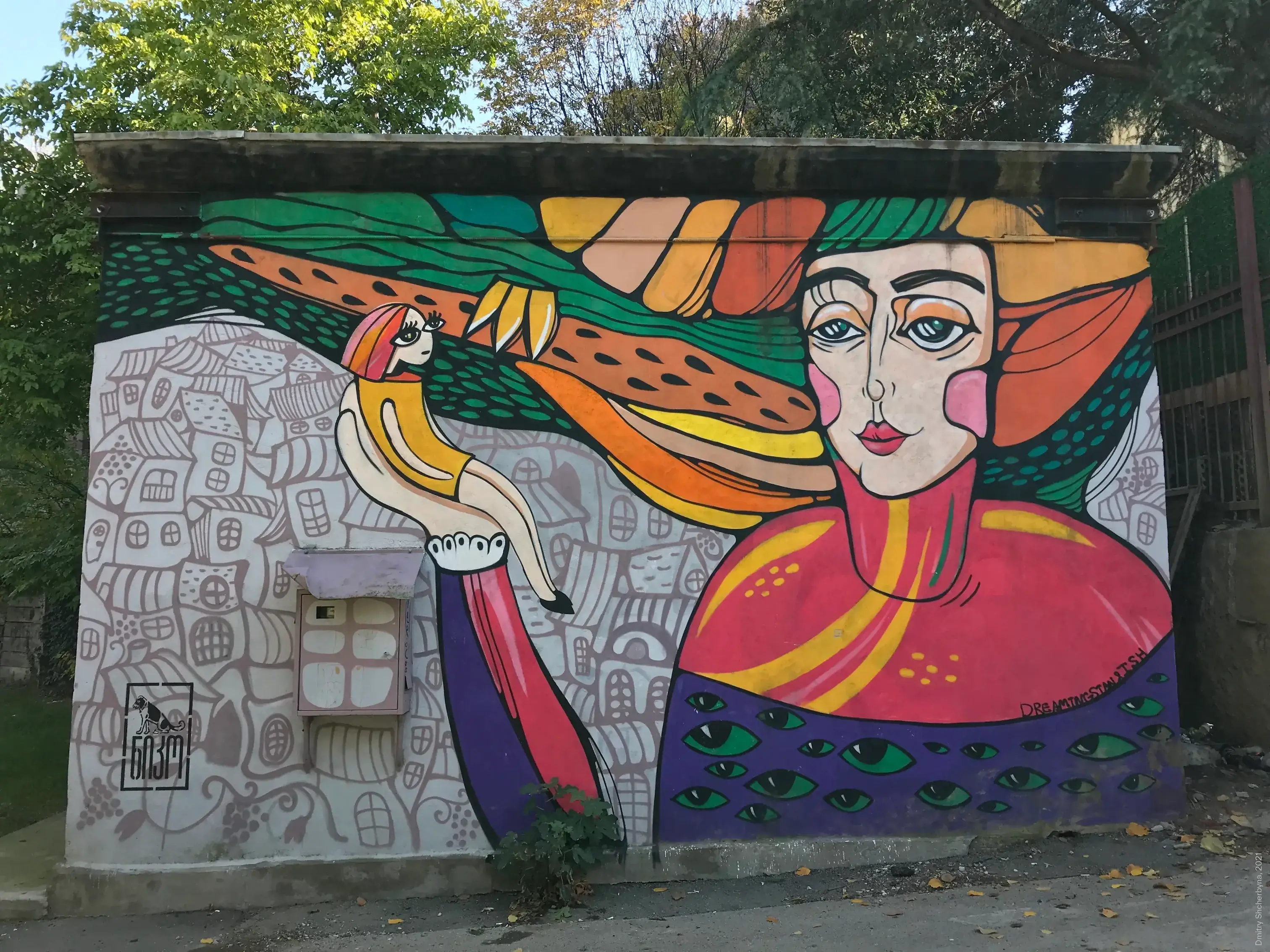
A colorful mural on a low concrete building depicts a large woman in a red and purple outfit with flowing, multicolored hair that stretches across the wall, cradling a small child figure. In the background, there are hand-drawn houses with watchful eyes.
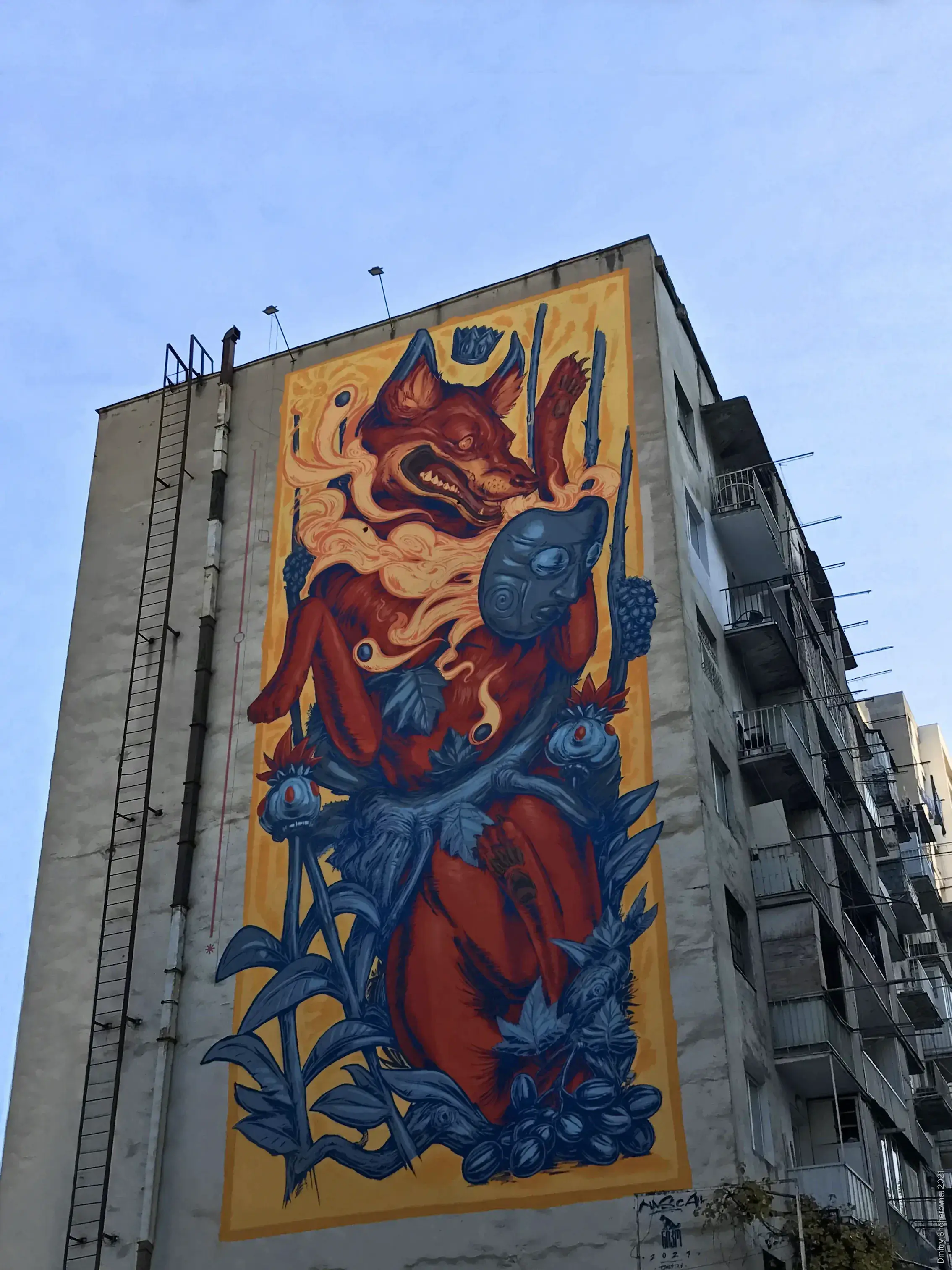
A multi-story building with a mural depicting a snarling red fox holding a blue tribal mask, surrounded by blue foliage and wide-eyed fish, set against a golden yellow background.
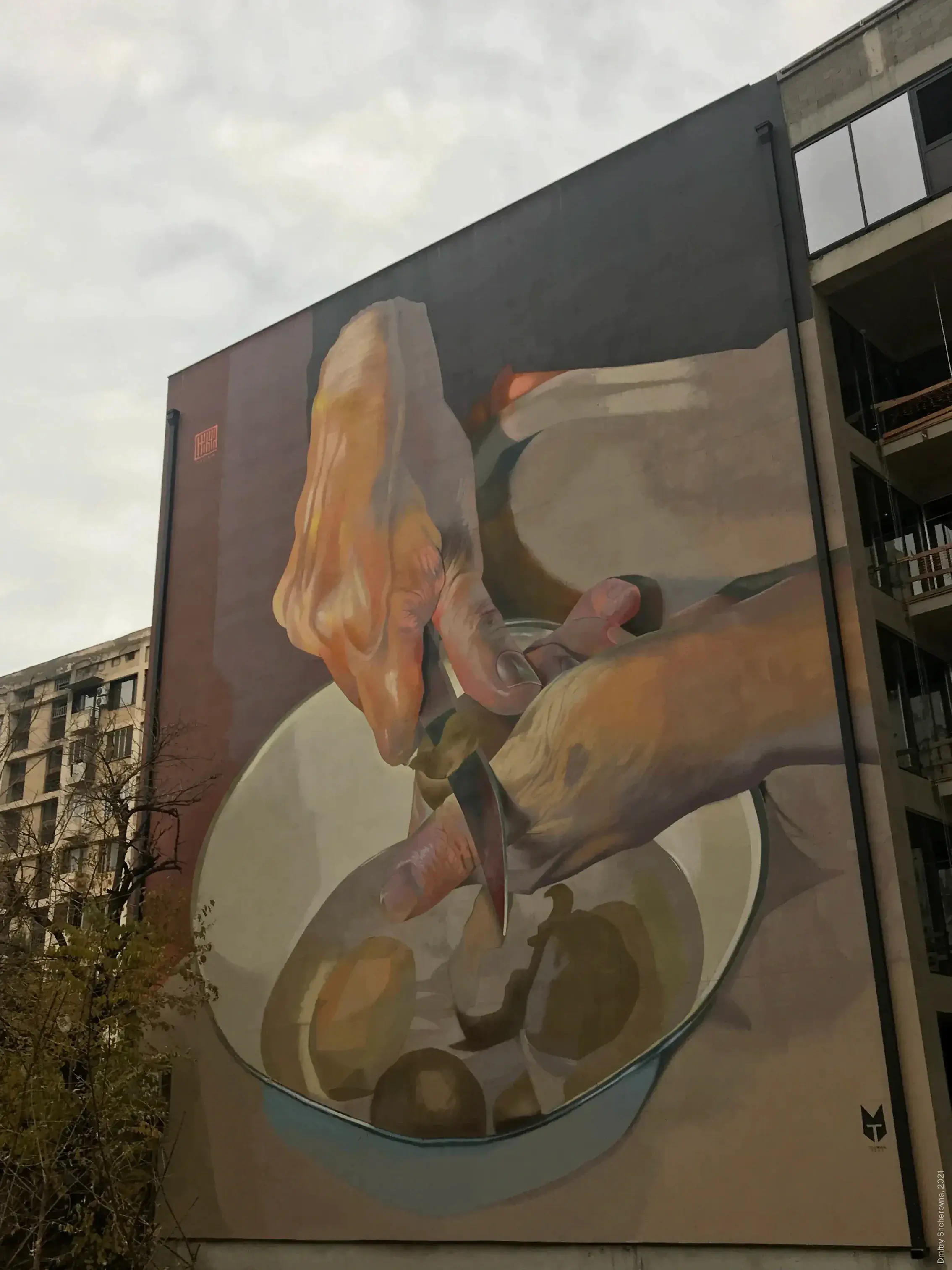
A photorealistic mural on the side of a building, showing a close-up of two hands peeling potatoes with a knife over a bowl, rendered in warm, earthy tones.

Everything began to take shape in the early 2000s, when affordable aerosol paints became widely available. What was initially perceived as vandalism and defacement of private property, over two decades, has shifted into something that the city increasingly recognizes as its own. Freedom of creativity is enshrined in the Georgian Constitution, but the walls that artists paint are either privately owned or belong to the city. This tension never fully disappears.

The widespread distribution of street art has prompted many countries to enact specific legislation regulating various aspects of this artistic phenomenon within public spaces. Public perception remains diverse: unauthorized tagging may face criticism, while commissioned murals are often widely embraced. Although some works remain unsanctioned, much of the contemporary mural scene operates through negotiated agreements with Tbilisi City Hall, which simultaneously supports festival initiatives and fines unauthorized work.
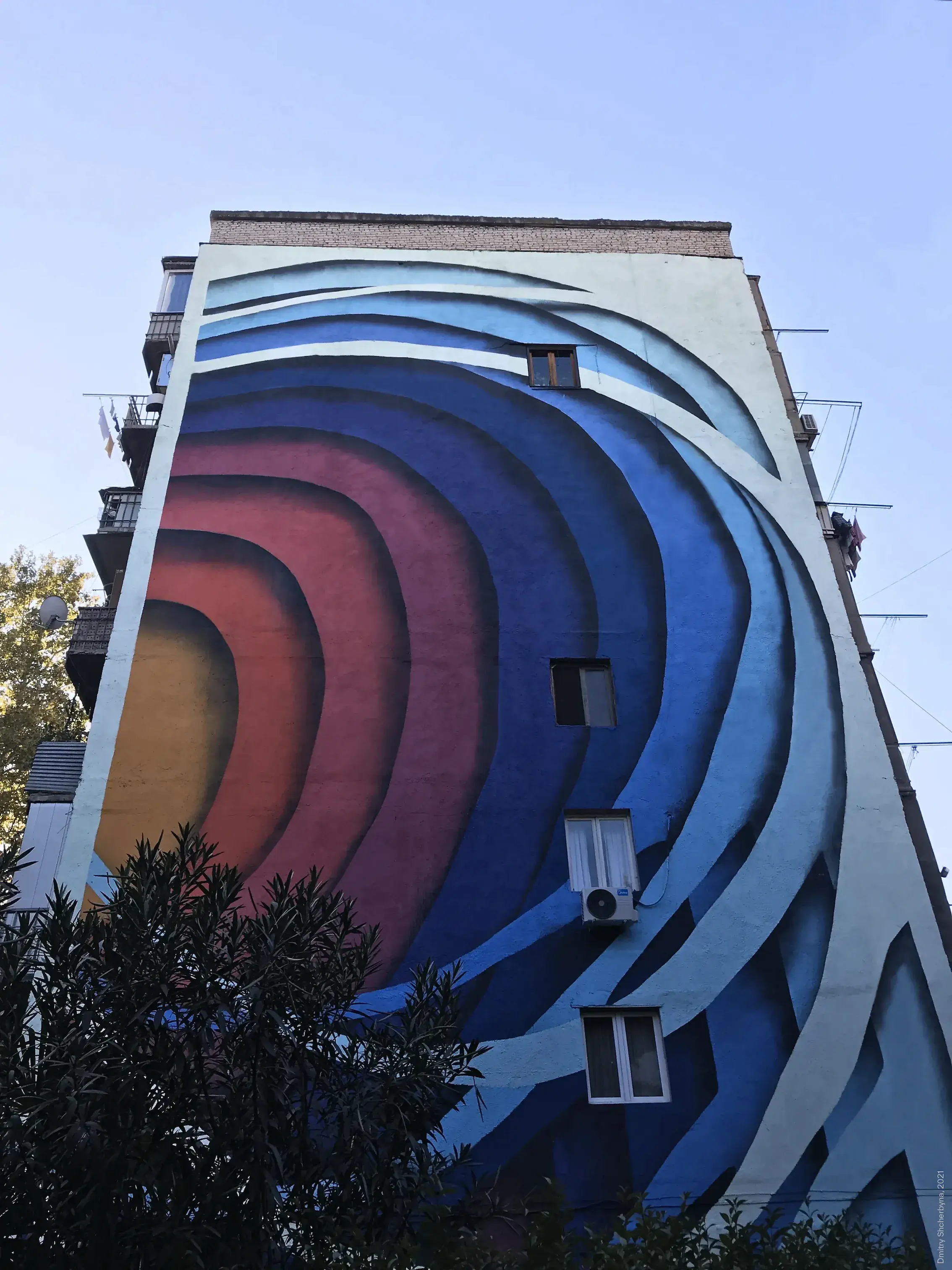
A mural covering the side of an apartment building features bold concentric curved bands that shift from warm gold and red in the center to deep blue on the outer edges, creating an optical illusion of depth.

Though graffiti appeared earlier in isolated instances, meaningful growth came with organized projects expanding strongly after the 2010s.

Street art is already most noticeable in the capital, where some areas are defined more by their murals than by their architectural ensembles.
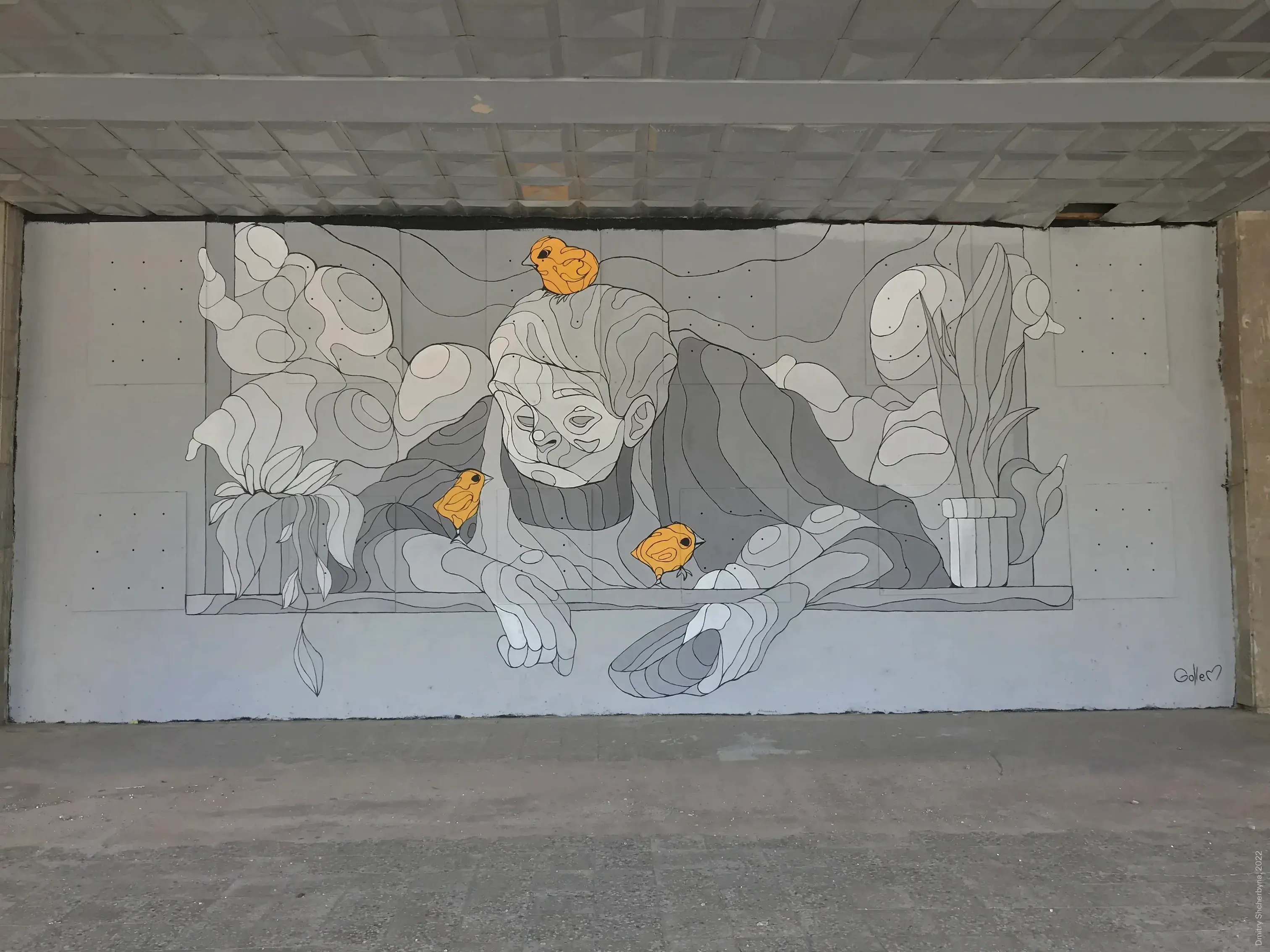
A monochrome grey mural depicts an elderly person leaning on a ledge with his hands, while three small orange chicks perch on and around him.
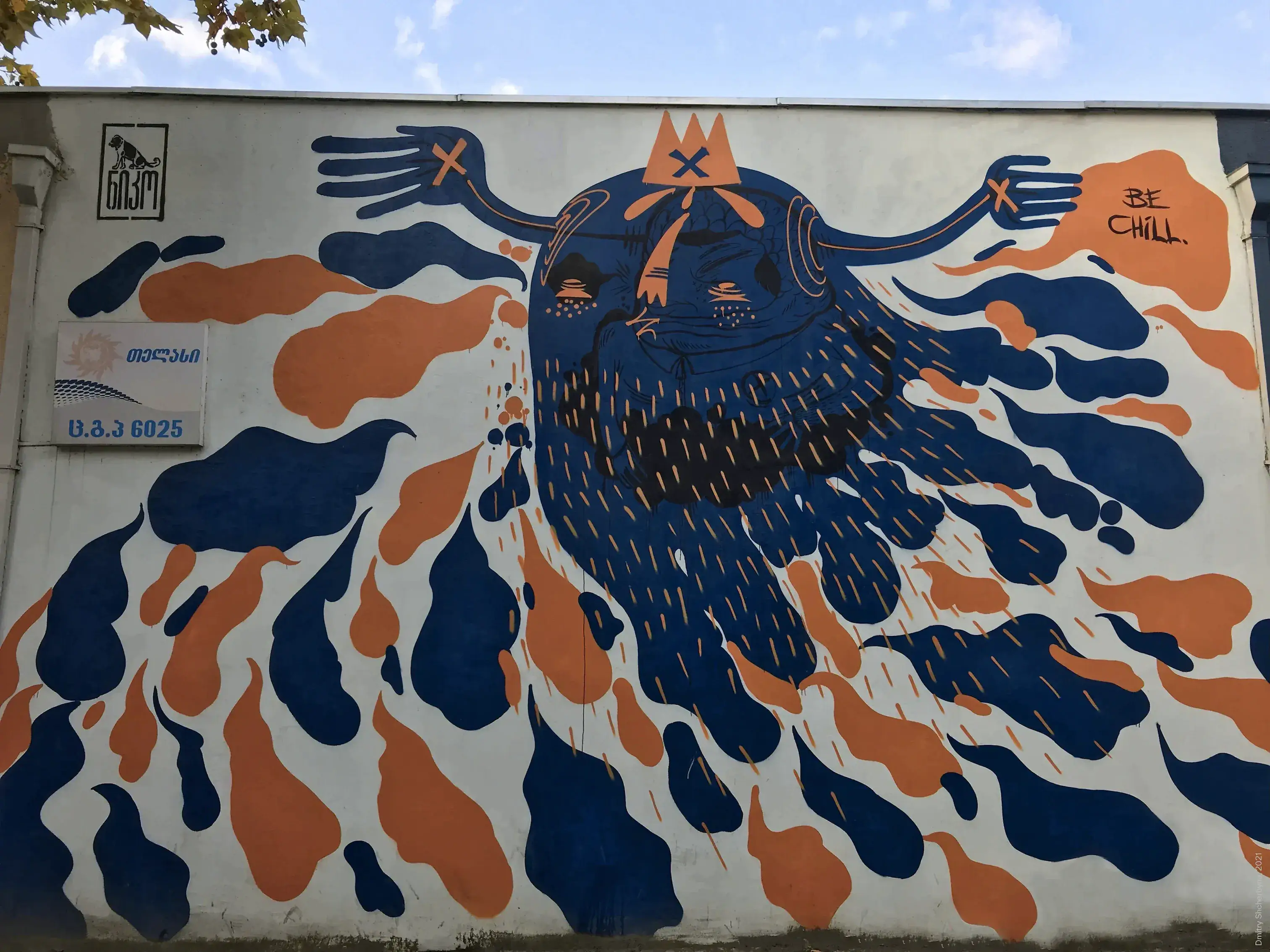
A graphic mural featuring a round-faced bearded figure wearing a small orange crown, with navy blue and orange teardrop-shaped splashes radiating outward across a white wall. The word "BE CHILL" is written in large letters.
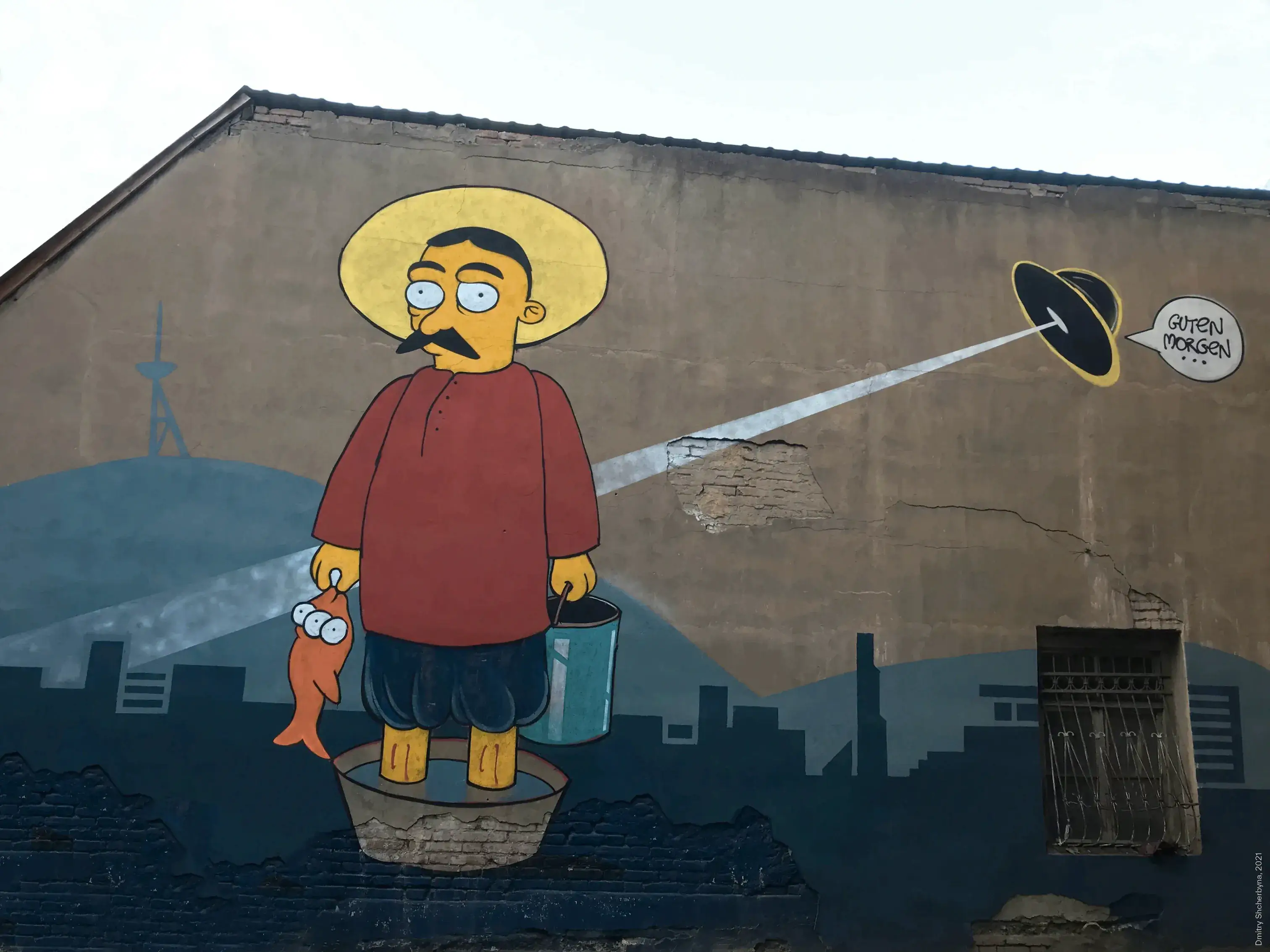
A humorous cartoon mural featuring a mustached man in a yellow hat and red shirt standing in a basin holding an orange fish with a flying saucer beaming light on him, with a speech bubble saying "Guten Morgen."
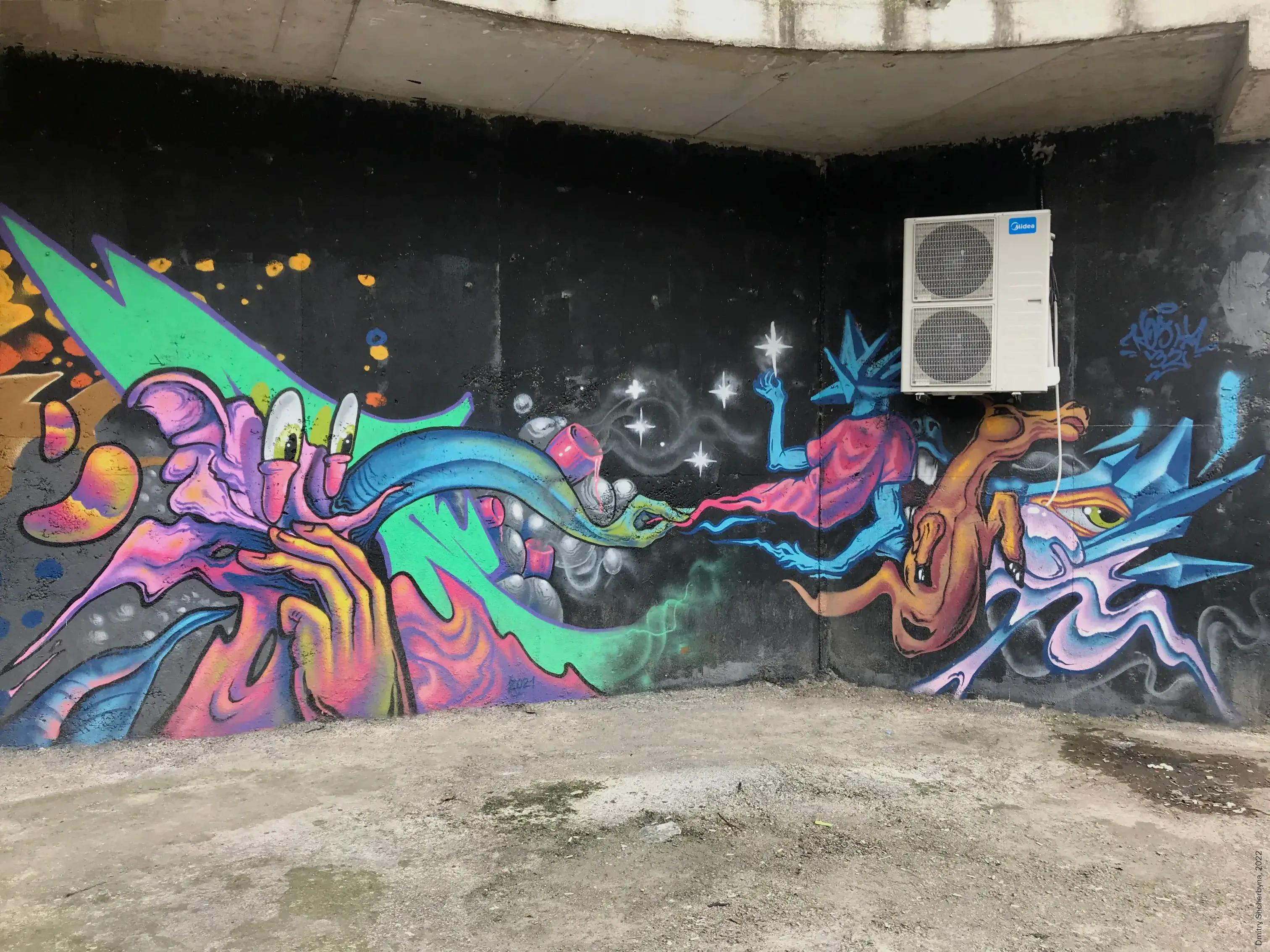
A mural on a dark wall beneath a concrete overhang depicts two fantastical creatures facing each other across a starry gap. On the left, there is a creature with neon green wings and pink and yellow flowing forms and bug-like eyes. On the right, there is another creature that is spiky and blue, with an orange body. The bright, psychedelic colors contrast with the black background.
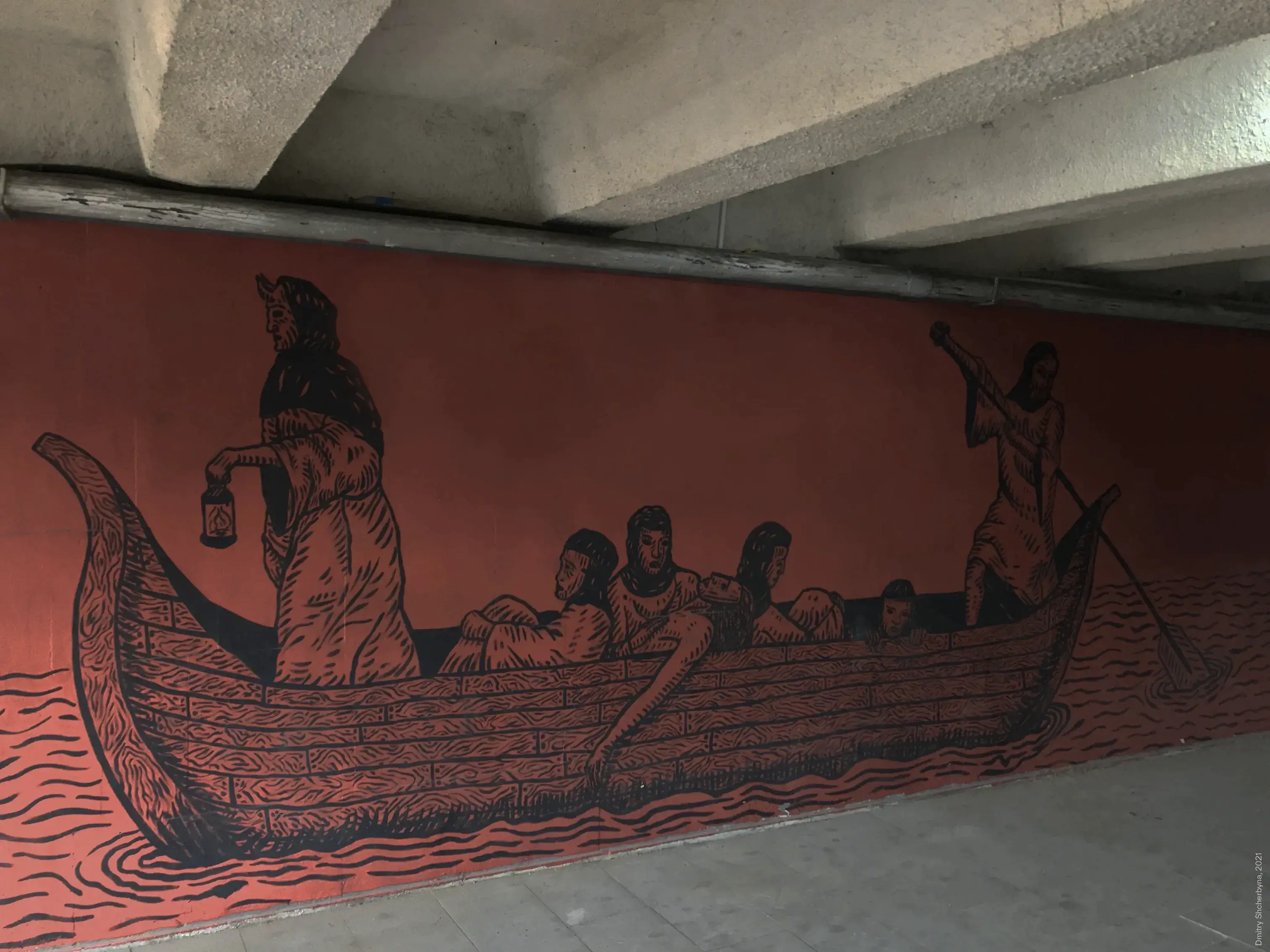
A woodcut-style mural, painted in black on a terracotta background inside an underpass, depicts a long wooden boat carrying several figures across wavy waters. A cloaked figure holds a lantern at the bow and another figure steers the boat with a paddle at the stern.
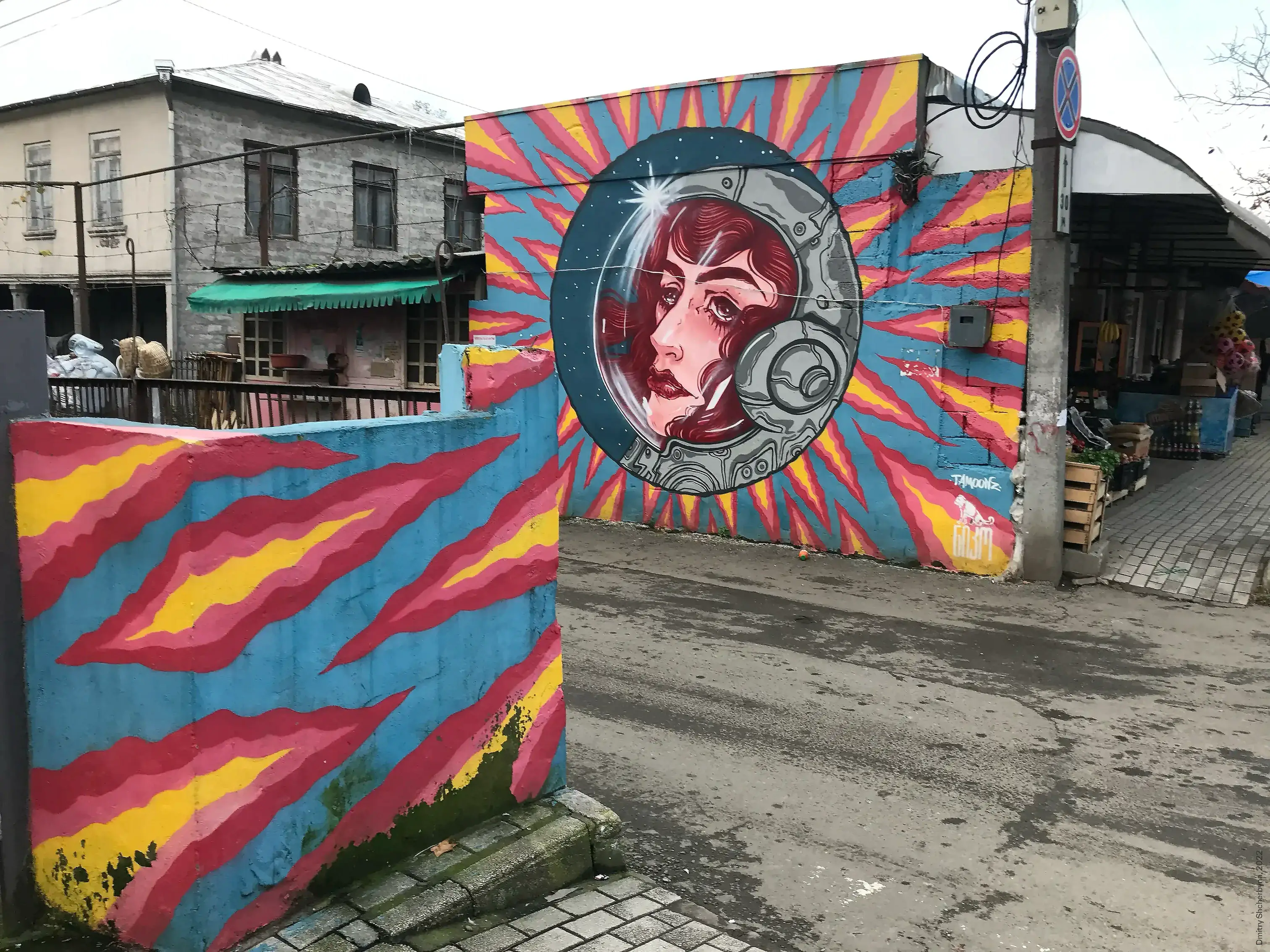
Colourful street-level mural of a woman's face inside a retro space helmet, set within a circular frame surrounded by radiating pink, yellow, and blue stripes.
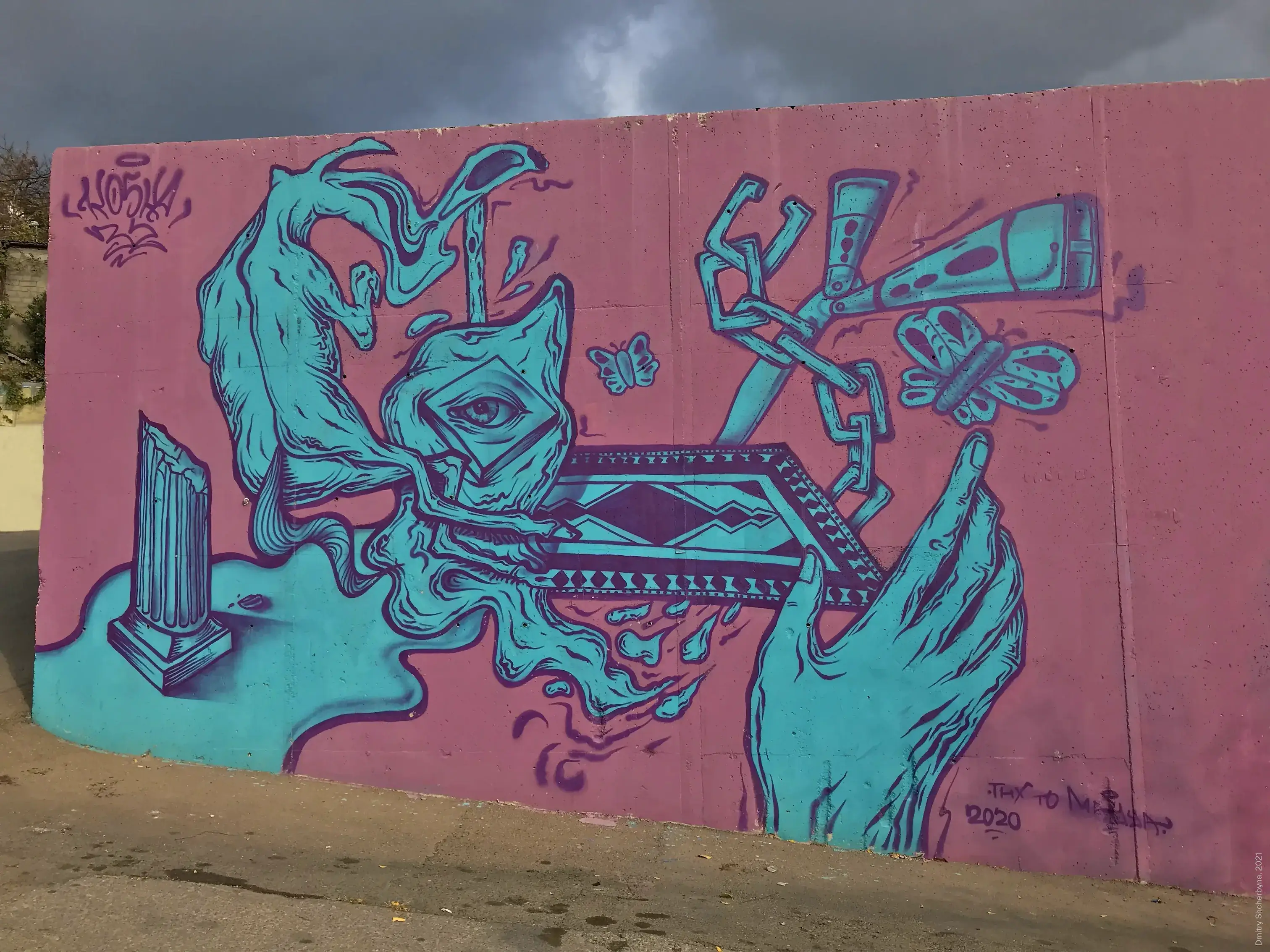
A teal-on-pink mural with surreal imagery, including two large hands forming a heart around a single eye and reaching toward butterflies and a megaphone, floats in the center. A geometric carpet pattern is on the floor, with a classical column on the left side.
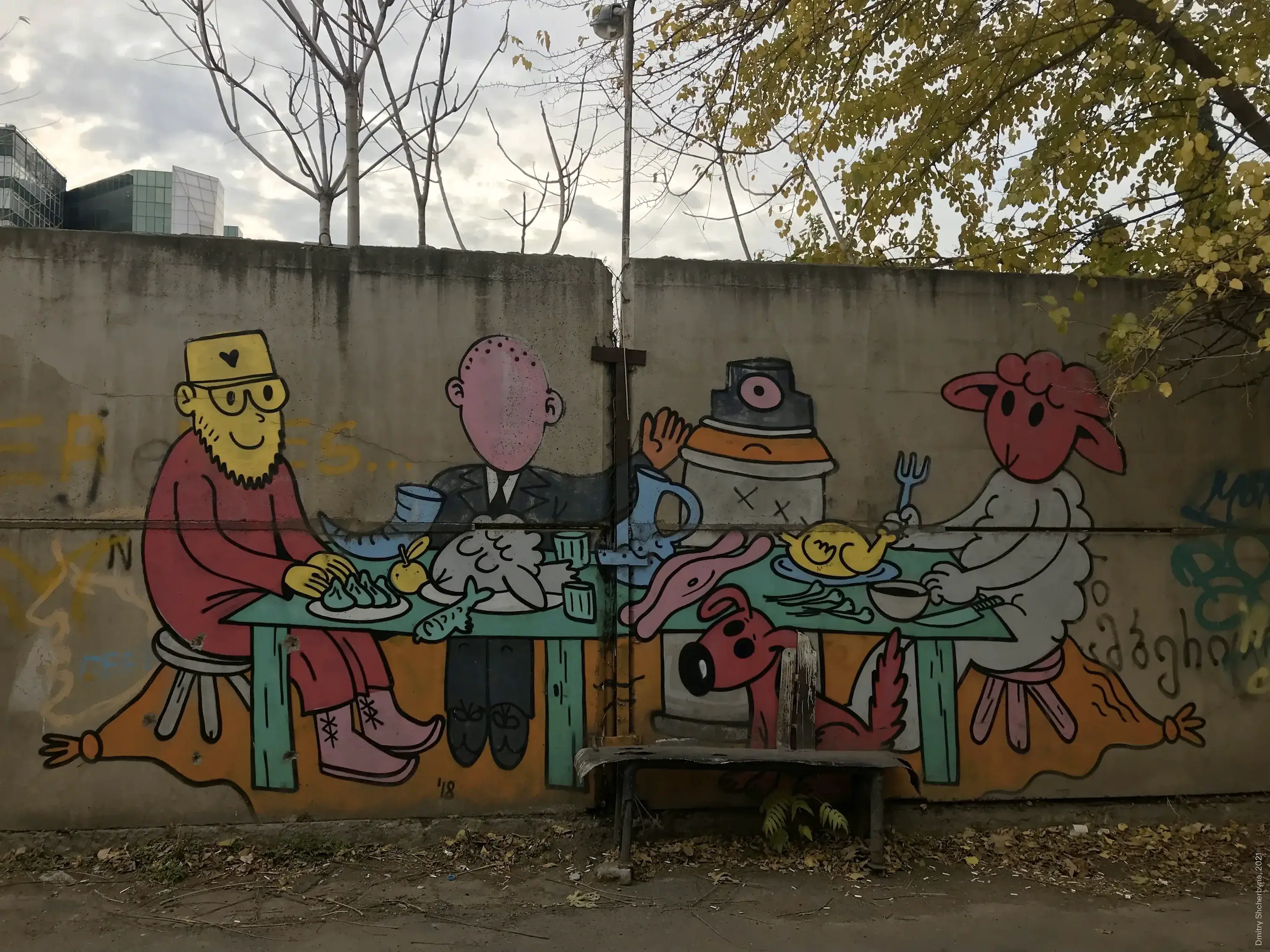
A colorful cartoon mural on a concrete wall shows four quirky characters sitting around a table laden with food and drinks — a bearded man in a red robe and yellow hat, a bald man in a suit, one-eyed robot wearing a top hat and a pink sheep holding a fork. A red dog peers out from under the table.
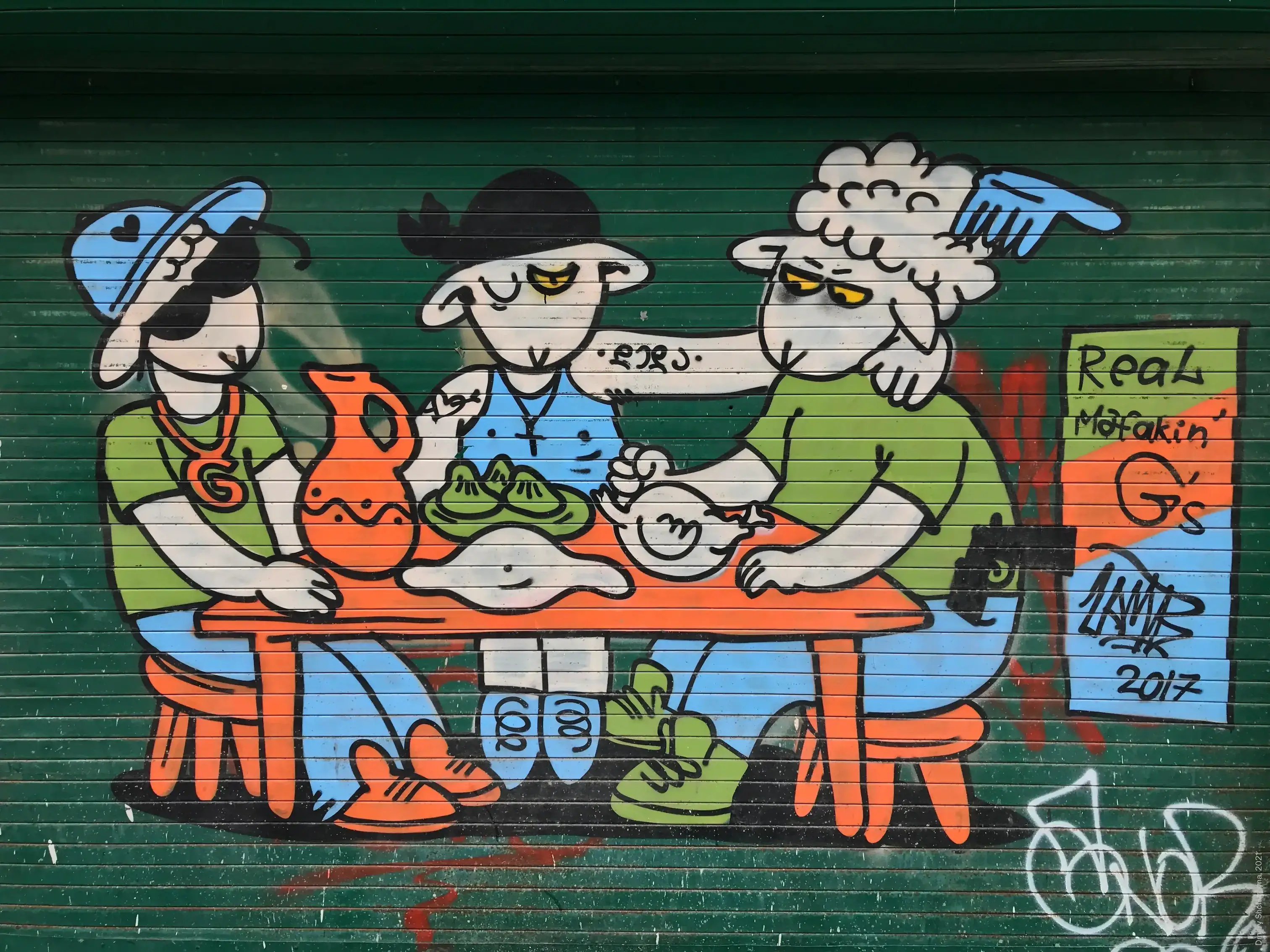
A mural on a green metal roller shutter depicts three cartoon characters with yellow eyes, sitting around an orange table covered in food. They are wearing hats and colorful streetwear.
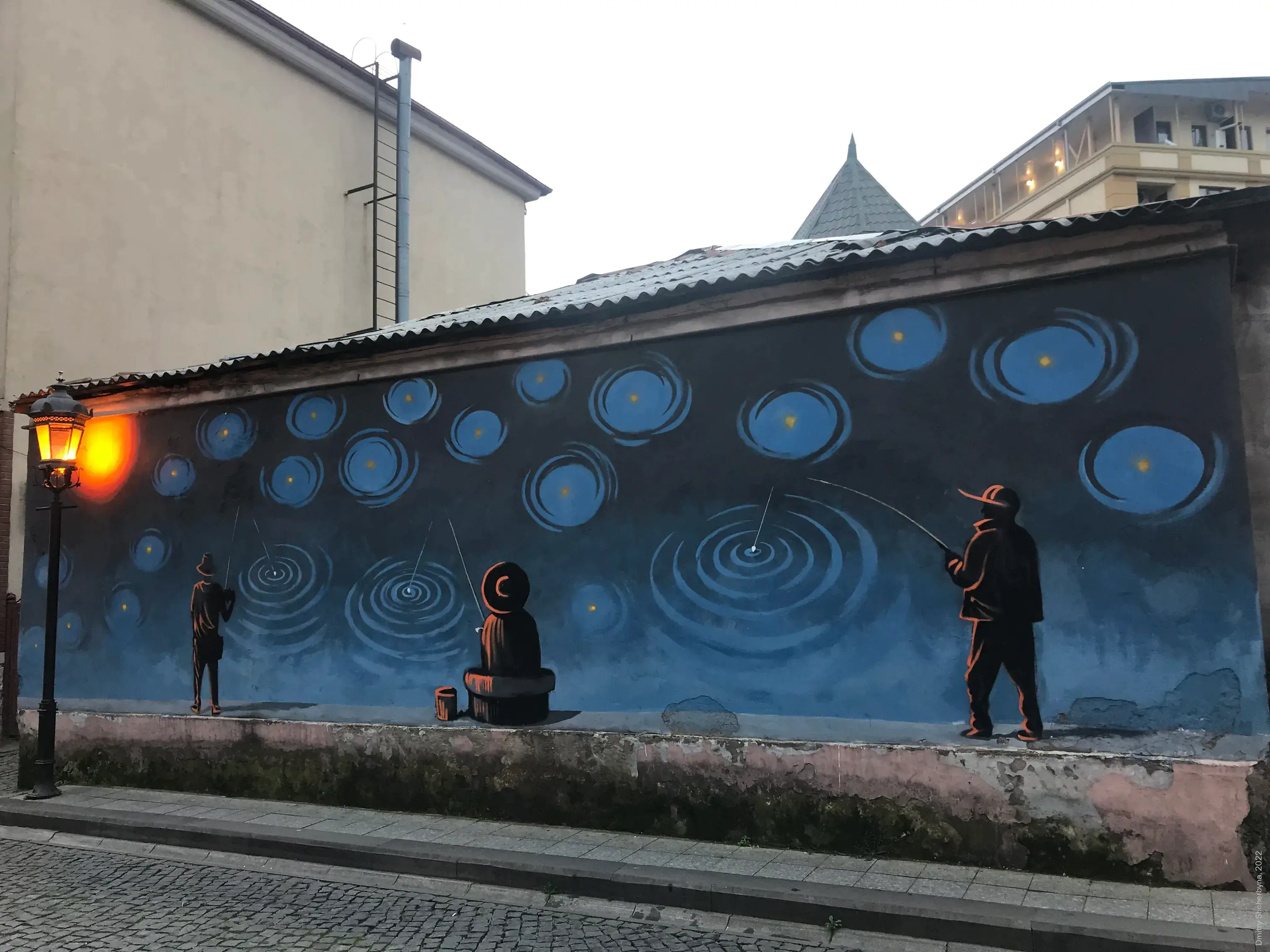
A nighttime street mural shows three silhouettes in warm orange tones, fishing with rods in concentric blue ripples that resemble both water and the starry sky. The painting is on a low wall beside a cobblestone street, next to a glowing lamppost.
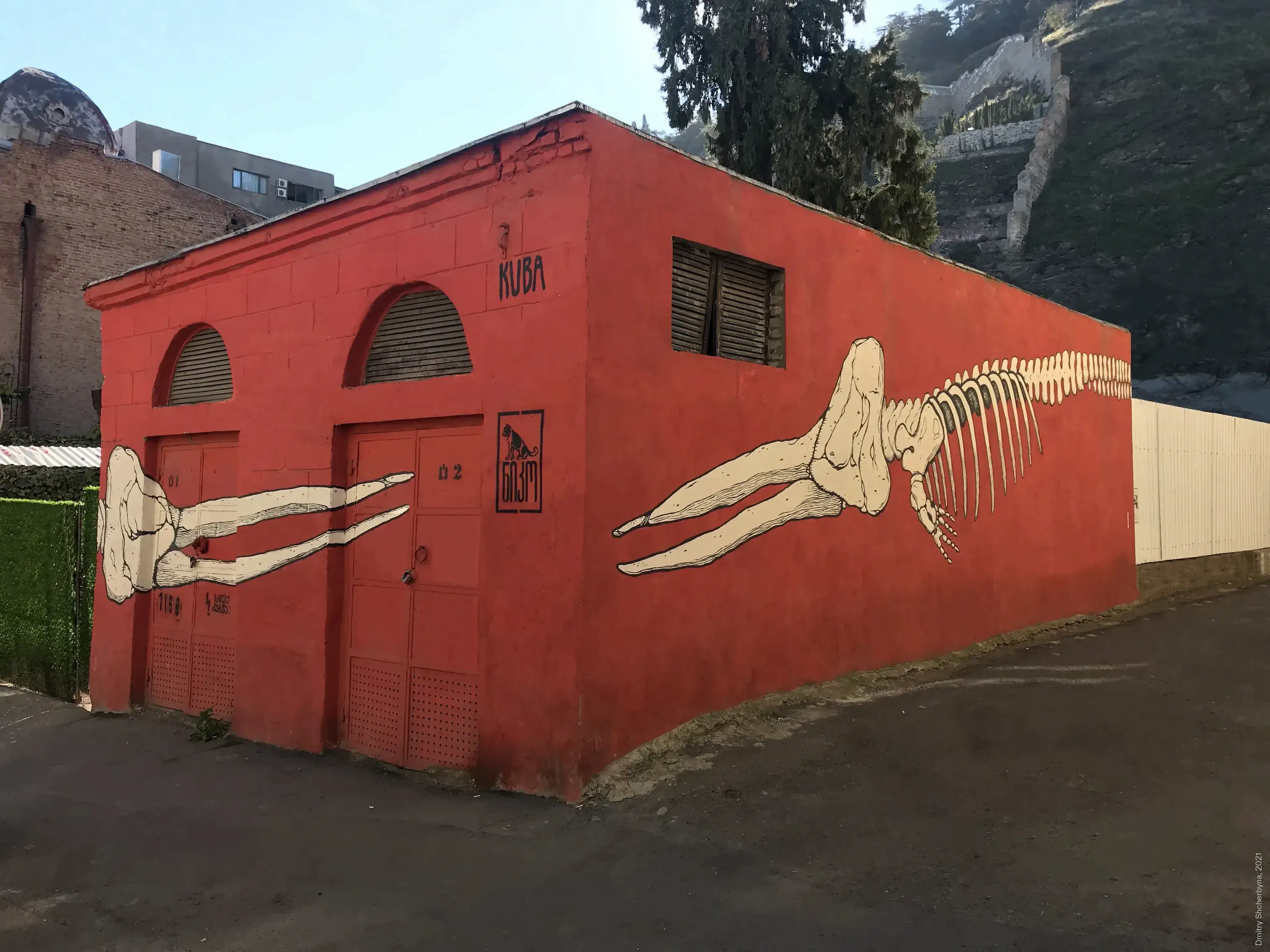
A mural wraps around the corner of the red building, depicting a large animal skeleton in cream and black lines that stretch across both walls. Its legs extend past the doorway.
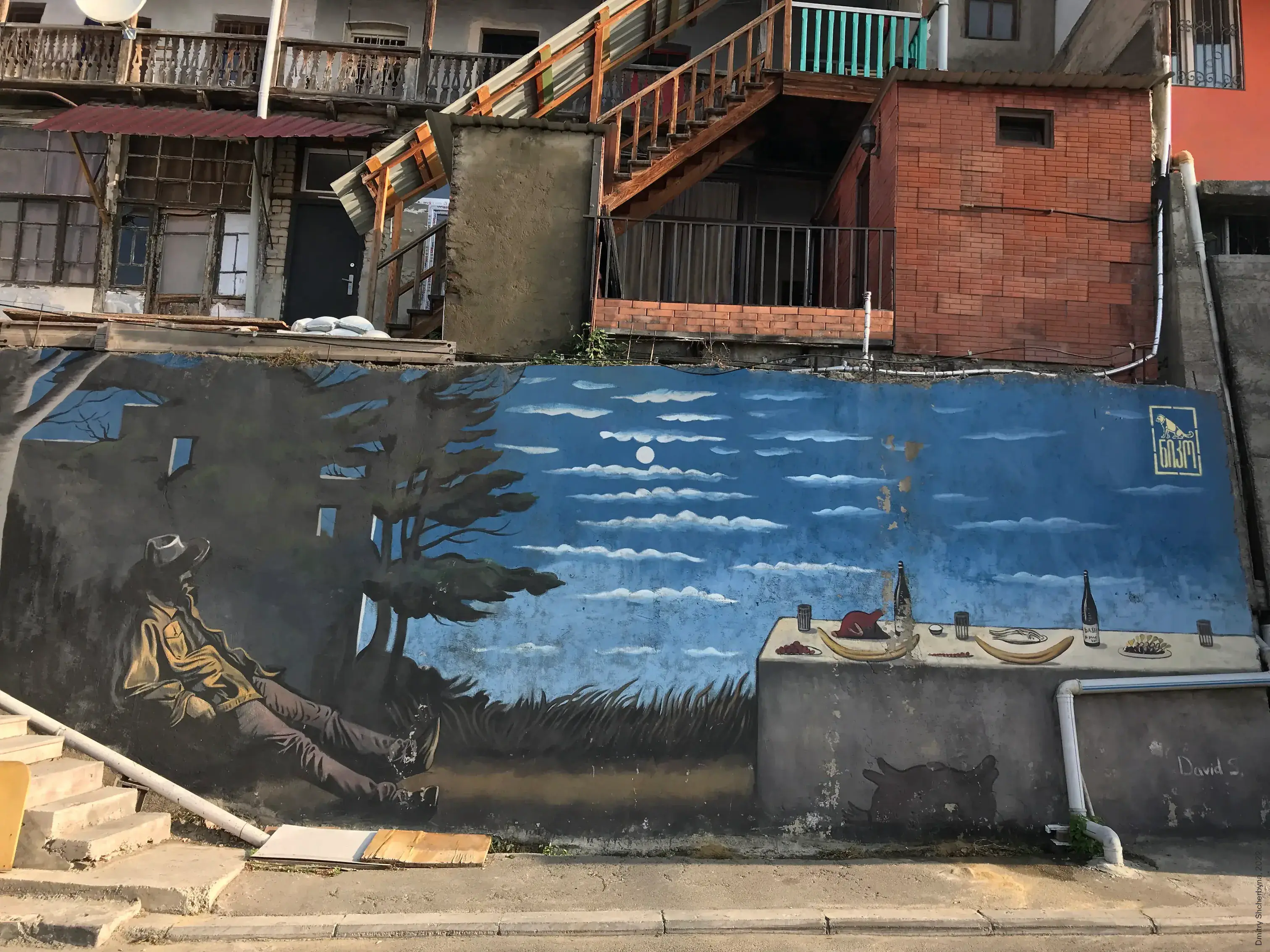
A mural on a residential wall shows a figure in a hat reclining beneath dark trees on the left, with a table set with wine bottles, food, and dishes on the right under a blue moonlit sky.

The tradition of bringing large-scale murals to working-class residential districts has roots in Latin America, where paint on concrete changed how people felt about the places they lived in. Tbilisi's outer districts like Varketili or Gldani have a similar logic: at sufficient scale, a mural becomes a landmark, a gathering point, a way of navigating the monotonous panel architecture.

The movement's rising popularity has attracted the interest of the private sector and local governments, which have sought to recruit artists for corporate and municipal projects. Tbilisi alone now counts well over a hundred murals, painted by both Georgian and international artists. What took root first in the capital is now steadily appearing, wall by wall, in cities across the entire country.

Street art can be found in cities such as Batumi, Kutaisi, Ozurgeti, Poti, and Rustavi. Its spread to other cities has also been reinforced by organized initiatives. One example is the “Batumi Grafikart Festival”, launched in 2013 and supported by the Adjara Ministry of Culture and Batumi City Hall, which played an important role and became a catalyst in the early development of the local scene.
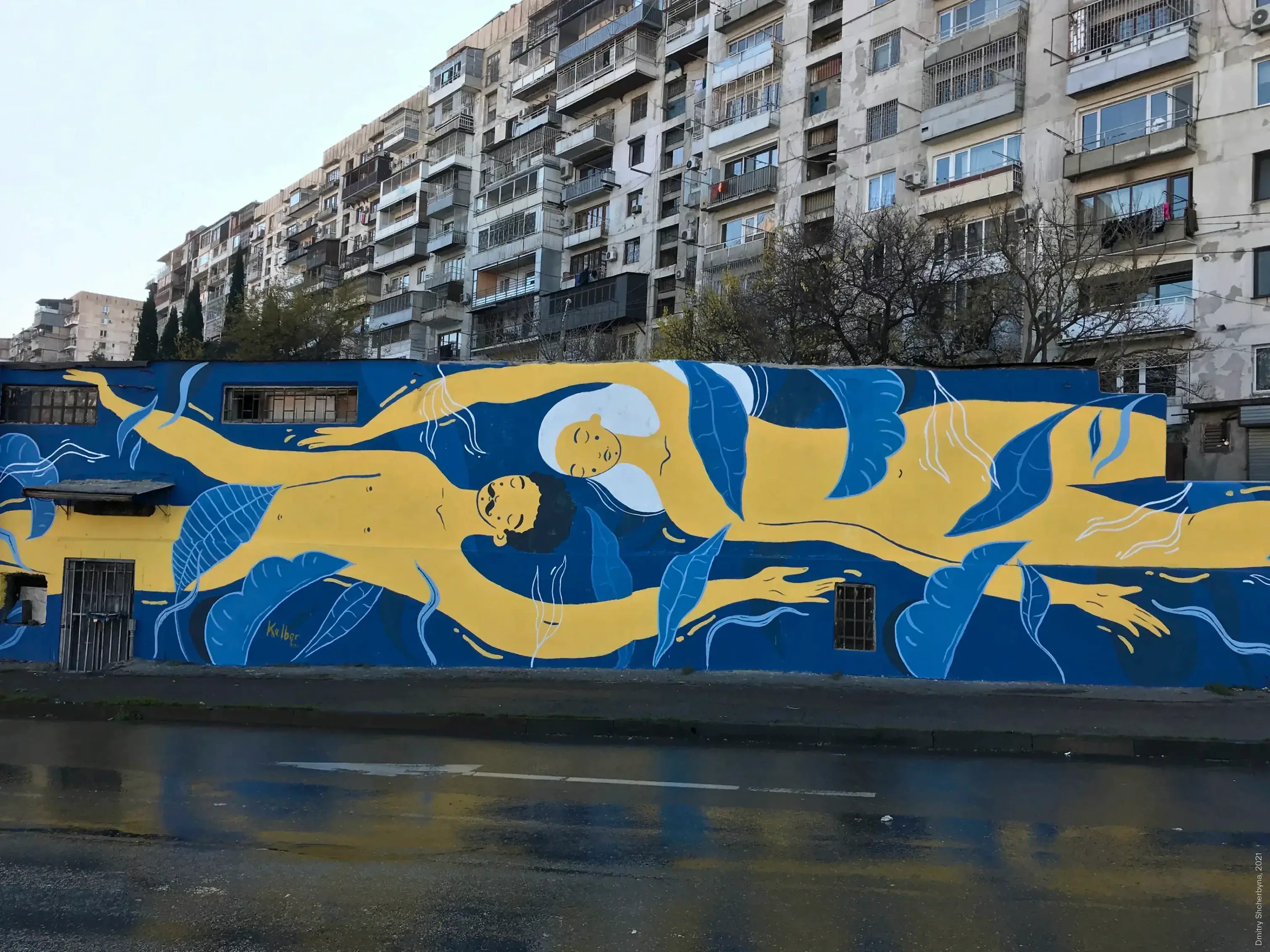
A long horizontal mural of stylized human figures floating and intertwining in blue and golden yellow, painted on a low wall in front of a Soviet-era apartment building.

Despite the diversity of authorship within the local street art scene, there may be little contextual information that could provide the basis for interpretation. Some street artists conceal their identity, thus making it more difficult to trace continuity in themes and style. Questions of meaning are further complicated by the relationship between subject matter and informal boundaries of tolerance: sensitive or political content faces stronger control, while less confrontational works pass relatively unnoticed.

As Gagosh, one of the pioneers of Georgian street art, put it, “If you draw flowers, no one will come and fine you.” In this sense, subject matter itself shapes the conditions under which street art is produced and received.

These challenges don't diminish the role street art plays in the urban environment. Anonymity, meanwhile, can create space for self-expression that might otherwise remain constrained by social or institutional pressure.

Since gaining independence from the Soviet Union in 1991, Georgia has sought to reclaim its cultural identity. Across the Soviet Union, mosaics functioned as instruments of urban design and ideological storytelling, turning public spaces in nearly every city and town into surfaces for large-scale state-commissioned imagery that glorified the future of the communist society.
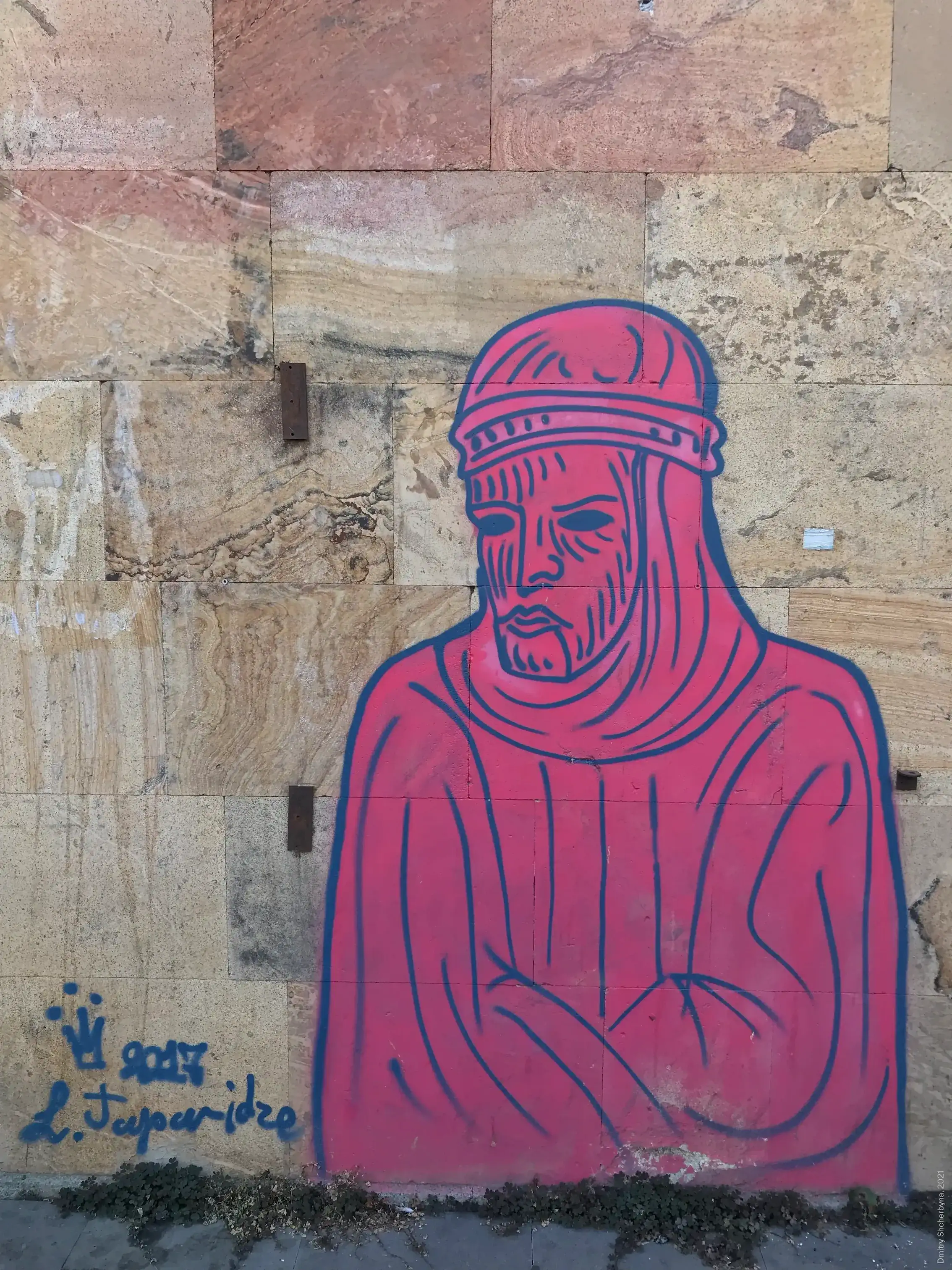
A stencil-style mural, in hot pink with dark blue outlines, on a sandstone wall shows the bust of a medieval figure wearing a banded helmet and robes with arms crossed.

Soviet visual culture used state-commissioned mosaics as propaganda tools that didn't wear out much, making them more durable for ideological meaning. Contemporary murals are typically paint-based, temporary, and artist-initiated.
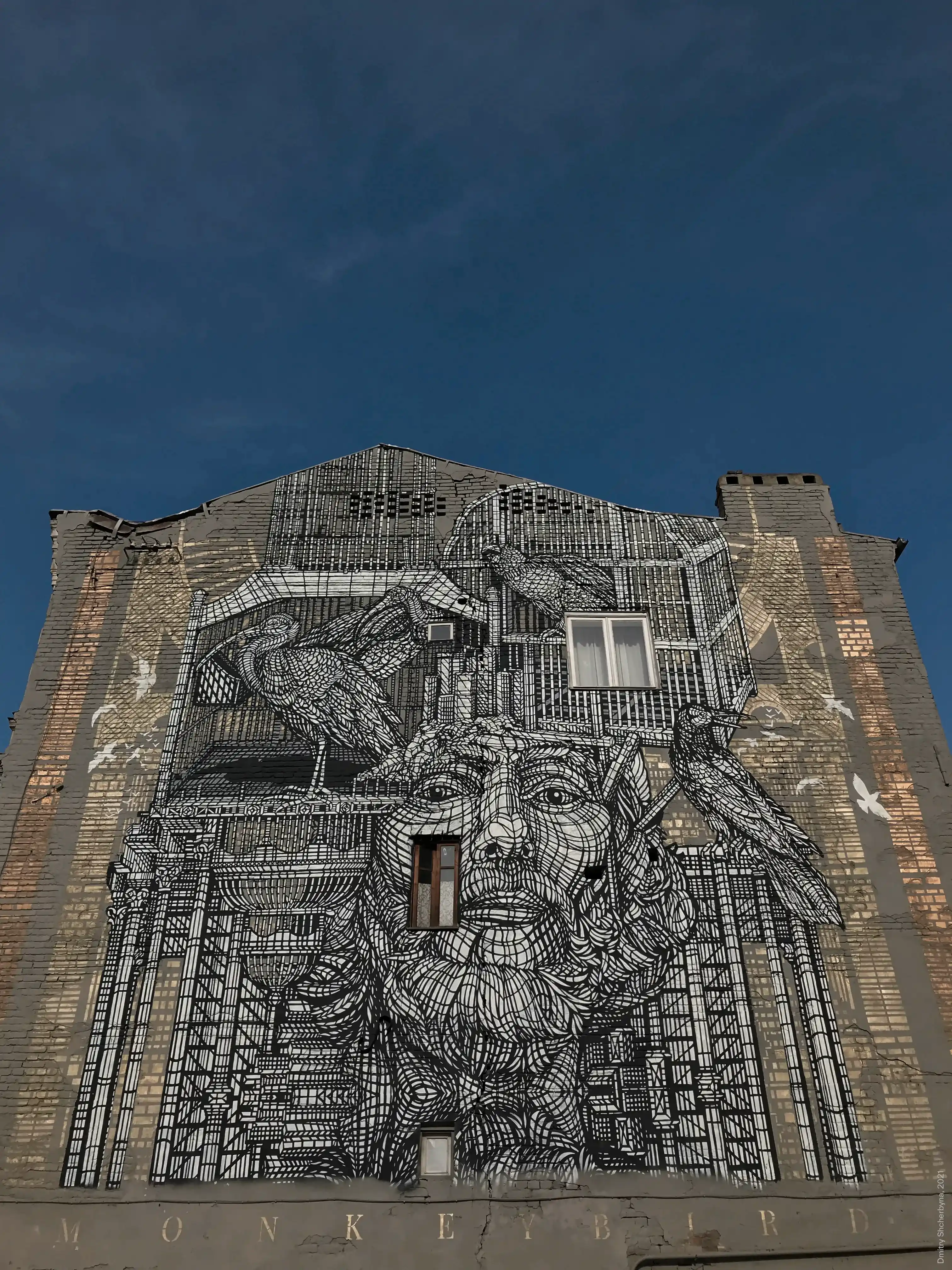
A full-building mural, in dense black-and-white linework, shows the face of a bearded old man. Birds perch on his forehead and head, and the entire composition is built from intricate geometric and organic patterns that blend the figure into an architectural framework of lines and grids.
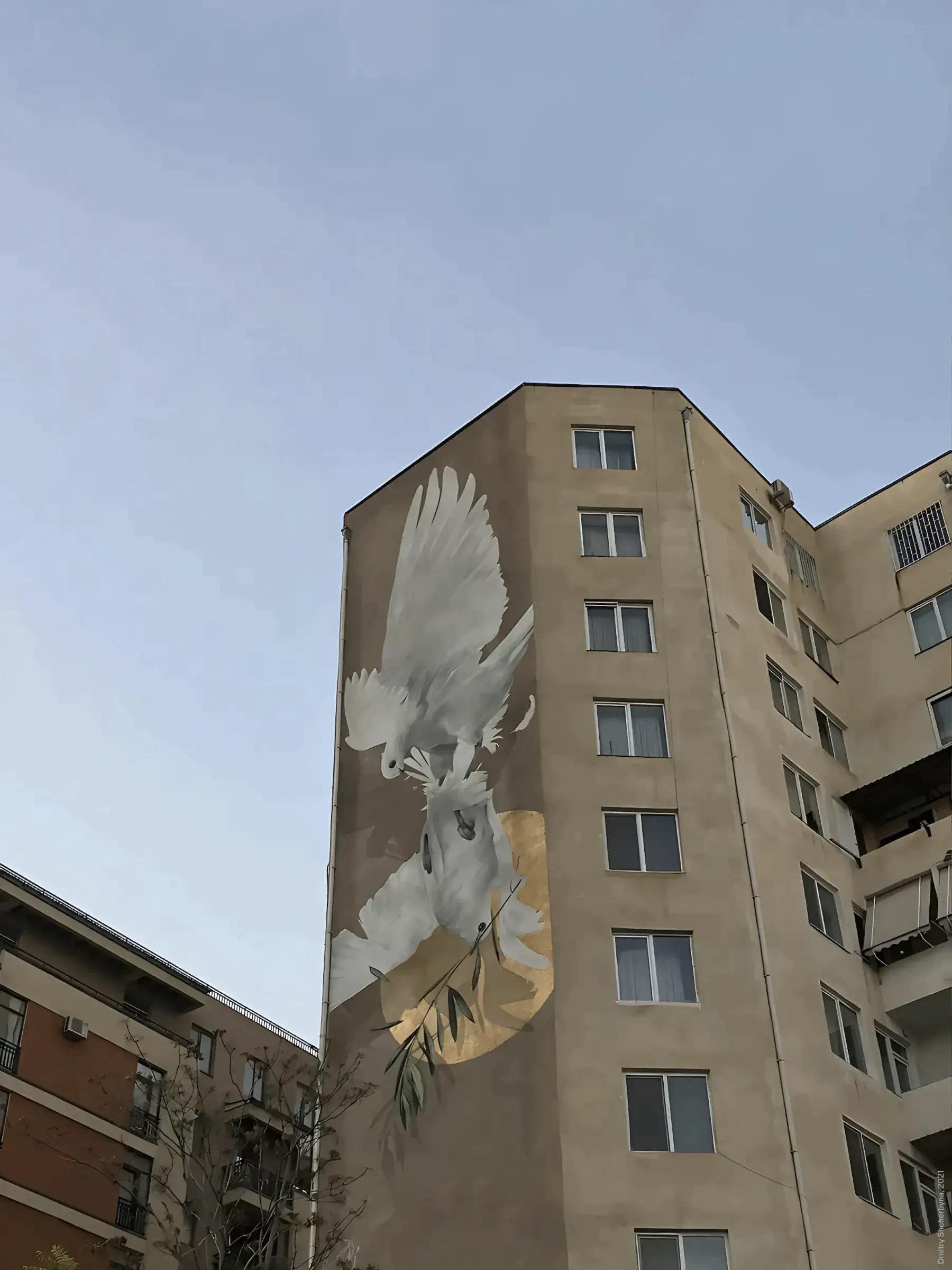
A mural on the narrow side of a tall apartment building shows two white doves fighting in flight, with the larger one carrying an olive branch. Behind them, a golden circular form shines, evoking the peace symbol.
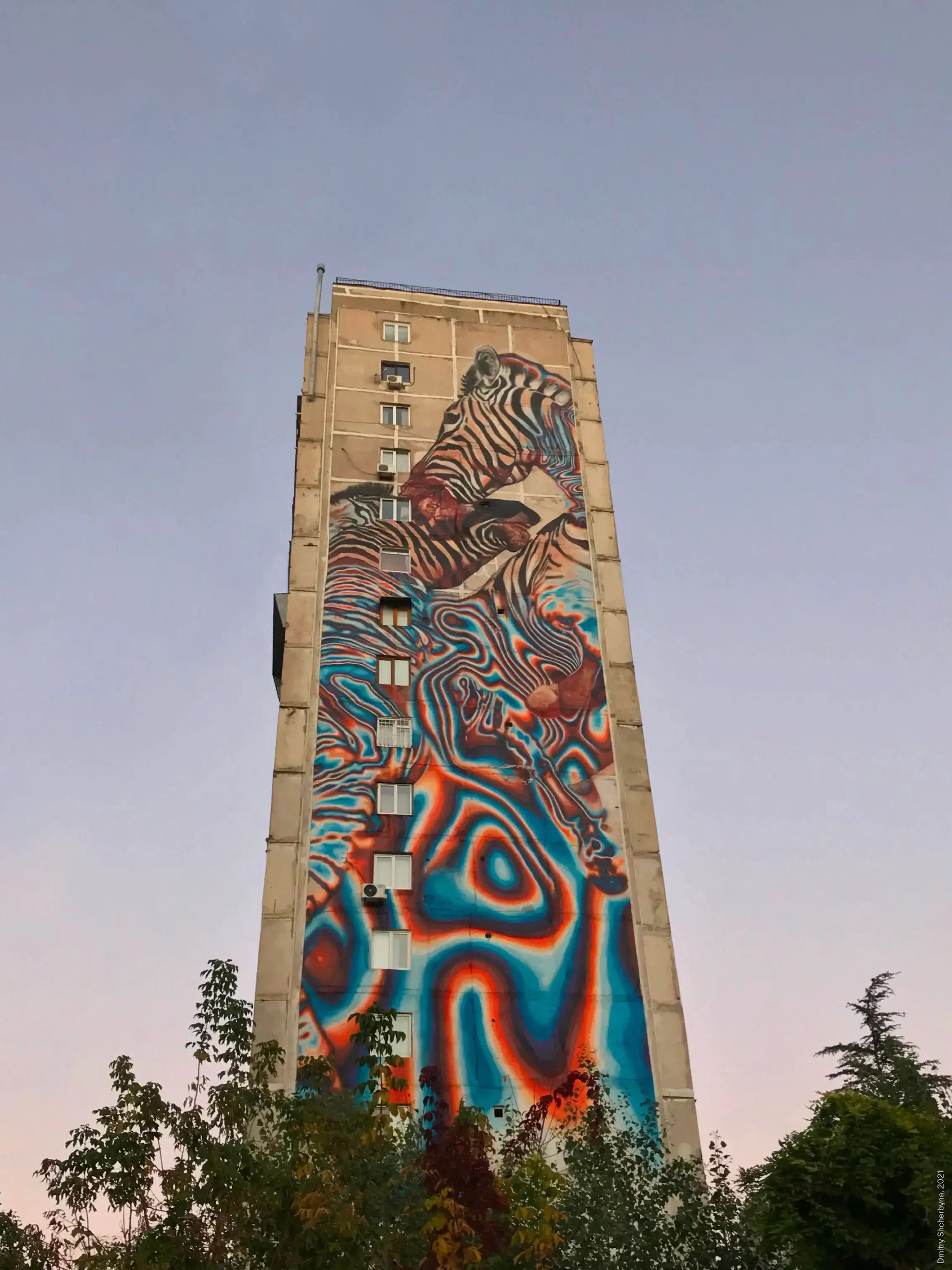
A mural covering an entire apartment building depicting zebras that dissolve into swirling psychedelic patterns in cyan blue, orange and red.

For Georgia, public art carries a particular weight. After decades of Soviet-imposed visual culture, the ability to put one's own image on a building's facade is not a neutral act in a country where those surfaces once belonged entirely to the state. What appears as decoration is often also a statement about who gets to shape the image of a city today.
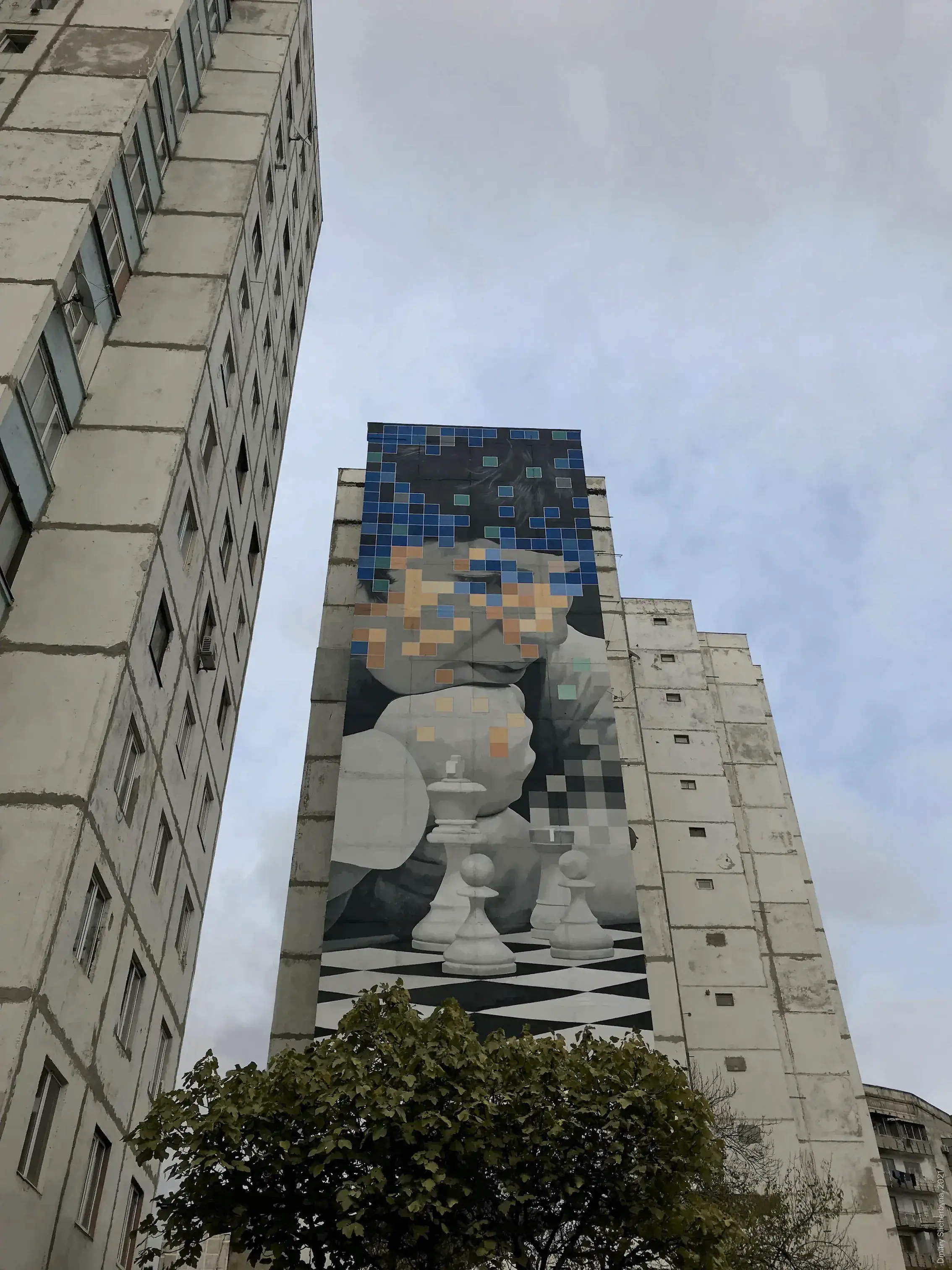
A tall mural on the side of a high-rise building depicts a figure leaning over a chessboard with white chess pieces. The figure's face dissolves into blue, teal, and tan pixel squares, blending realism with digital abstraction.
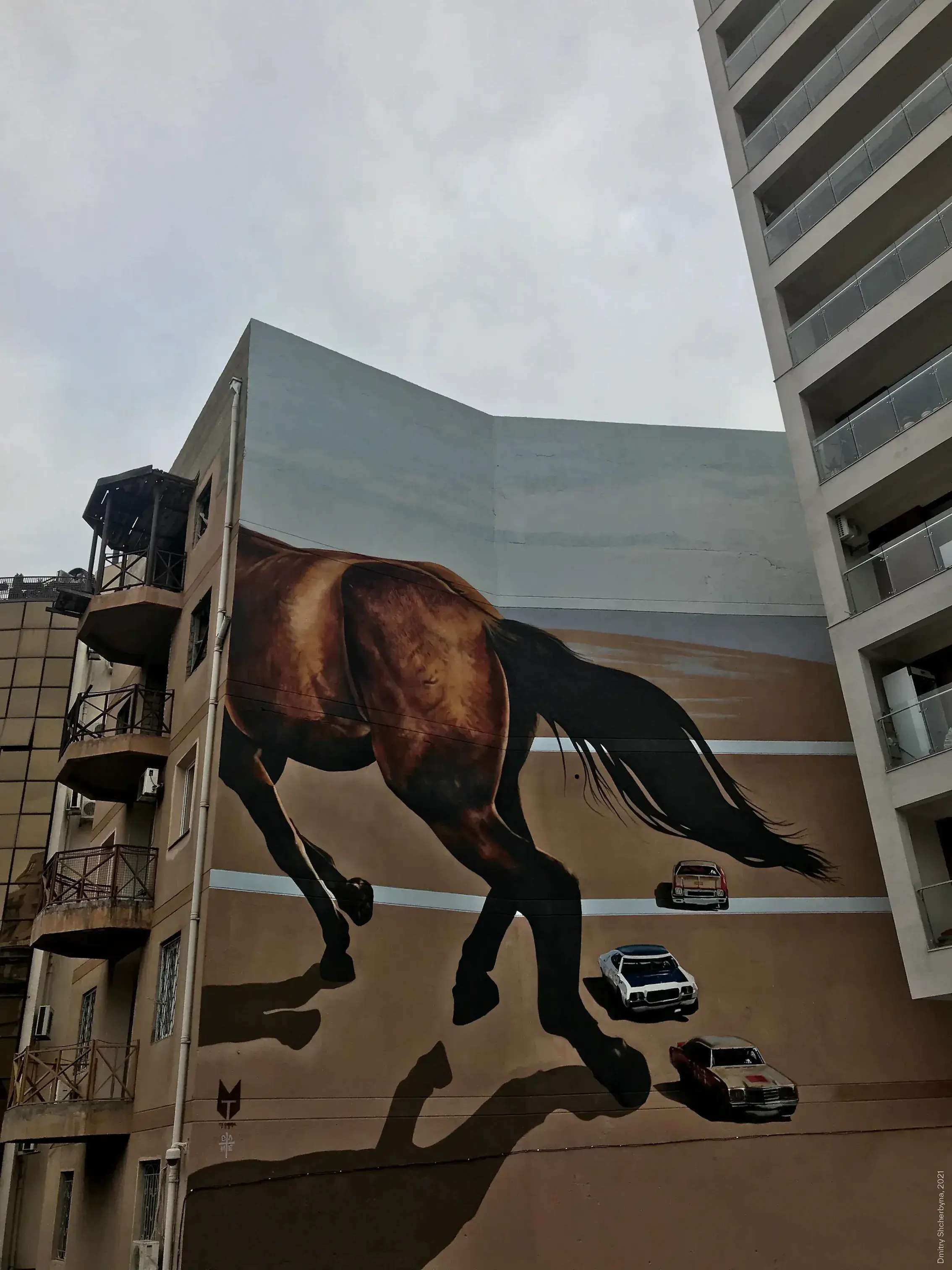
A photorealistic mural on the side of a tall building shows the rear half of a galloping brown horse, at massive scale. Three small vintage cars are on a road below it, emphasizing the dramatic size contrast.
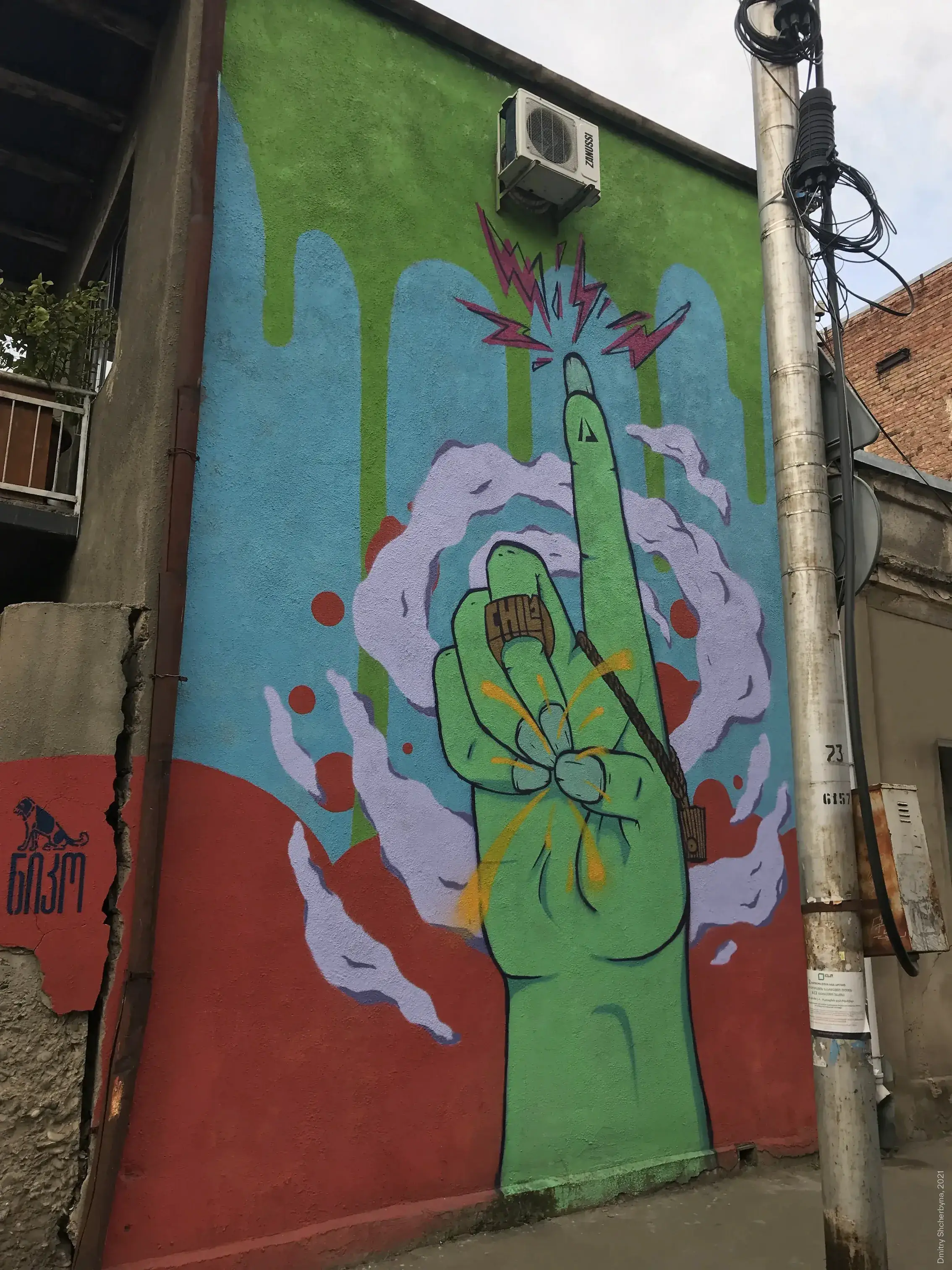
A street mural depicting a large green hand pointing upwards with its fingertip, surrounded by clouds of smoke on a blue and green background. The word "CHILL" is visible on the wrist of the hand.
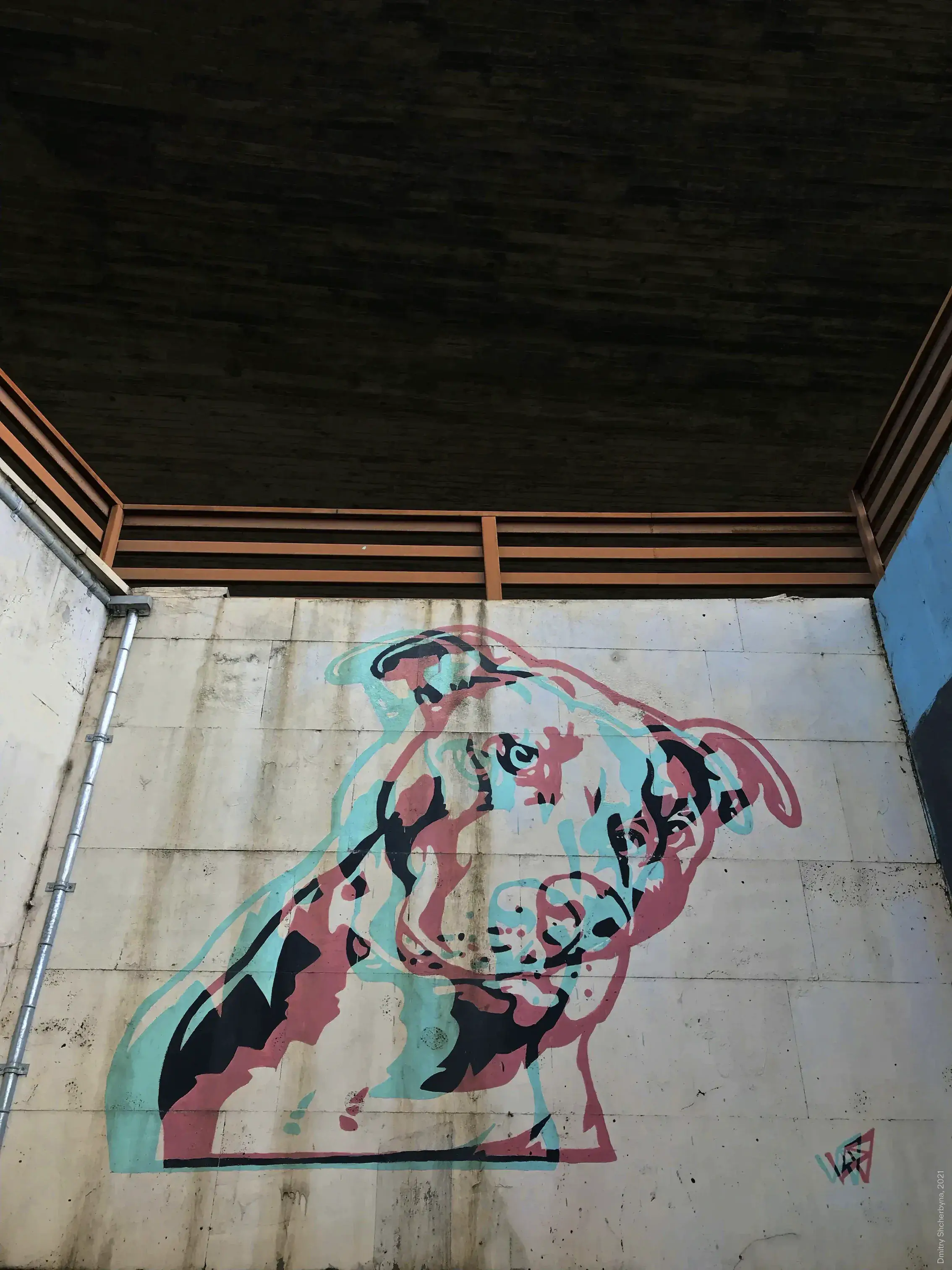
A large street mural of a pit bull, painted in pink, mint green and black, on a concrete wall beneath an overpass.
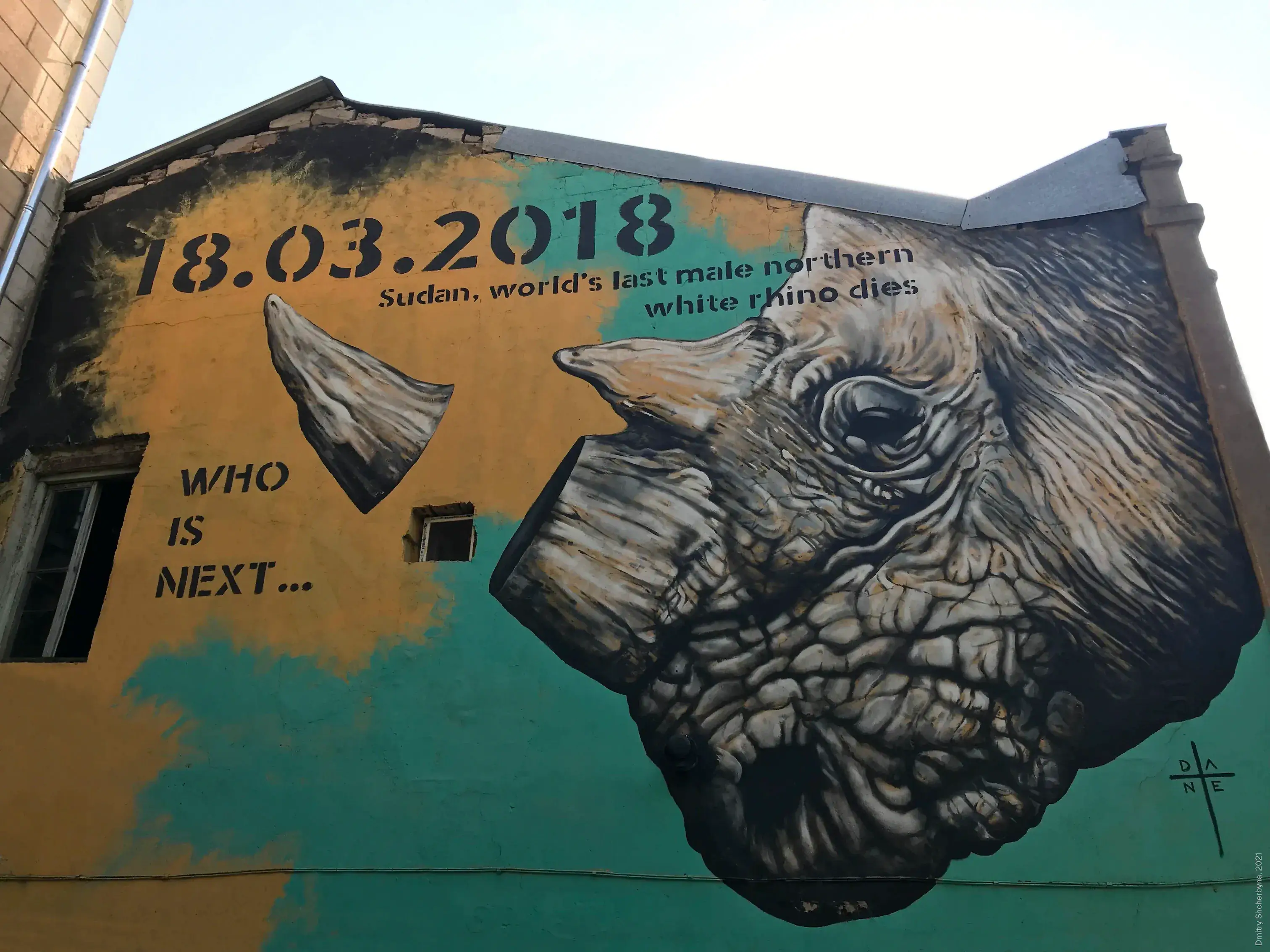
A mural memorializing the last male northern white rhino features a detailed grayscale rhinoceros head with its horn separated from its body. The text reads "18.03.2018," "Sudan, the world's last male Northern White Rhino dies," and "Who is next?"

Broader cultural transformations find their most visible and concrete expression through festivals and initiatives dedicated to public art.

Georgia hosted its first “Tbilisi Mural Fest” in 2019, founded by Besik Maziashvili with the support of the Berlin Senate and the Tbilisi City Hall, to give the local mural scene international visibility. It is an annual event that invites artists from across the globe to paint large-scale murals on buildings and walls. In addition to the murals, the festival hosts lectures and exhibitions to foster a deeper understanding and appreciation of street art culture. It features a diverse range of styles, techniques, and themes — from lifelike portraits and abstract designs to political messages and humor. The festival welcomes artists, including celebrated muralists, to take part in its events, but at the same time, it actively supports local established and up-and-coming talent, offering them a unique platform. It typically takes place in autumn over a period of several weeks. During this time, visitors have the opportunity to witness the creative process up close, engage with artists, and participate in public events like panel discussions and open workshops.

The organizers emphasize that the primary goal of the festival is to foster community engagement, encourage cultural dialogue, and facilitate creative exchange while also enhancing the urban environment and leaving a legacy for the city. Since its inception, the festival has drawn increasing attention from international media, art professionals, and cultural tourists, establishing itself as a recurring fixture on the region's cultural calendar. In 2023, the festival received the “Guardians of Tolerance” award within the “Unity Through Diversity” program implemented by UNA Georgia — recognition of its sustained efforts in promoting diversity, inclusion, and tolerance through public art. The 2024 edition attracted international coverage while producing more than twenty new murals across five Georgian cities, marking the “Tbilisi Mural Fest” expansion beyond Tbilisi. Some of these works have drawn on history, mythology, and regional traditions, connecting mural practice to the specific cultural memory of each carefully selected location.
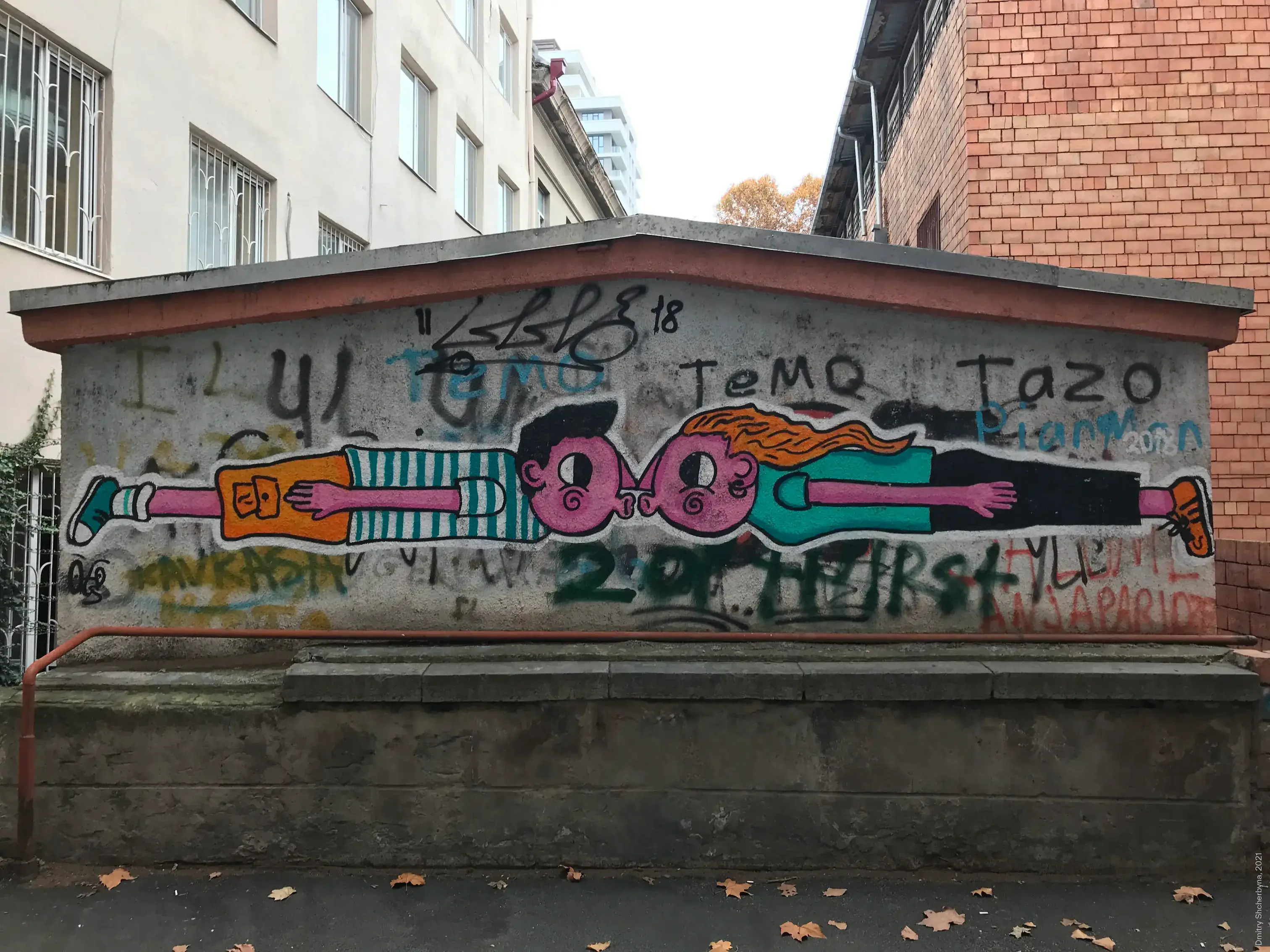
A simple, playful mural on a low concrete wall features two cartoon children, floating horizontally and kissing nose to nose. One has dark hair and is wearing an orange and striped outfit. The other has orange hair and wears teal and black clothing.

Unlike a gallery or museum, a mural requires no ticket, no invitation, and no detour from daily life. It meets people where they already are — including those who would never otherwise walk through that door.

This kind of incidental exposure has its own quiet value. Encountering ambitious, large-scale work gradually shapes visual literacy and cultural expectations through repetition and presence in citizens' daily routines.
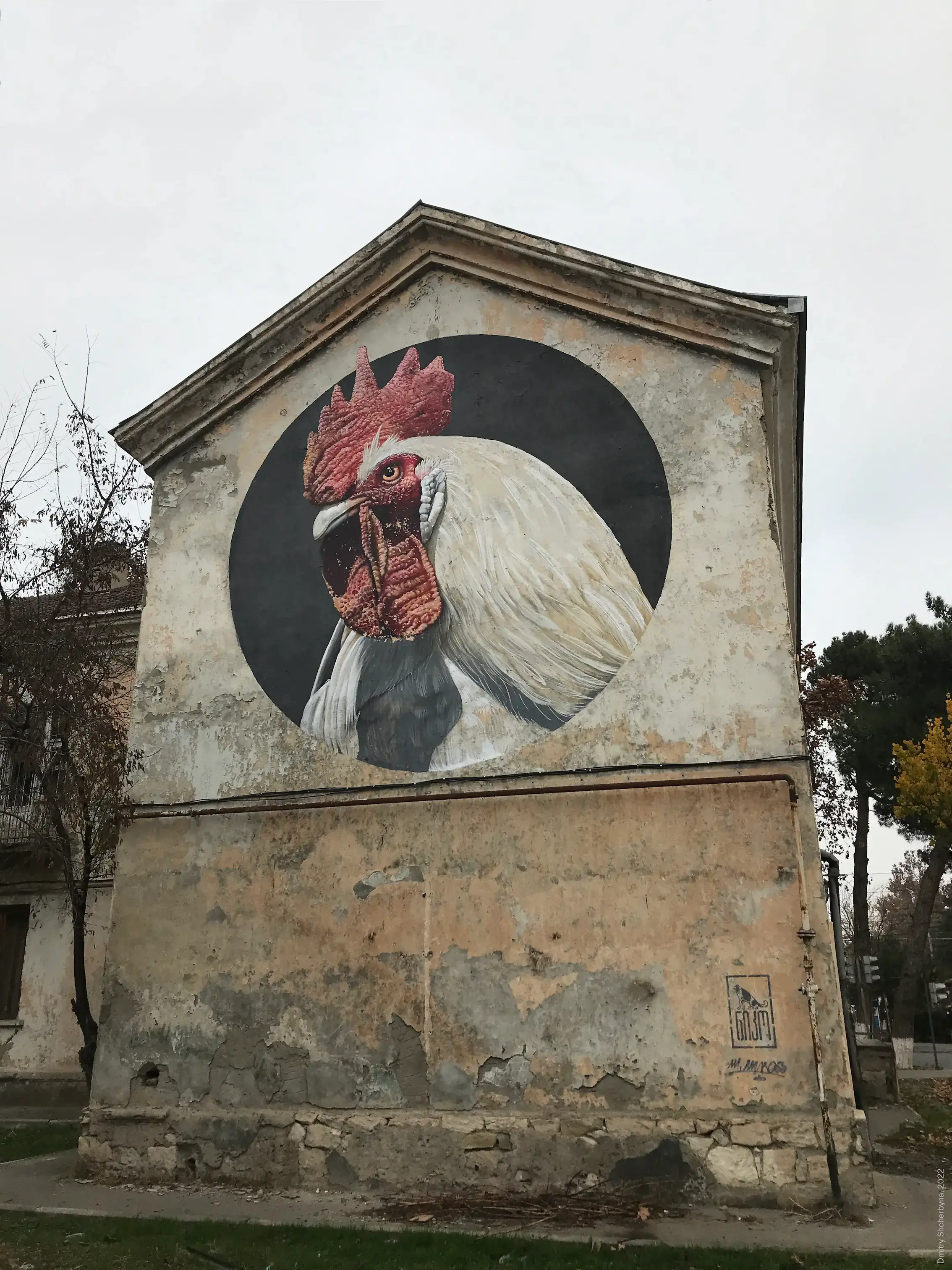
A hyper-realistic mural of a white rooster's head and chest, painted inside a large black circle, on the weathered gable wall of an old building. The rooster has a vivid red comb and wattle, and its feathers are rendered in fine detail.

In addition to celebrated foreign muralists participating in festivals or working independently outside institutional frameworks, a distinct Georgian cohort of artists has steadily emerged alongside them.

Many local artists have established themselves — yet continue to work on the streets of their own cities, often supported by the same initiatives and movements that helped them gain access to their first walls.
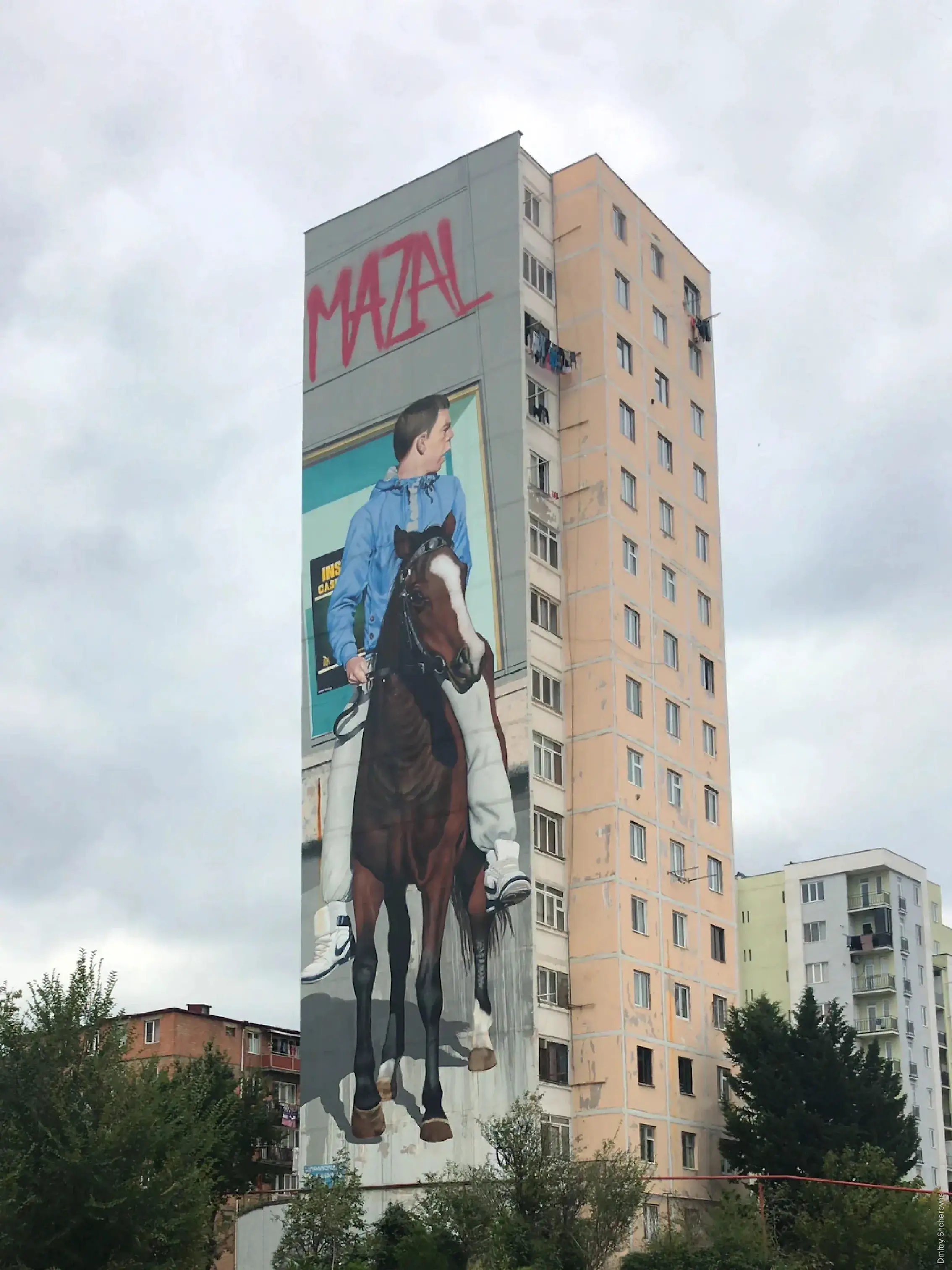
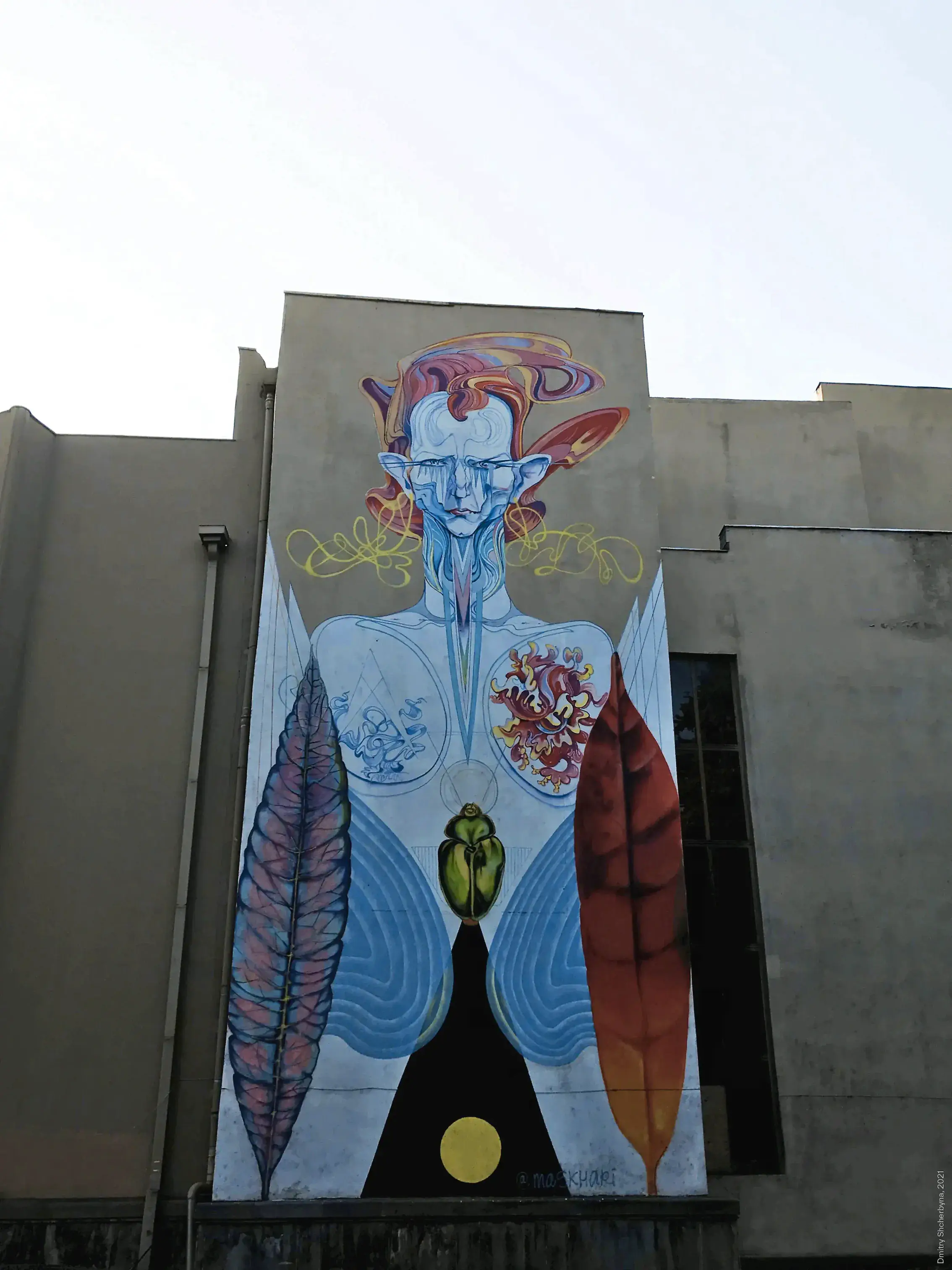
A photorealistic mural on the narrow side of a tall Soviet-era apartment building, depicting a young man in a blue shirt sitting atop a brown and white horse.
A tall surrealist mural featuring a pale blue humanoid figure with swirling multicolored hat, pointed ears, and elongated face.
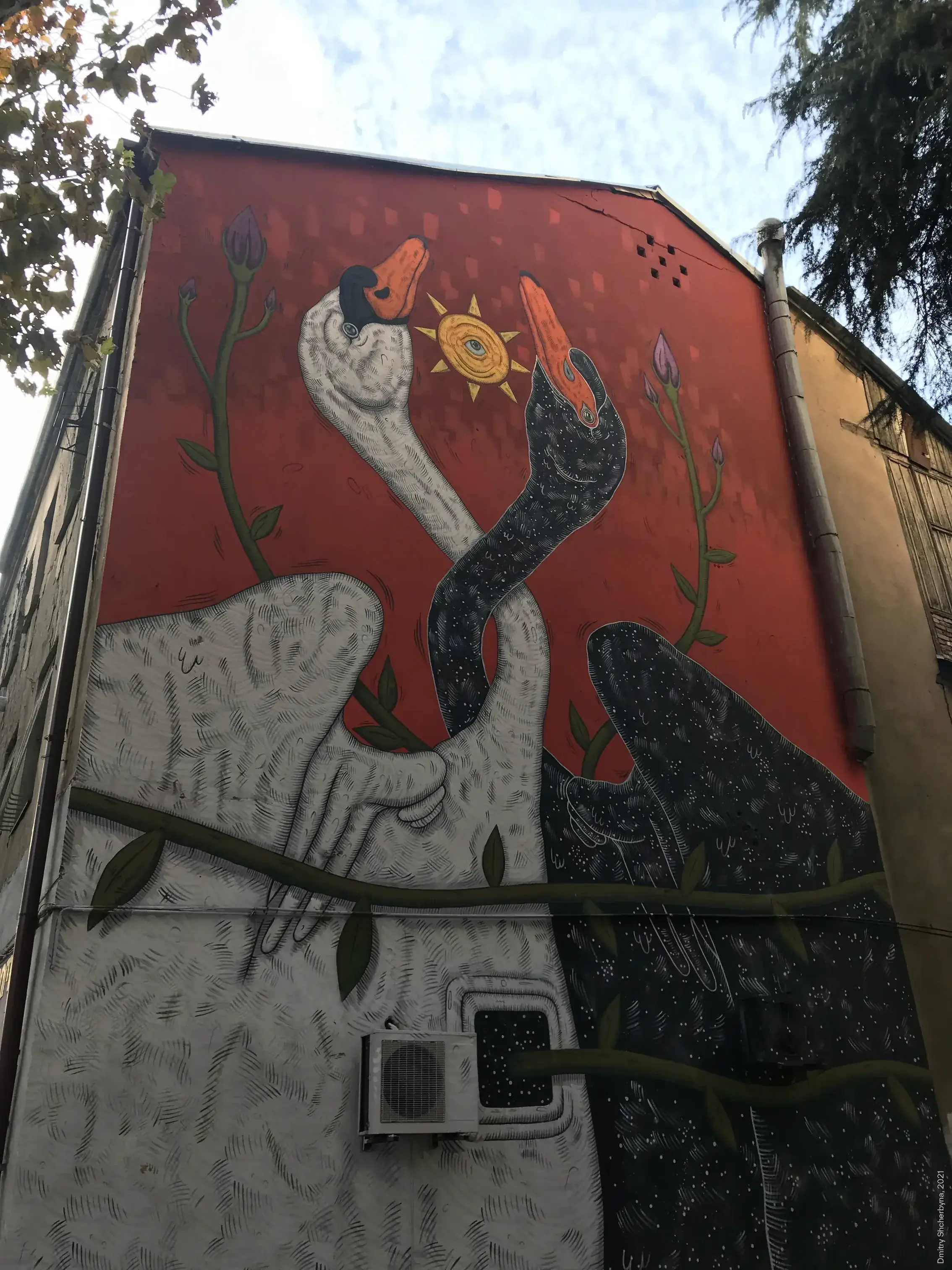
A mural on the side of a building showing two swans with intertwined necks — one white and one black speckled with stars — facing each other beneath a golden spiral sun against a deep red background.
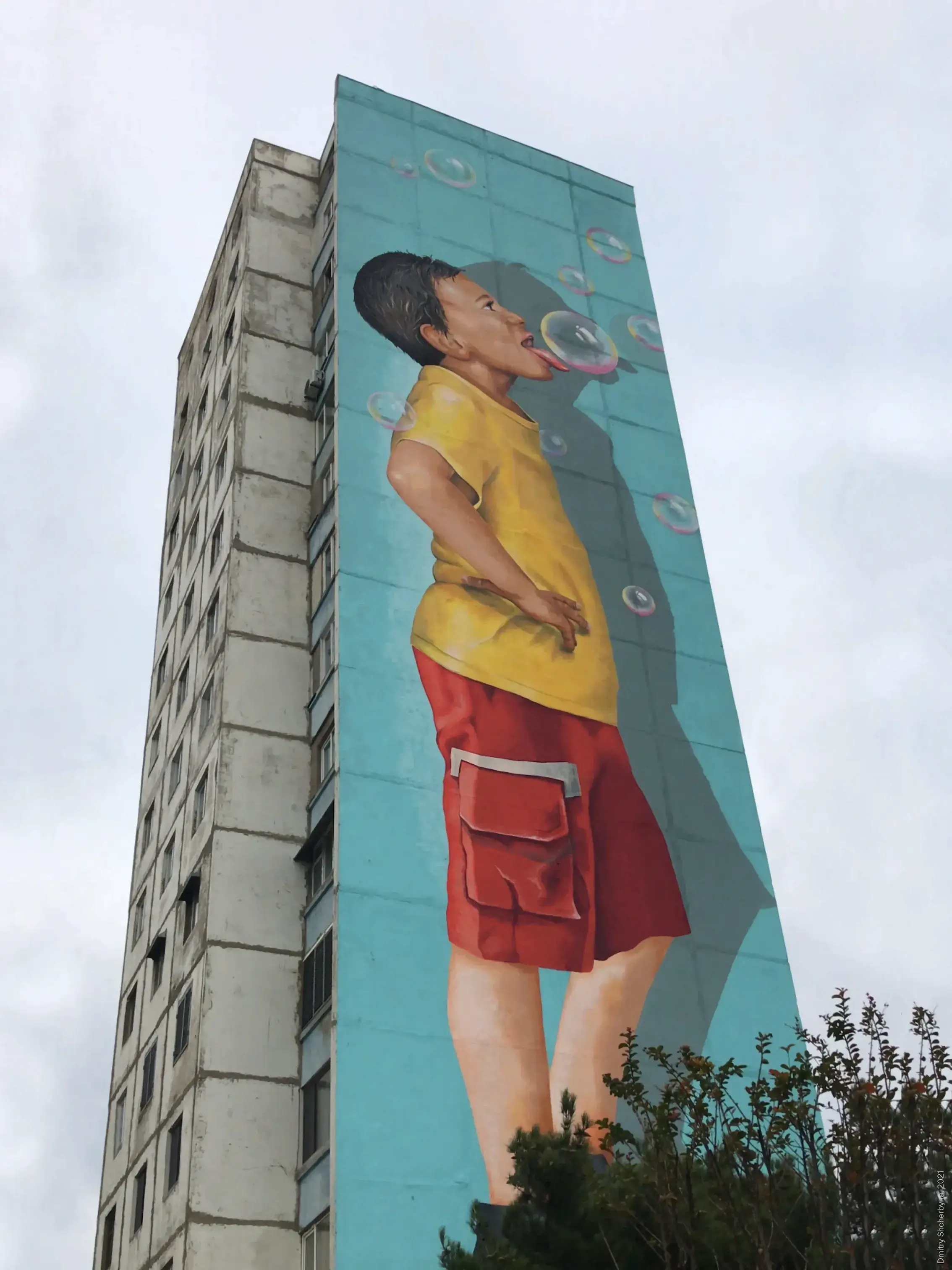
A photorealistic mural on the side of a tower block shows a barefoot boy in a yellow shirt and red cargo shorts standing in profile, blowing soap bubbles against a bright turquoise background.
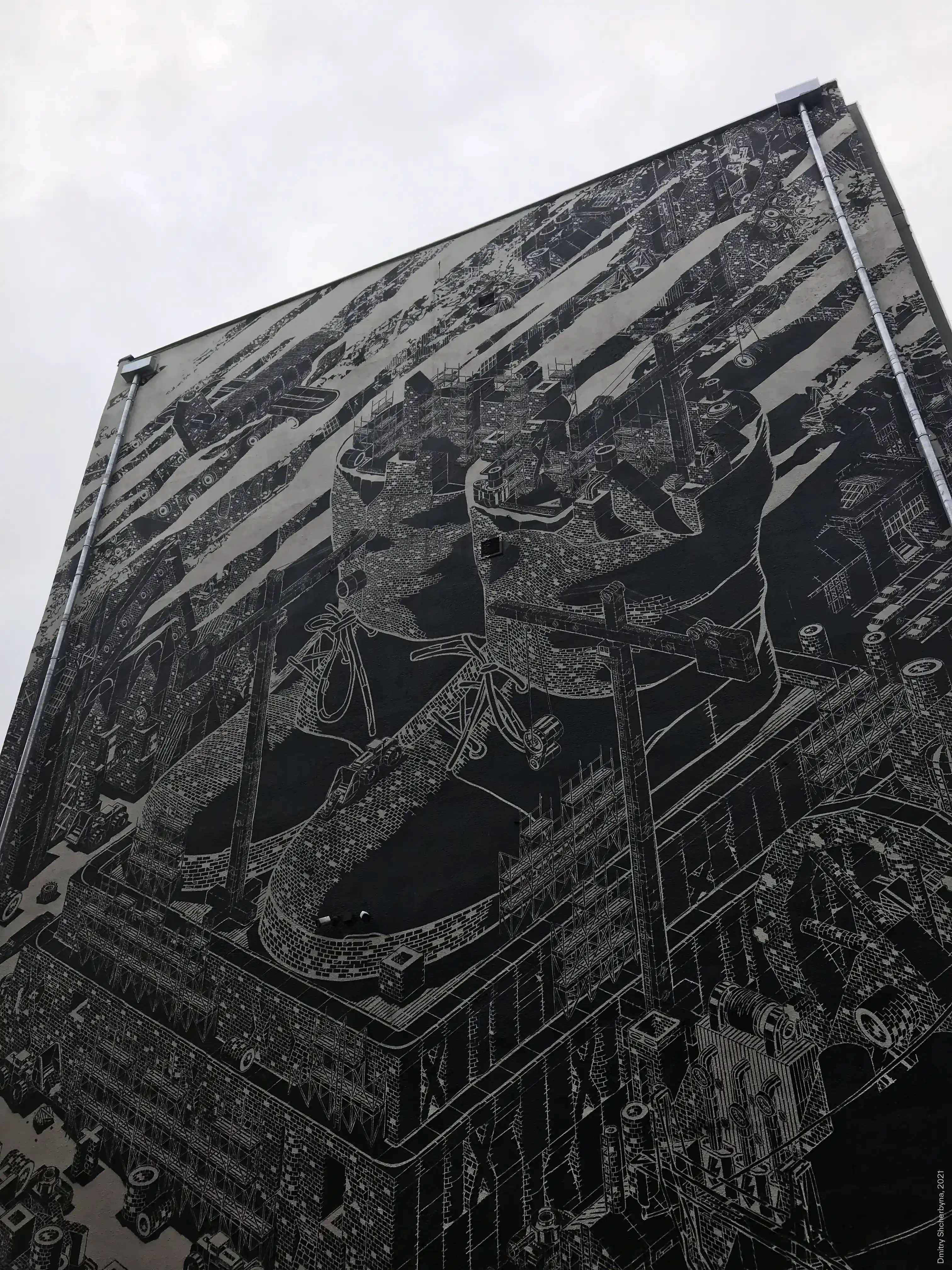
A massive black-and-white mural covers an entire building wall, showing enormous boots. The level of intricacy is reminiscent of etching or engraving.
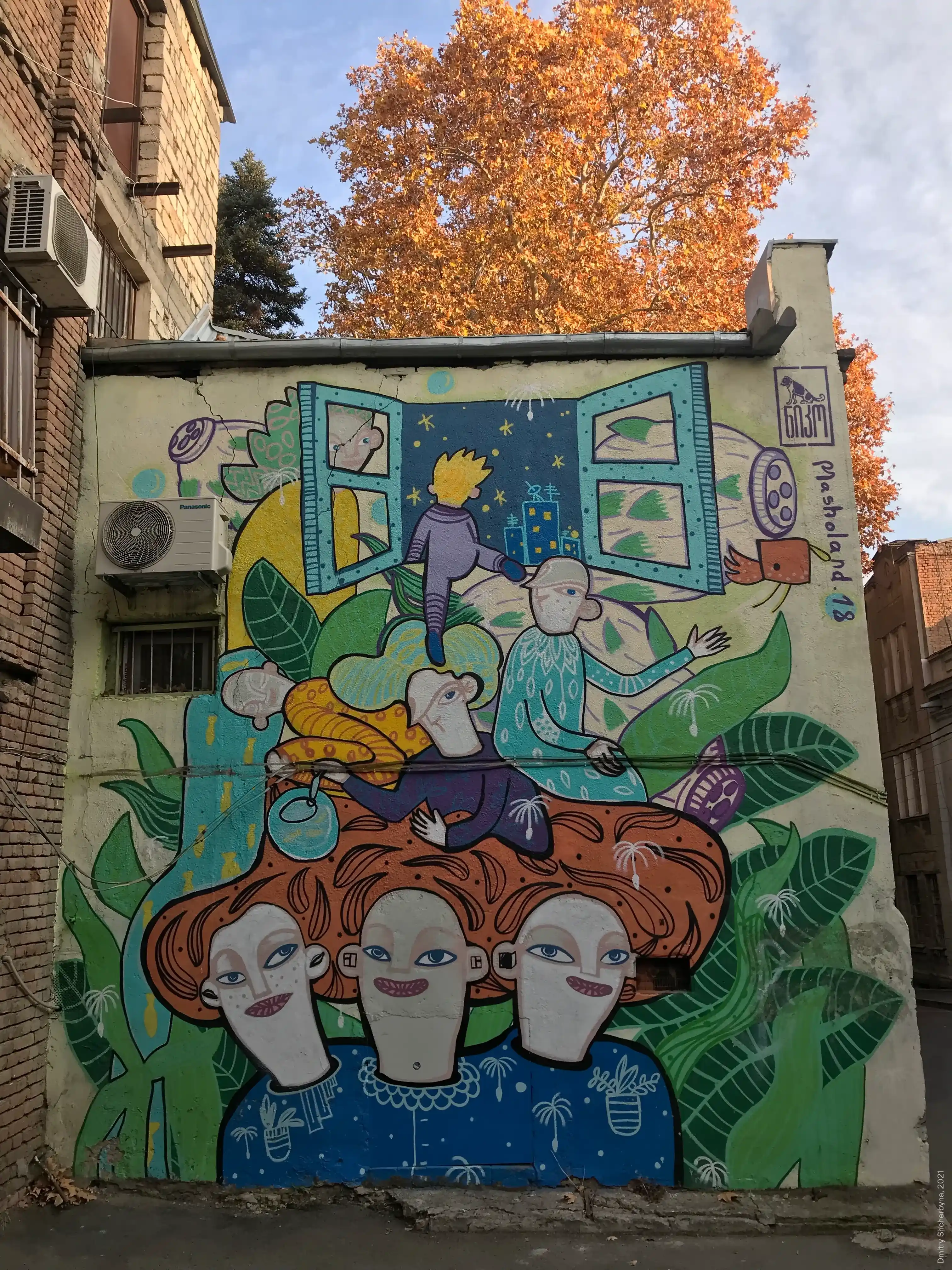
A whimsical mural on a small building shows three red-haired people at the bottom, gazing upward. Above them, playful figures are climbing and tumbling through lush green leaves. At the top of the mural, an open turquoise window reveals a starry night sky and a glowing city below.
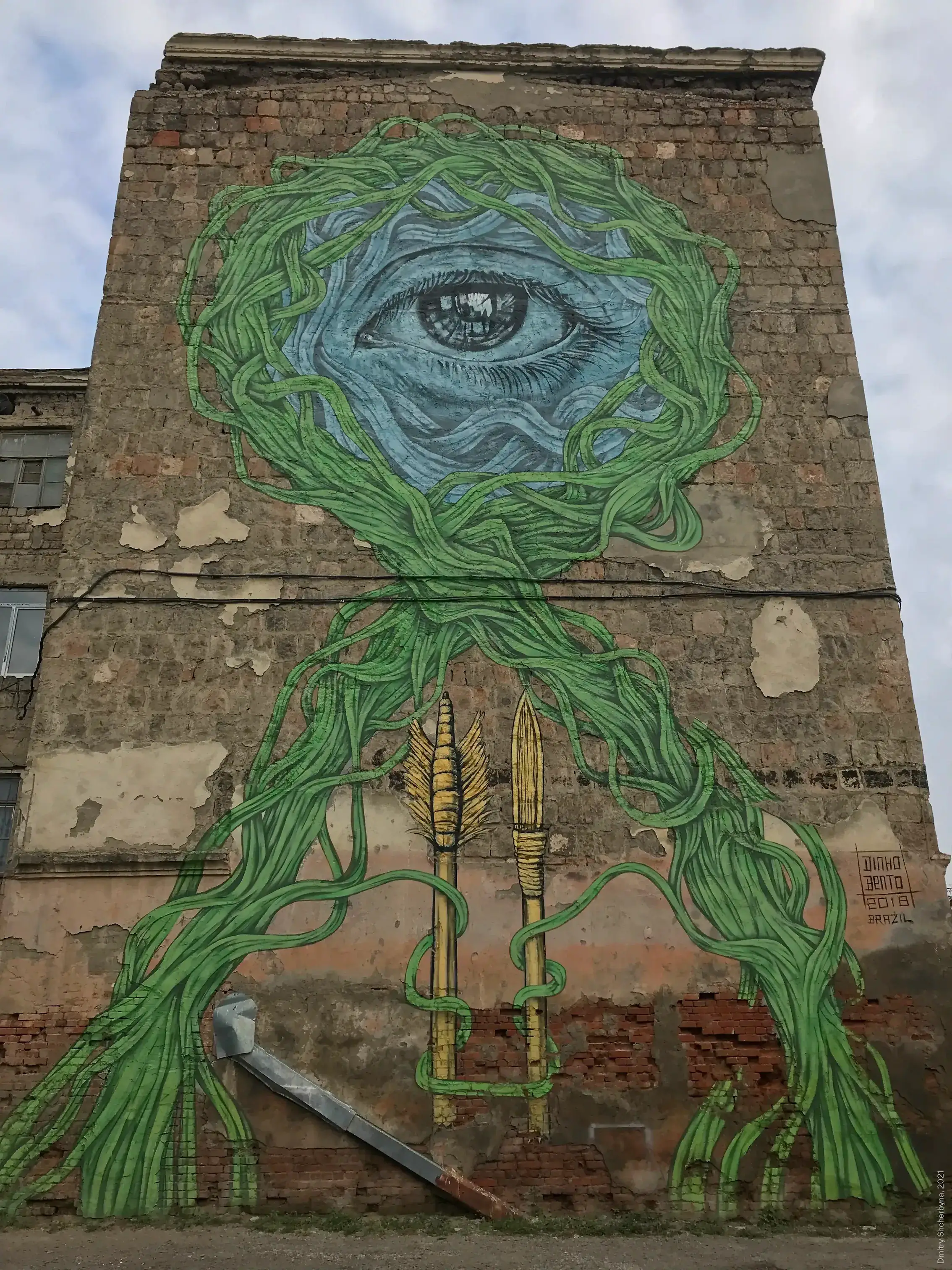
A mural on an exposed brick wall features a large realistic blue eye surrounded by tangled green vines that cascade down around two golden arrow-shaped forms.
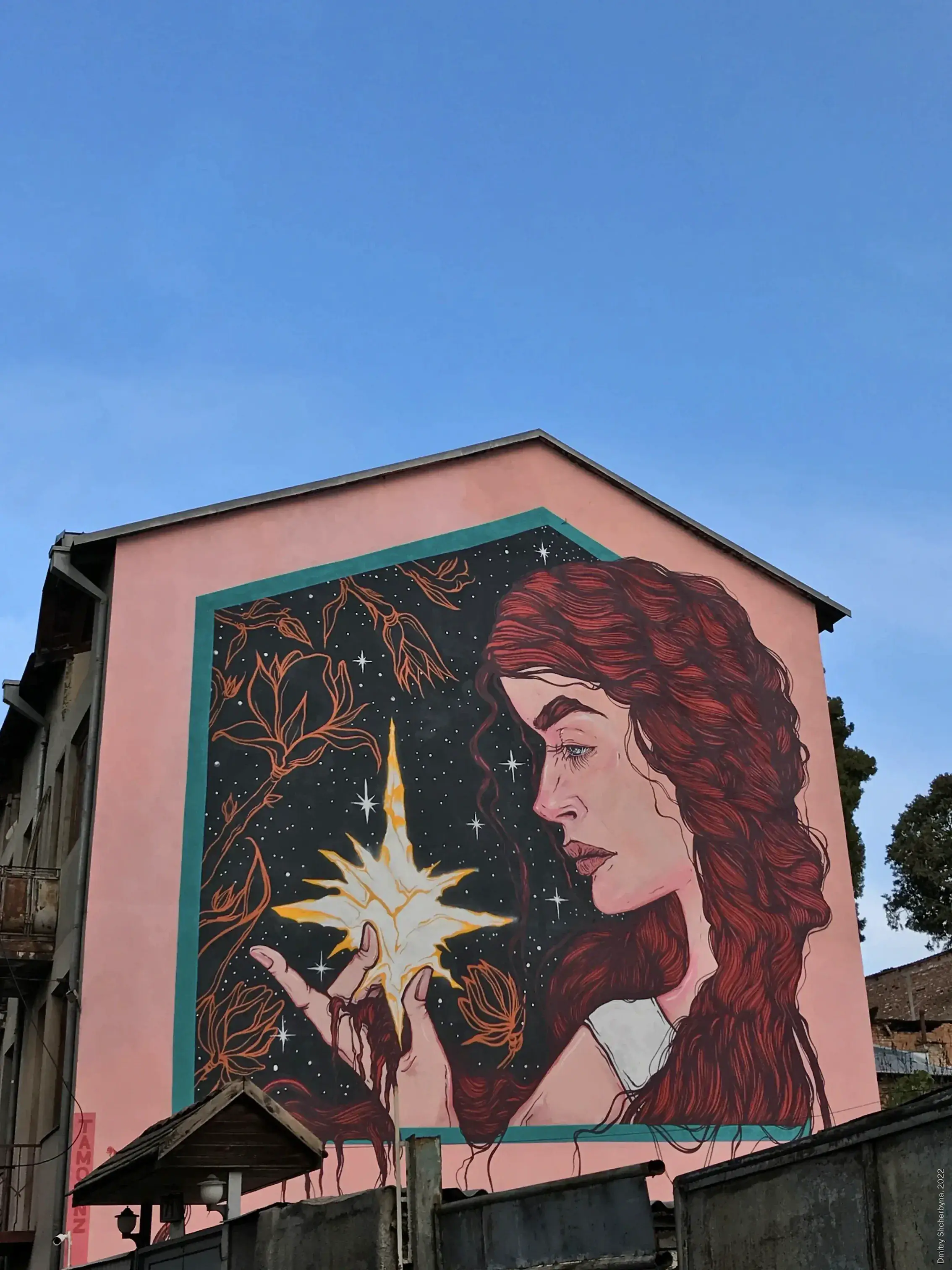
Mural on a pink building wall depicting a woman in profile, with long, flowing red curly hair holding a glowing star in her hands, against a dark night sky filled with smaller stars and stylized floral branches.

One of those movements is “Niko”, founded by Sandro Kvantaliani in 2017. What began as a small initiative to connect emerging artists with walls, permits, and basic equipment has since grown into one of the most significant and consistently active presences in the Georgian street art scene.
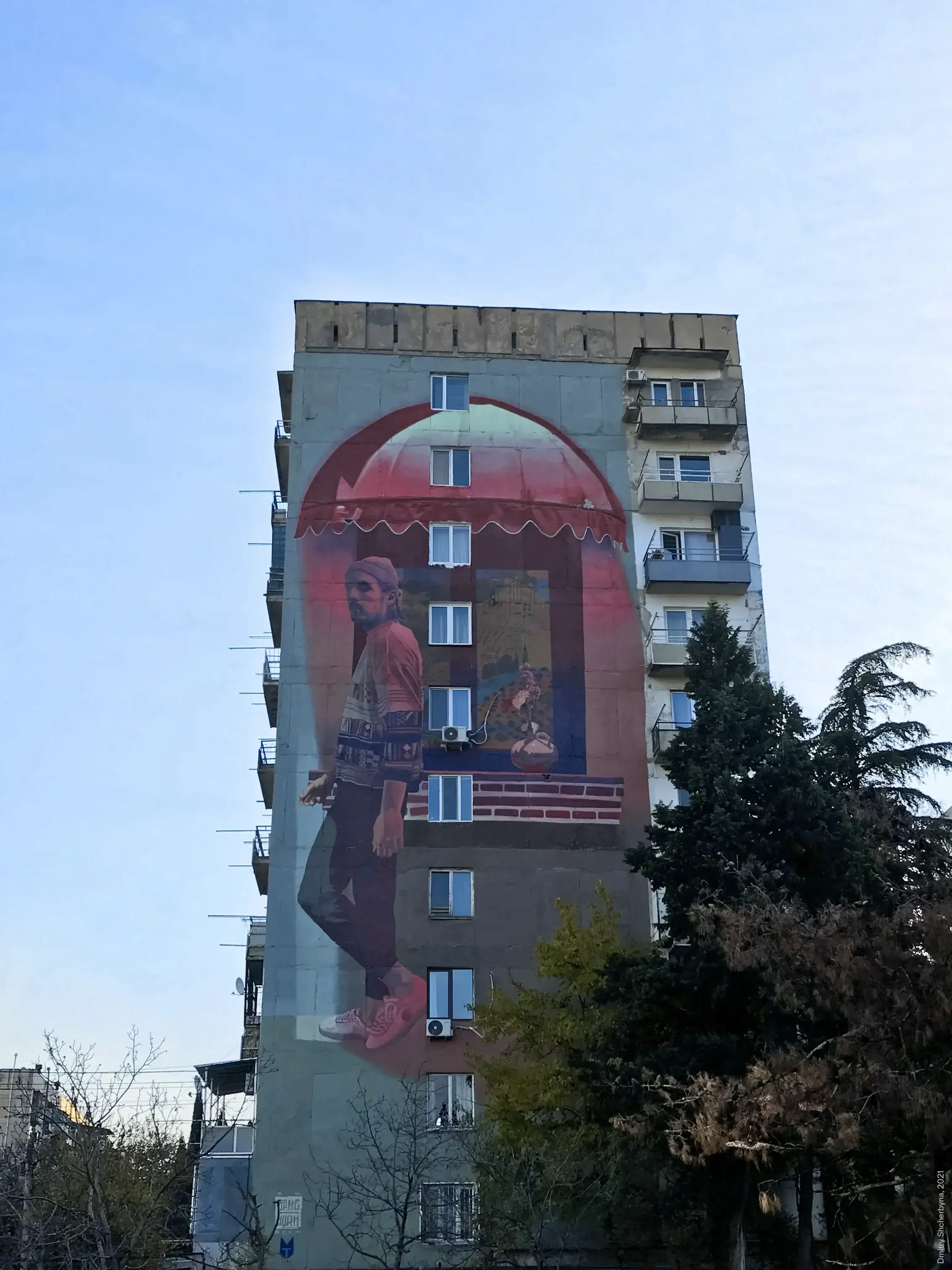
A tall mural on a Soviet-era apartment building shows a young man in a patterned sweater and beanie walking inside, contrasting the warm interior with the grey exterior of the building.

The “Niko” movement works exclusively with private wall owners, treating each agreement with residents as part of the creative process itself — seeing the negotiation with the community not as a bureaucratic step but as something inseparable from the work. In this way, “Niko” creates concrete pathways for emerging Georgian artists — giving a structure without imposing a program, and providing walls, equipment, and a professional context that would otherwise remain out of reach.
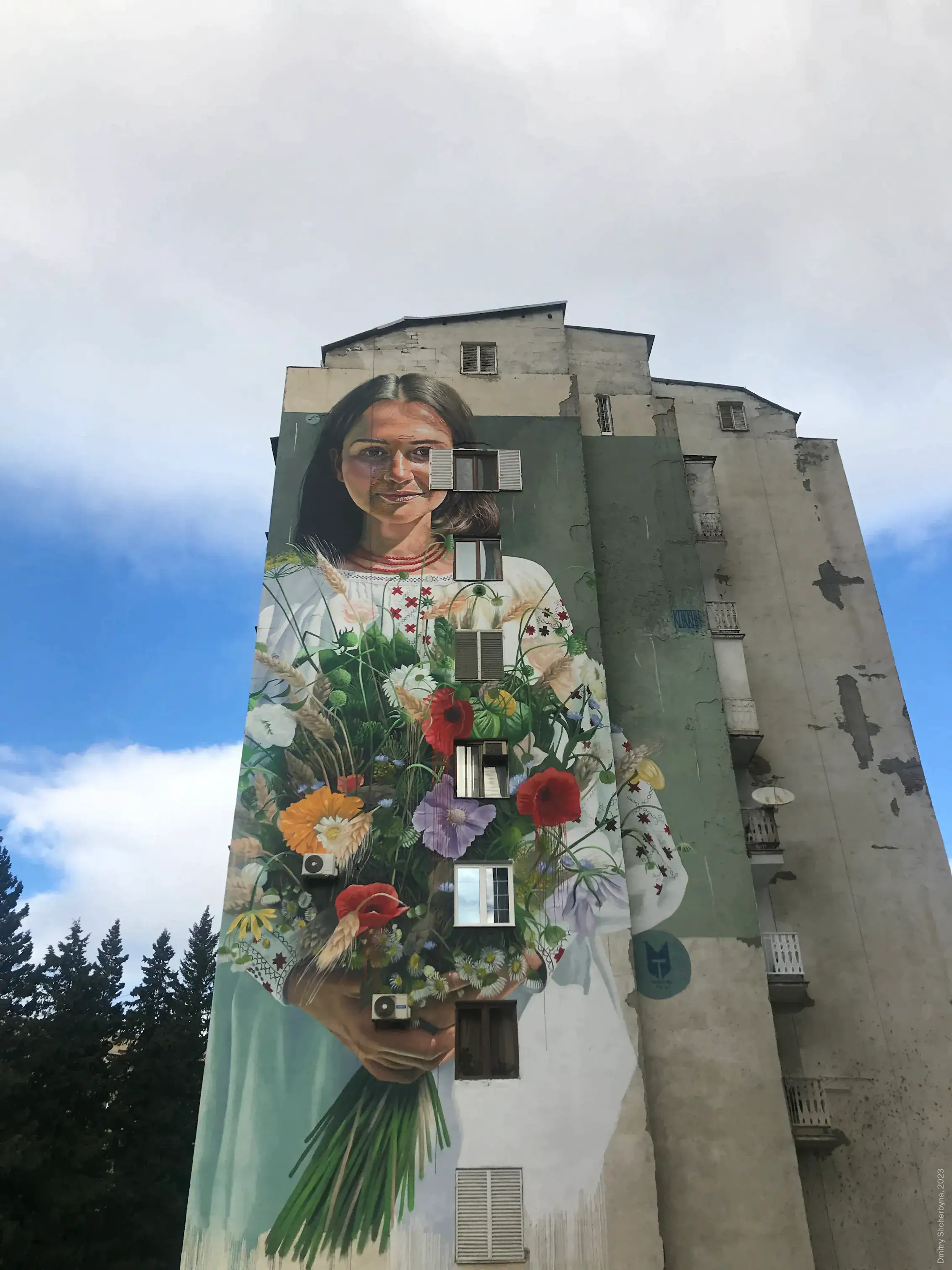
A mural spanning the full height of an apartment building depicts a woman in a traditional Ukrainian embroidered blouse, holding an overflowing bouquet of wildflowers, including poppies, wheat, daisies and irises.

Over the years, “Niko” has attracted support beyond the local art community — embassies and cultural institutes have become active partners, with German, Brazilian, Italian, French, and Polish institutions among those who have contributed to bringing international artists into the movement's projects. This growing network of support has allowed “Niko” to expand its reach and operate at the intersection of local development and international exchange. It also creates spaces for artistic experimentation and growth.
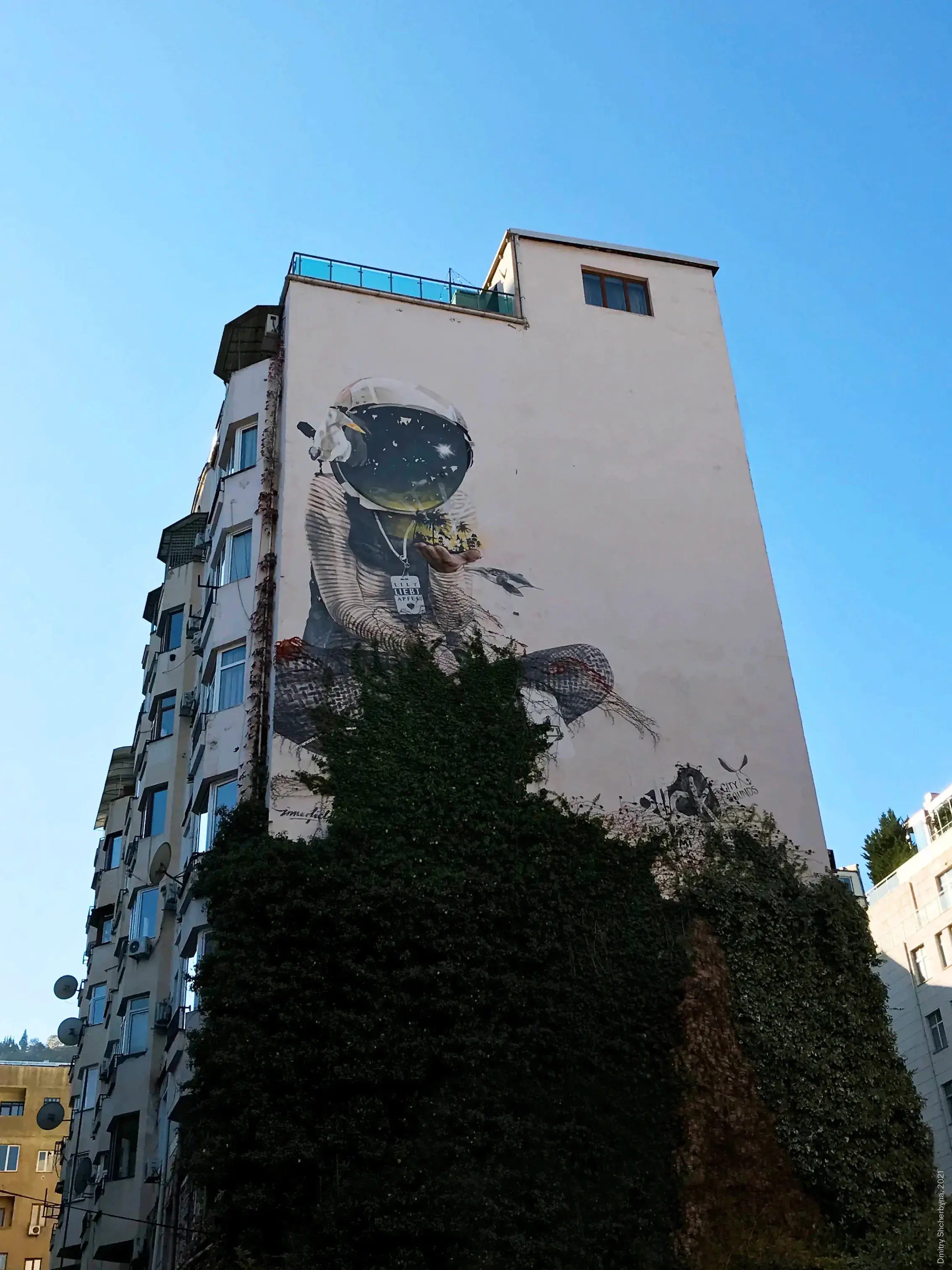
A mural of an astronaut high on an apartment building, wearing a space suit and holding something delicate in one hand, with a star-like visor. The lower part of the mural is partly obscured by climbing ivy.

The appearance of a large-scale mural is rarely spontaneous. Each work requires negotiations with authorities and building residents, careful planning over weeks, an abundance of materials, and technical equipment — from scaffolding to auto-lifts — that most individual artists could not access or afford independently. Without this kind of support, the gap between an artist's vision and its execution on a residential wall remains simply unbridgeable. This is precisely the gap that “Niko” was built to close.
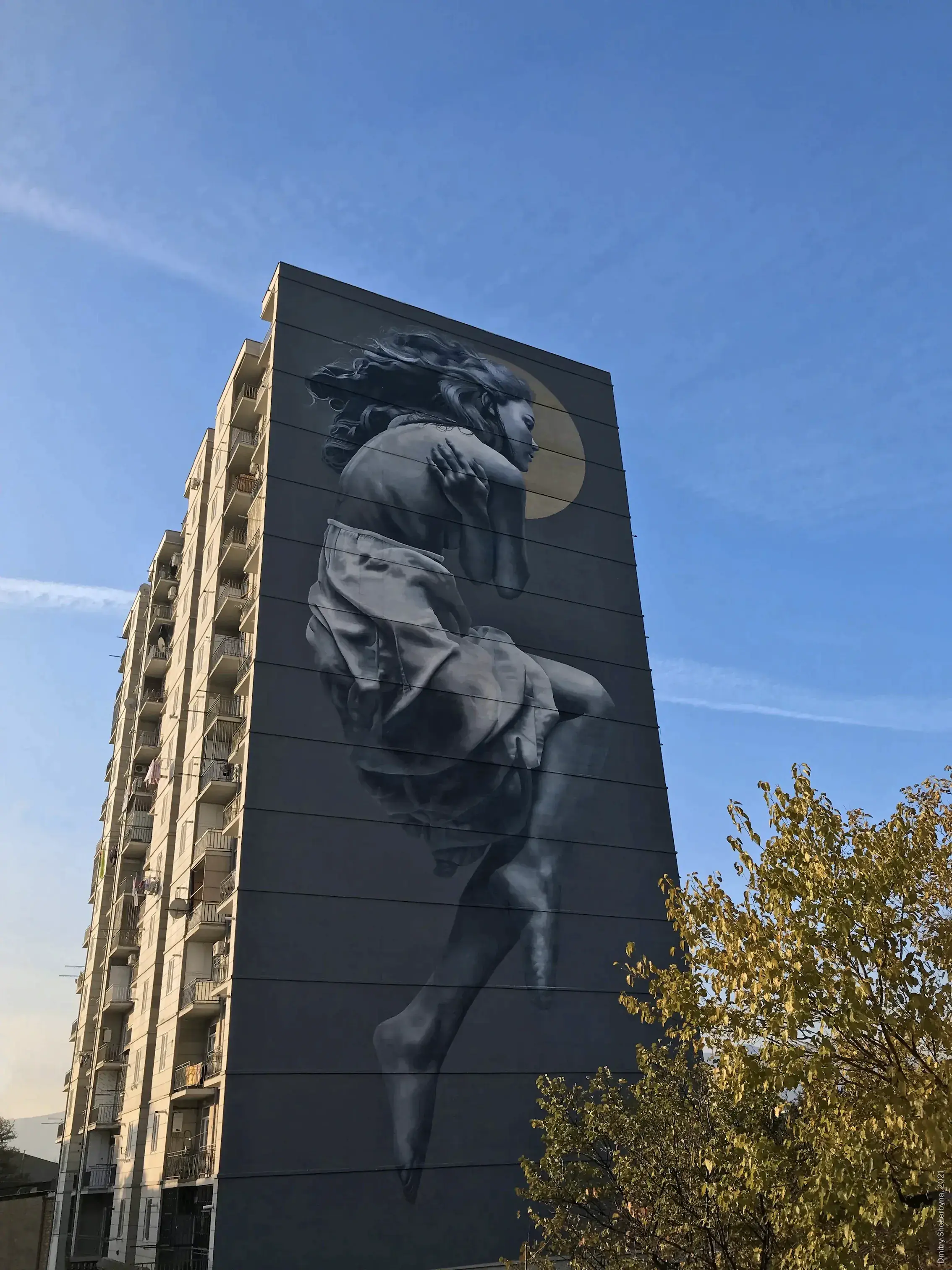
A tall mural of a woman on a dark building wall painted in greyscale. She is floating or leaping, with her hair blowing upward. Her hands are pressed together. A golden crescent moon glows behind her shoulders.

Maglivi, known as a part of Tbilisi State University, is a place where you can see a wide range of works at the same time. This site functions as a practice ground for street-art artists where all walls are frequently replaced, layered, or painted over.
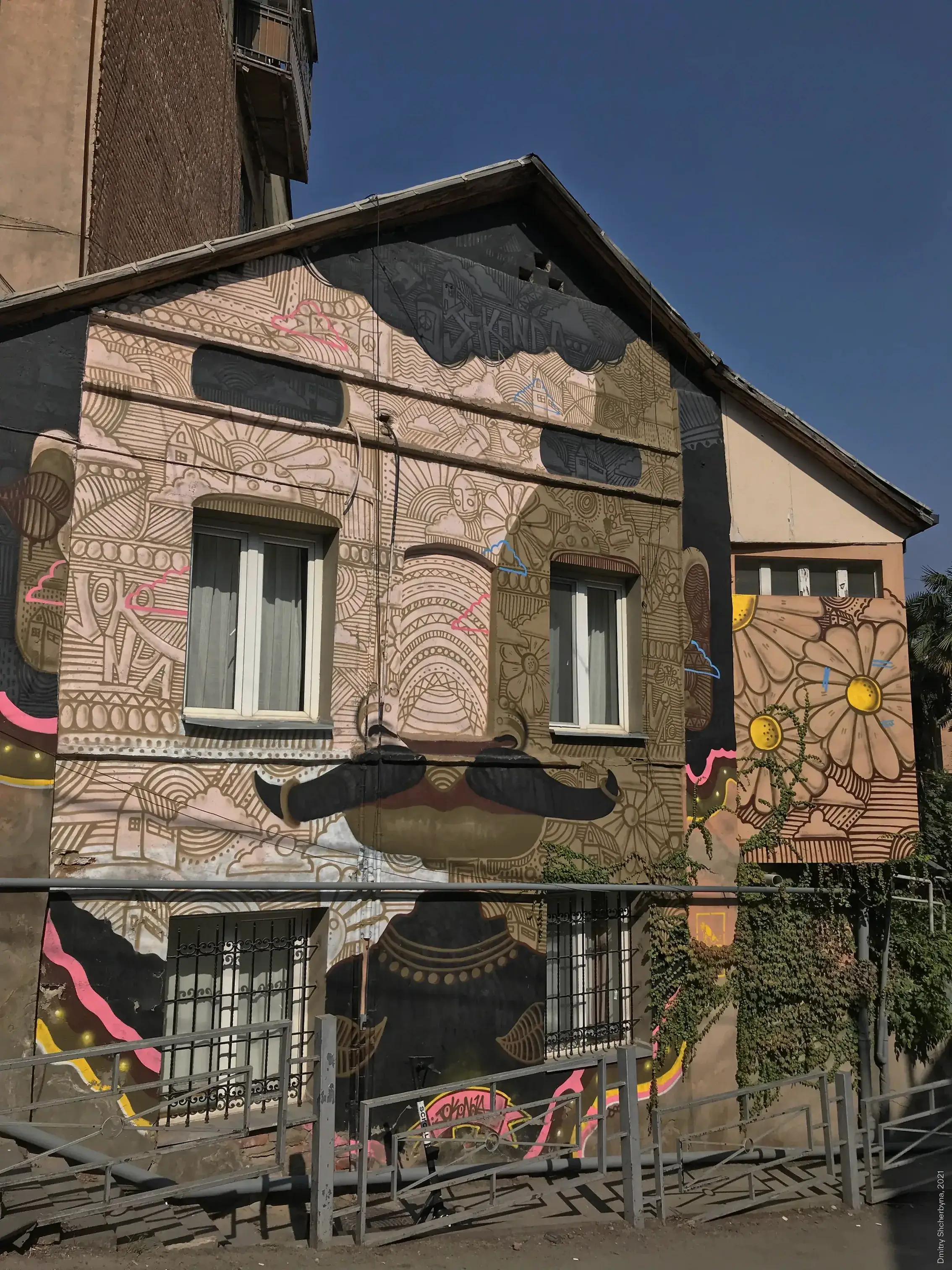
A mural covering the entire house, using the windows as the eyes of a large, hidden face composed of brown tan and walls filled with geometric and floral designs in pink, gold, and dark brown.
A mural covering an entire house, using the building's windows as the eyes of a large hidden face composed of intricate tan and brown line patterns. A prominent curled mustache sits below the windows, and the surrounding walls are filled with geometric and floral designs in pink, gold, and dark brown. Signed "Kenta."
A mural covering the entire house, using the windows as the eyes of a large, hidden face composed of brown tan and walls filled with geometric and floral designs in pink, gold, and dark brown.

Just as Niko Pirosmani painted without support or recognition — working alone, exchanging paintings for meals, in obscurity for most of his life — the “Niko” movement has made supporting young talents its founding principle. The dog from the movement's logo, featured in Pirosmani's painting “The Feast in a Grape Gazebo”, makes this cultural connection visible on every wall they paint. What began as a coincidence — a first wall near Pirosmani's memorial — has since become a meaningful point of reference.
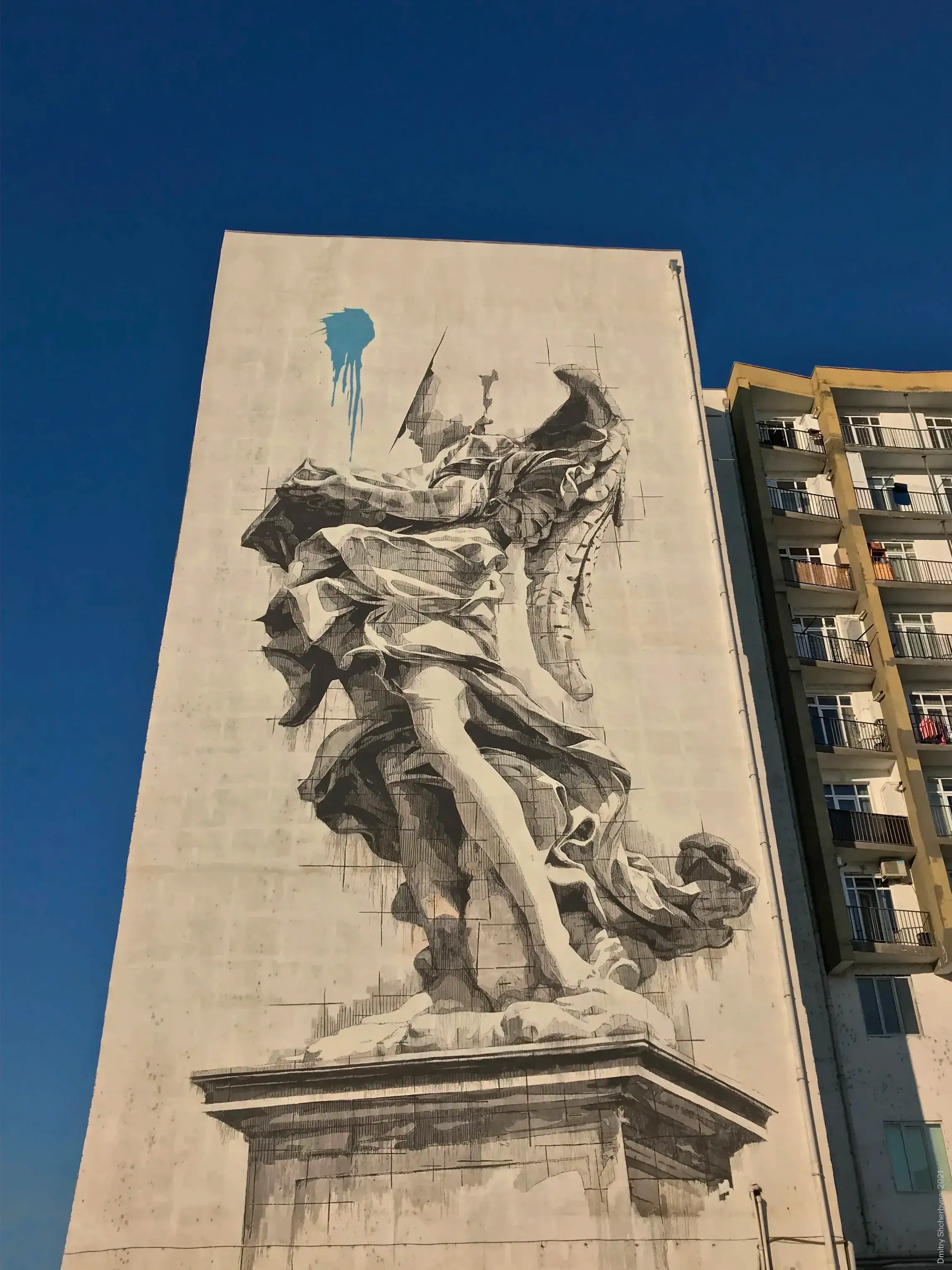
A monochrome black-and-white mural spanning the full height of a building, depicting a Baroque-style winged angel statue on a pedestal in dramatic flowing robes, rendered with fine cross-hatching.

Street art has always been a way of self-expression and a distinct voice — a way of transmitting information, where what gets communicated depends on the author. Achieving influence on public consciousness, however, requires works that combine visual techniques with conceptual depth. For “Niko”, this openness to meaning is matched by an openness to form: the movement is expanding beyond murals into light installations and sculptures, treating urban art not as a fixed medium but as a continuously evolving language.
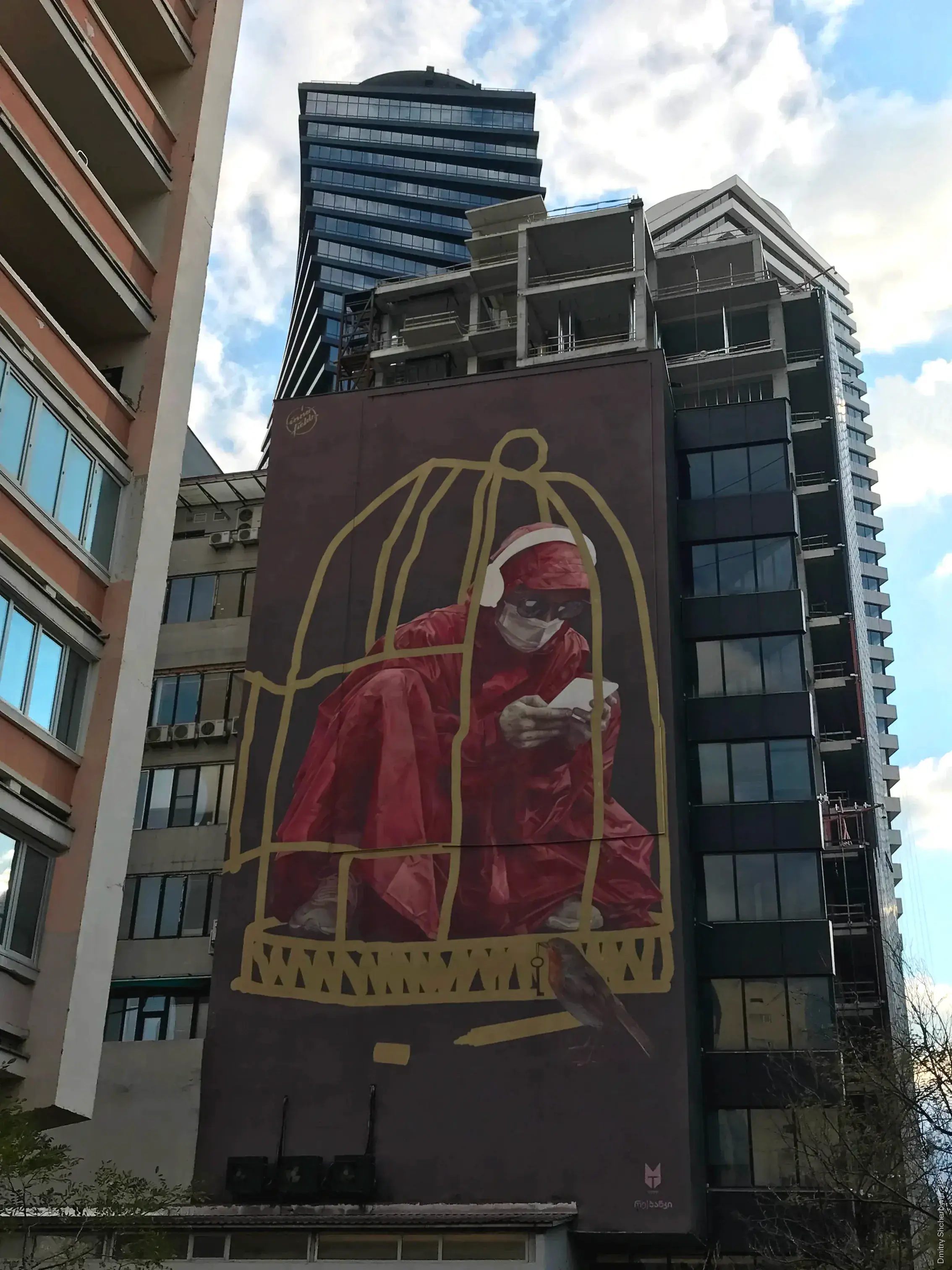
A tall building mural depicting a person wearing a red hooded garment, a white face mask and sitting inside a hand-drawn bird cage, looking down at a phone in their hands. At the bottom of the cage sits a small bird with a key in its beak.
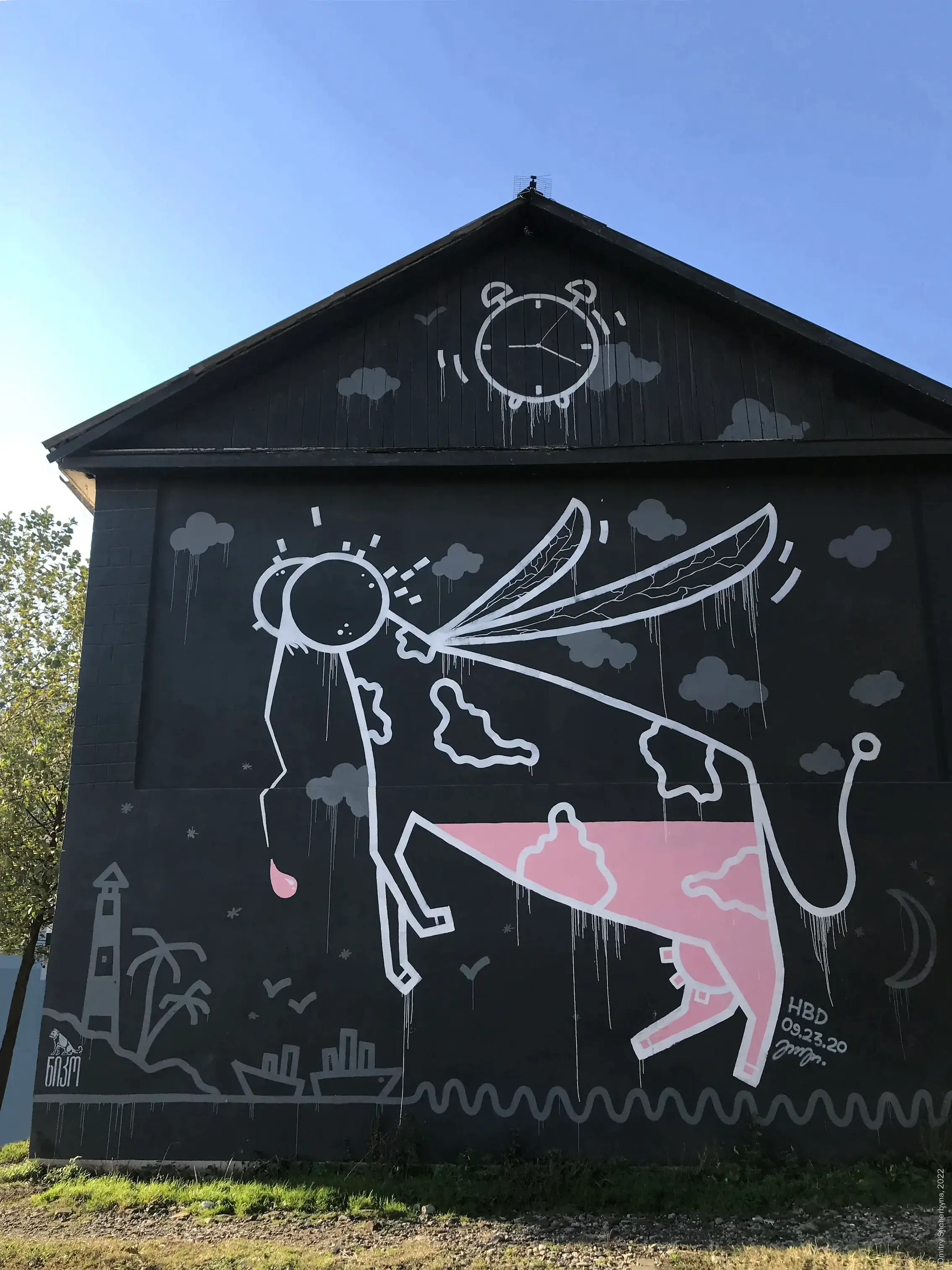
A white line drawing of a large creature on a barn wall. It looks like a pink cow with a mosquito's face. At the top of the roof is surrounded by grey clouds and an alarm clock.

In the historic Chugureti district of Tbilisi, a former Soviet sewing factory called 'Nino' sat abandoned for years after the USSR collapsed. In 2016, Adjara Group Hospitality and Multiverse Architecture (MUA) transformed it into “Fabrika” — a cultural and creative hub housing artist studios, co-working spaces, cafes, and the largest hostel in the region. It has since become one of the most recognisable and frequently visited landmarks on the Left Bank of the city and an unexpected entry point into Tbilisi's street art scene.
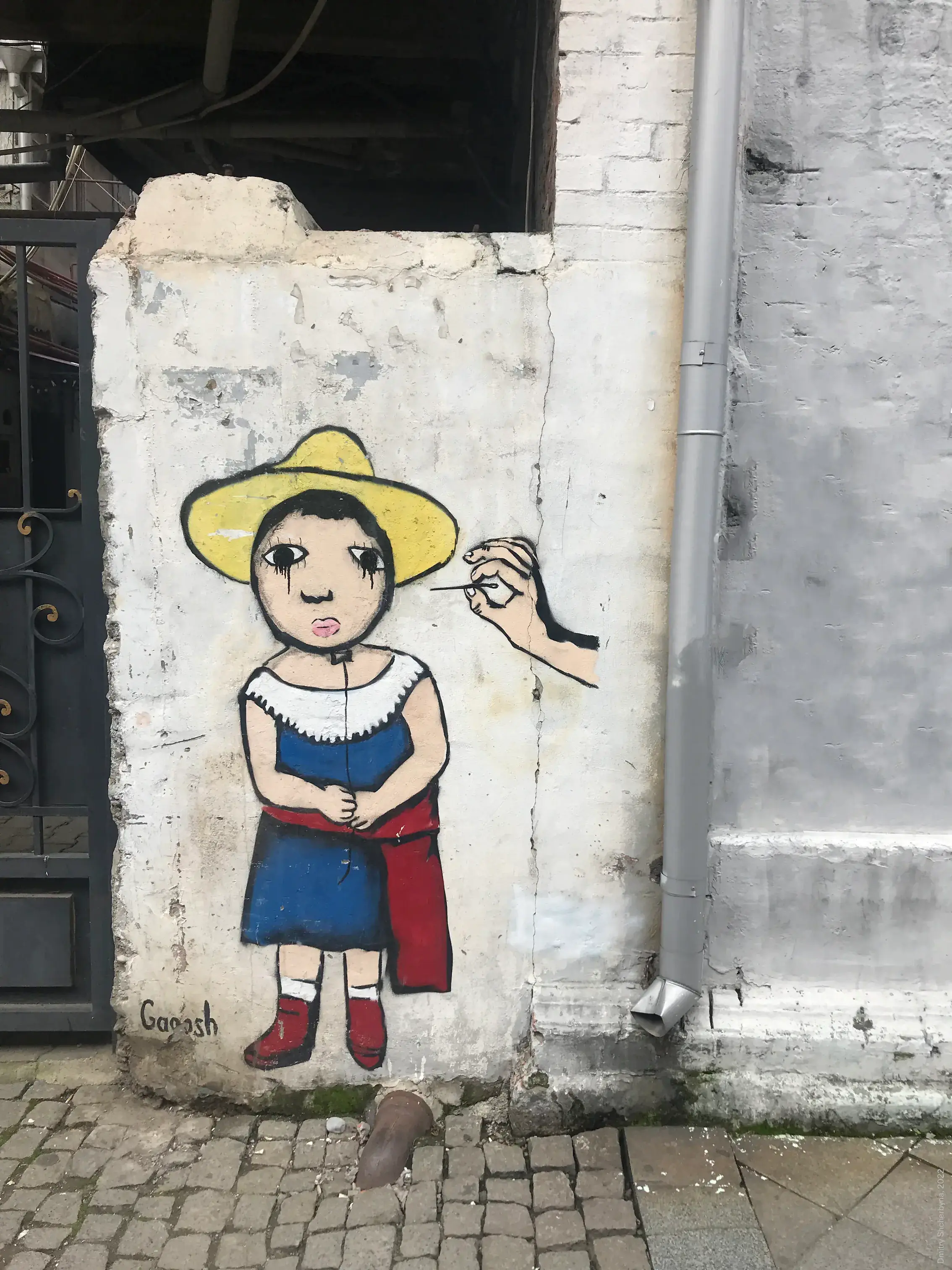
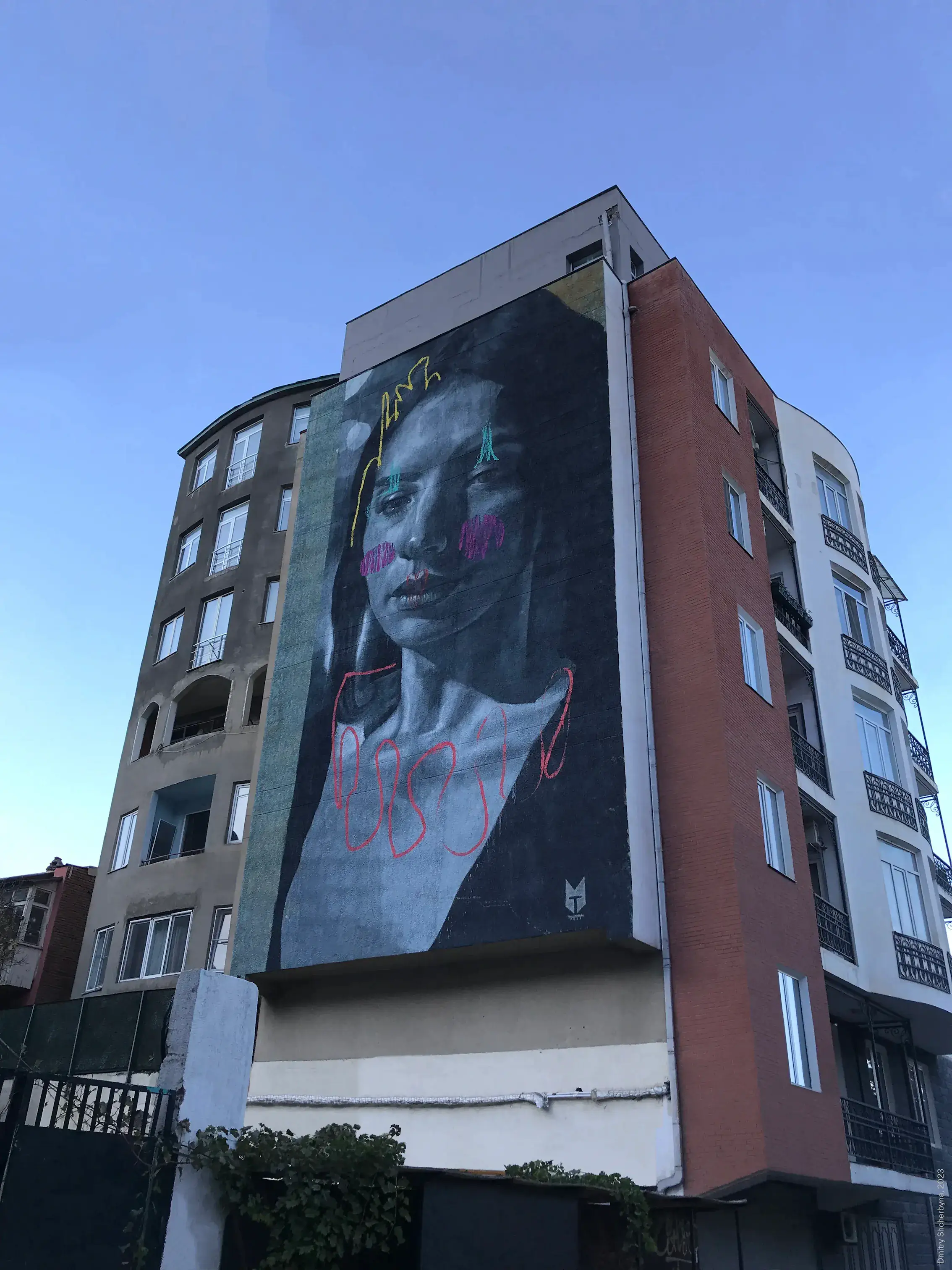
A small stencil-style mural on a worn white brick wall depicts a sad-eyed child wearing a yellow hat, a blue dress, and red shoes. Her disembodied right hand reaches toward the viewer.
A large dark-toned portrait mural of a woman's face on the side of an apartment building, painted mostly in deep blue-grey with subtle colorful accents — yellow and teal lines across her forehead and a pink looping outline around her neck and chest. A small fox-like logo appears at the bottom.
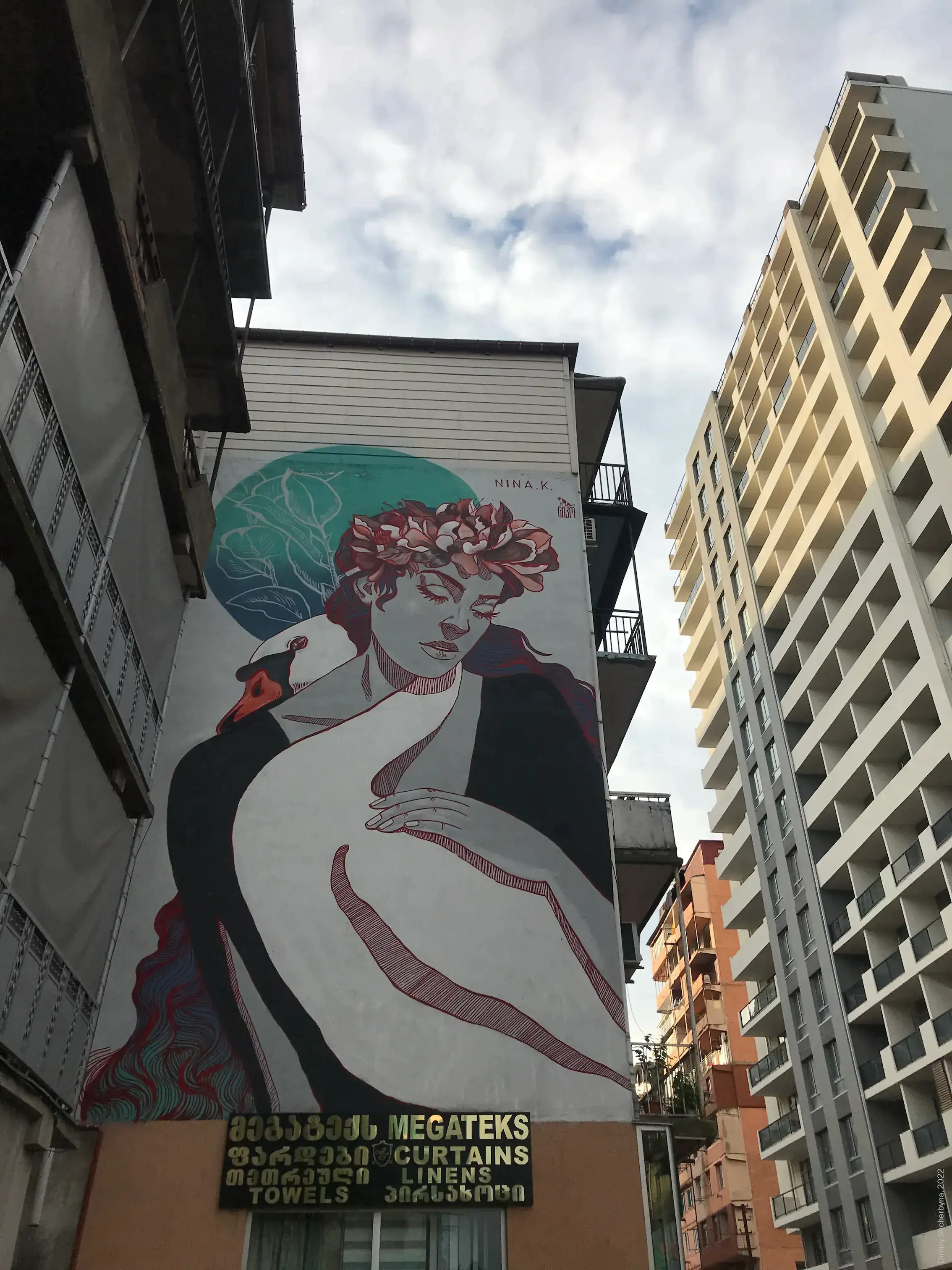
A mural of a woman with closed eyes and flowers in her dark red hair, gently embracing a white swan against a teal circular background. The style is inspired by art nouveau with fine red linework on pale skin.

From the beginning, street art was central to Fabrika's identity rather than an afterthought. It was the first building in Tbilisi to deliberately offer its walls to artists — both local and international — making it a living canvas rather than a fixed exhibition.

Exposed pipes, repurposed factory equipment, and colorful works create a contrast reflecting Georgia’s transition from its Soviet legacy to the present. The exterior is entirely covered in works of varying scale — from small pieces to a large mural.

The complex is organized around a central courtyard formed by three interconnected building blocks, which functions as a primary hub for social interaction. It also regularly hosts public events, exhibitions, markets, and live performances.

What began as a project to revitalize an abandoned industrial site has, over the following years, contributed noticeably to an incremental transformation of the surrounding neighborhood, attracting a steady stream of foreign and local visitors.
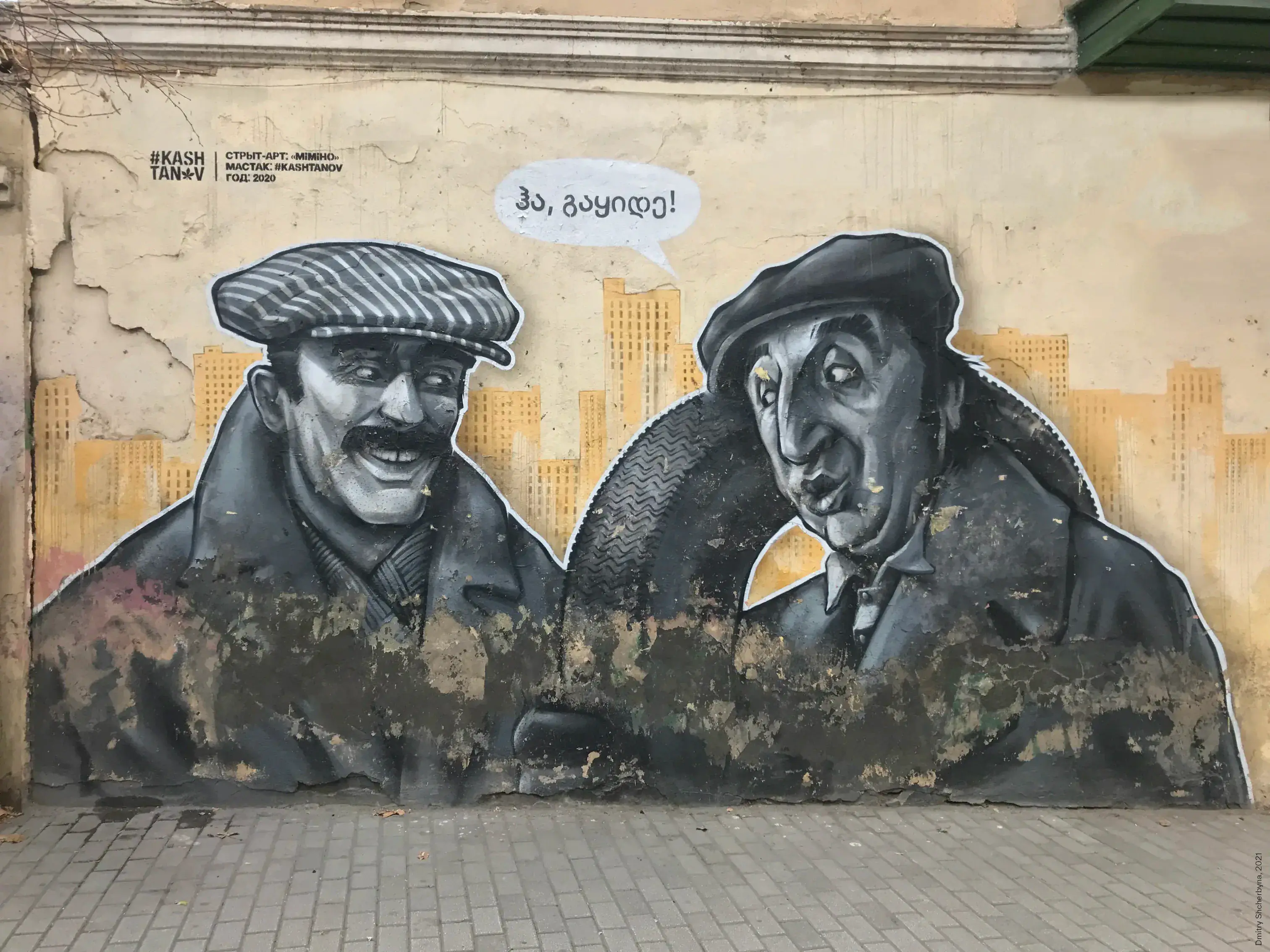
A grayscale mural of two men in coats and hats smiling and leaning towards each other, with a golden city skyline behind them. They are characters from the film "Mimino".

Its growing visibility has also made “Fabrika” a case study in adaptive-reuse urban redevelopment, drawing interest from investors, boosting local businesses, and contributing to spurring the gradual area gentrification.

“Fabrika” has hosted its own “Fabrikaffiti festival” since 2016, organized in collaboration with the local CRU Crew collective. The event invites both Georgian and international artists to repaint the venue's walls, connecting the visual practice to the broader urban culture from which it historically evolved.
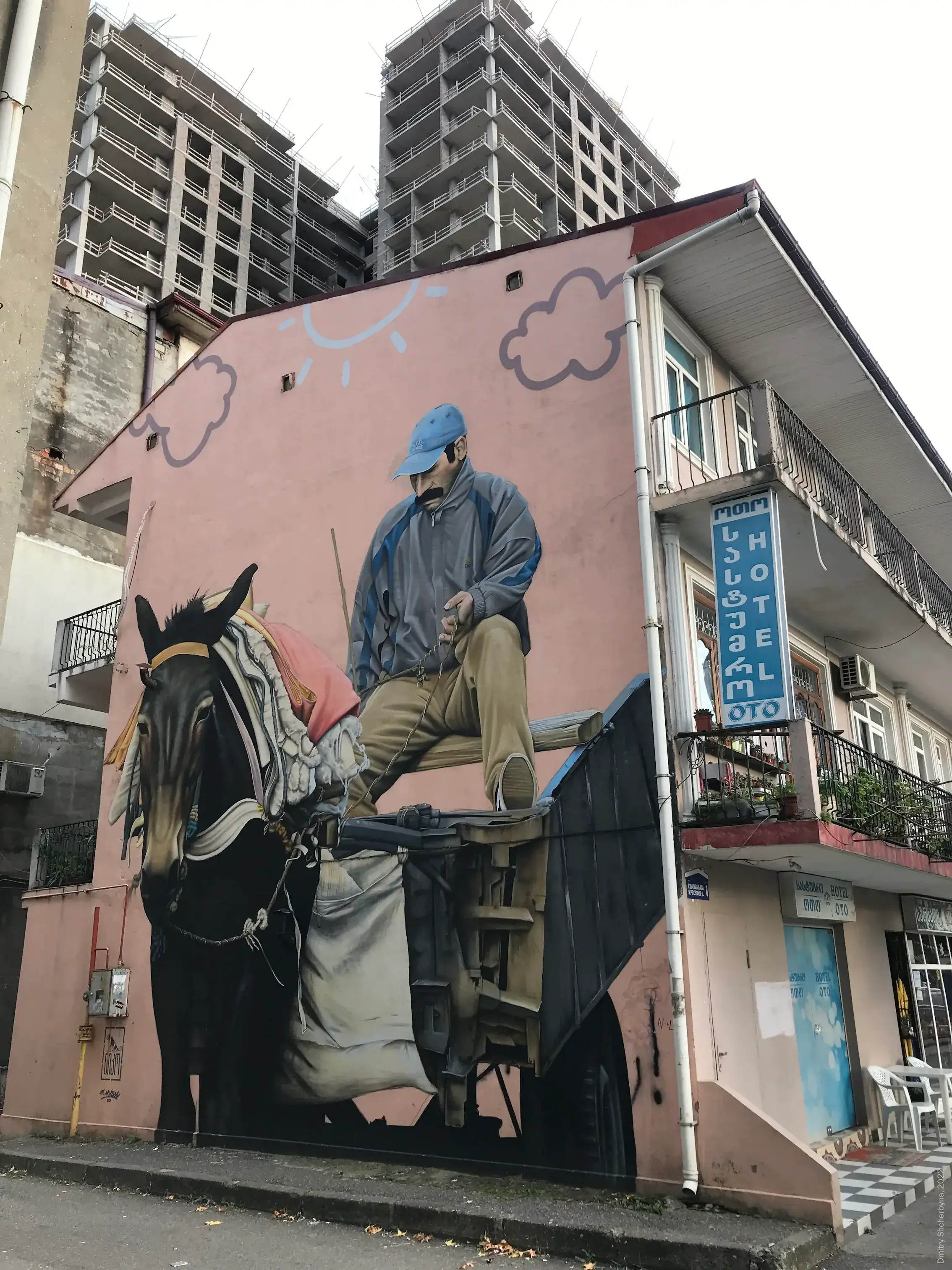
A mural on the side of a small building shows a realistic depiction of a man in a blue jacket and cap sitting on a wooden horse-drawn cart with a dark horse pulling it along in a harness.
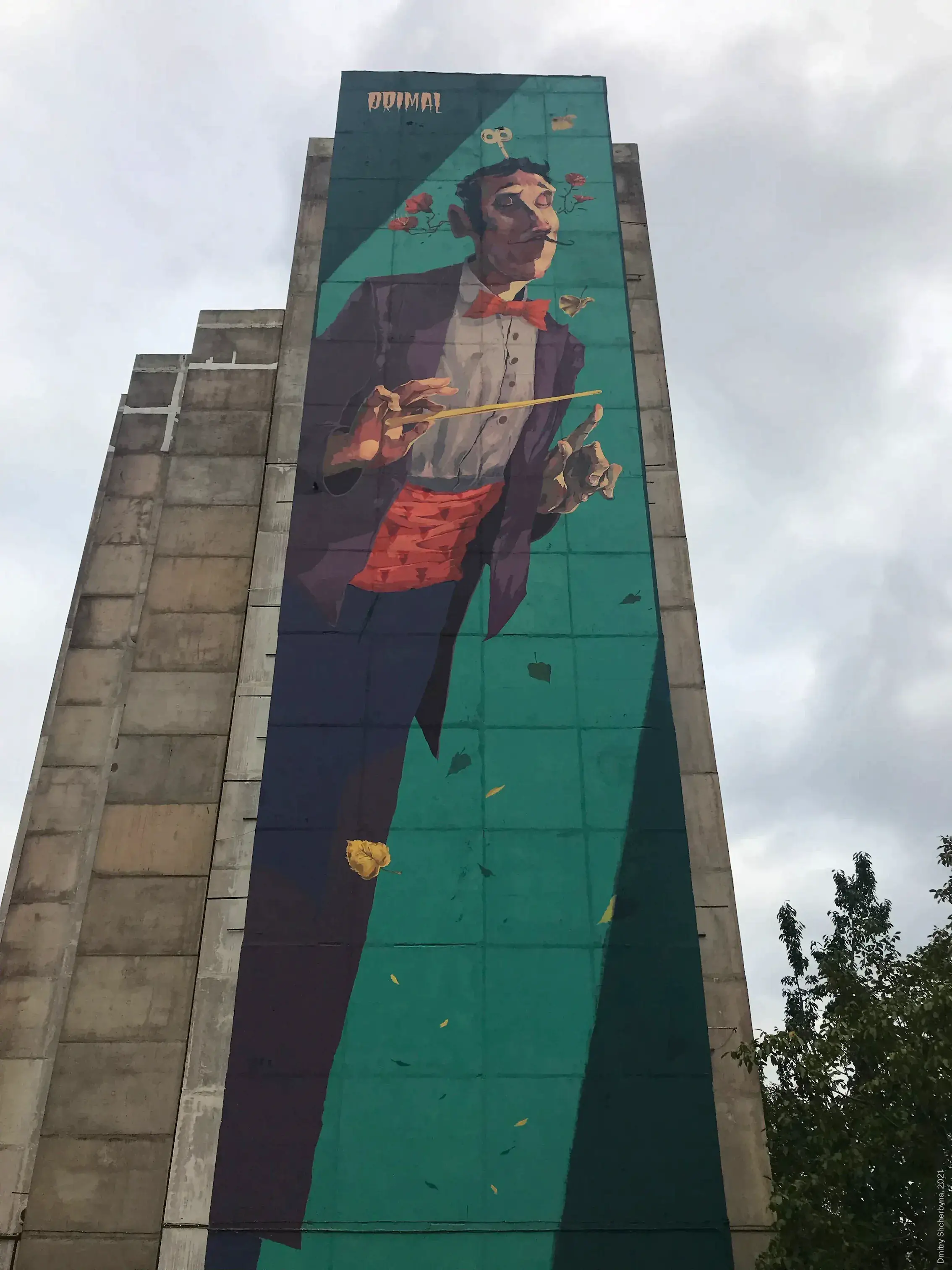
Large-scale mural on a concrete tower depicting a dapper orchestra conductor in a purple tuxedo with a red bow tie and cummerbund, holding a baton while roses and autumn leaves swirl around him against a teal background.
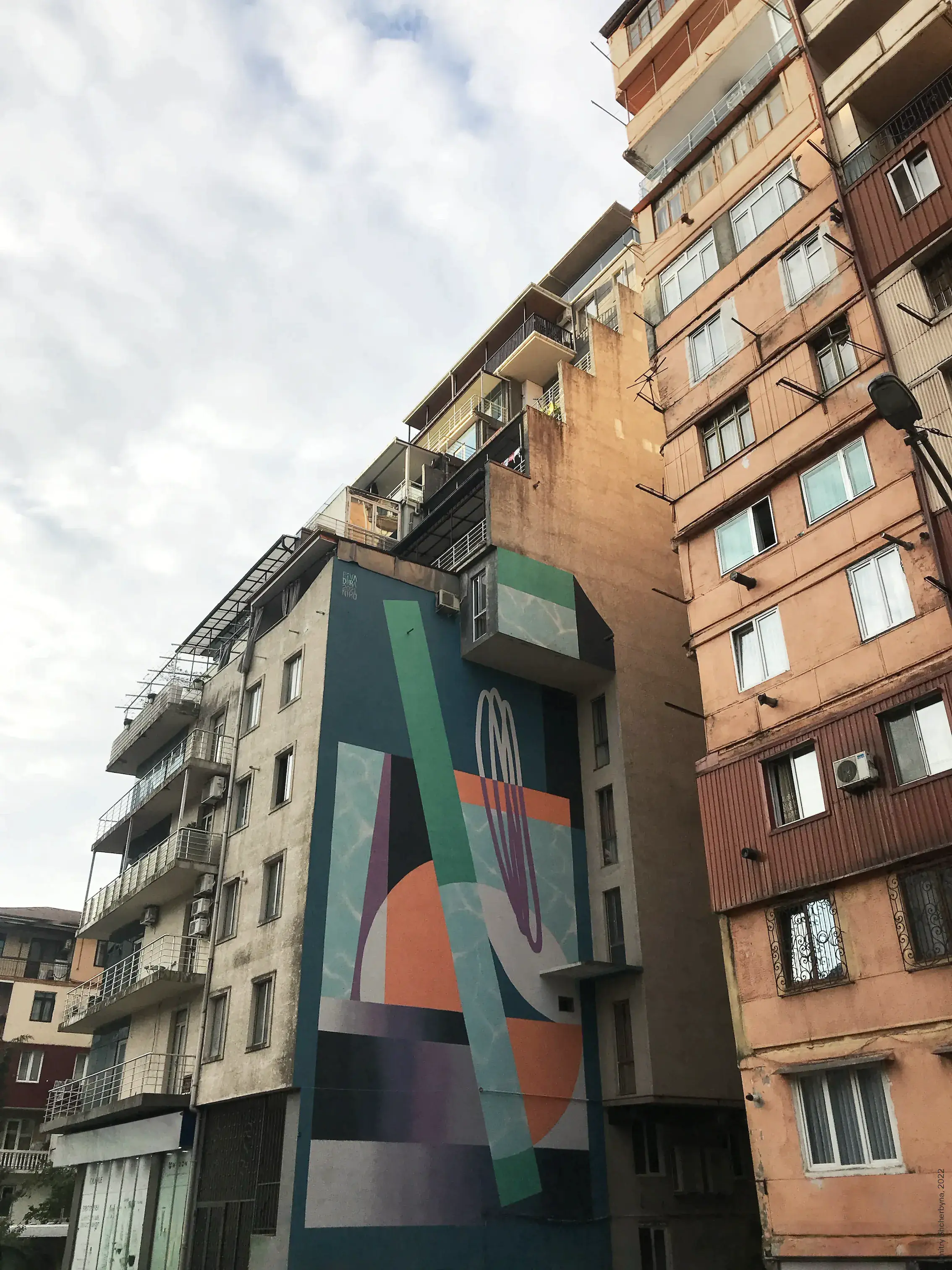
Abstract geometric mural painted in teal, orange, green and purple on the narrow side wall of a residential apartment block.
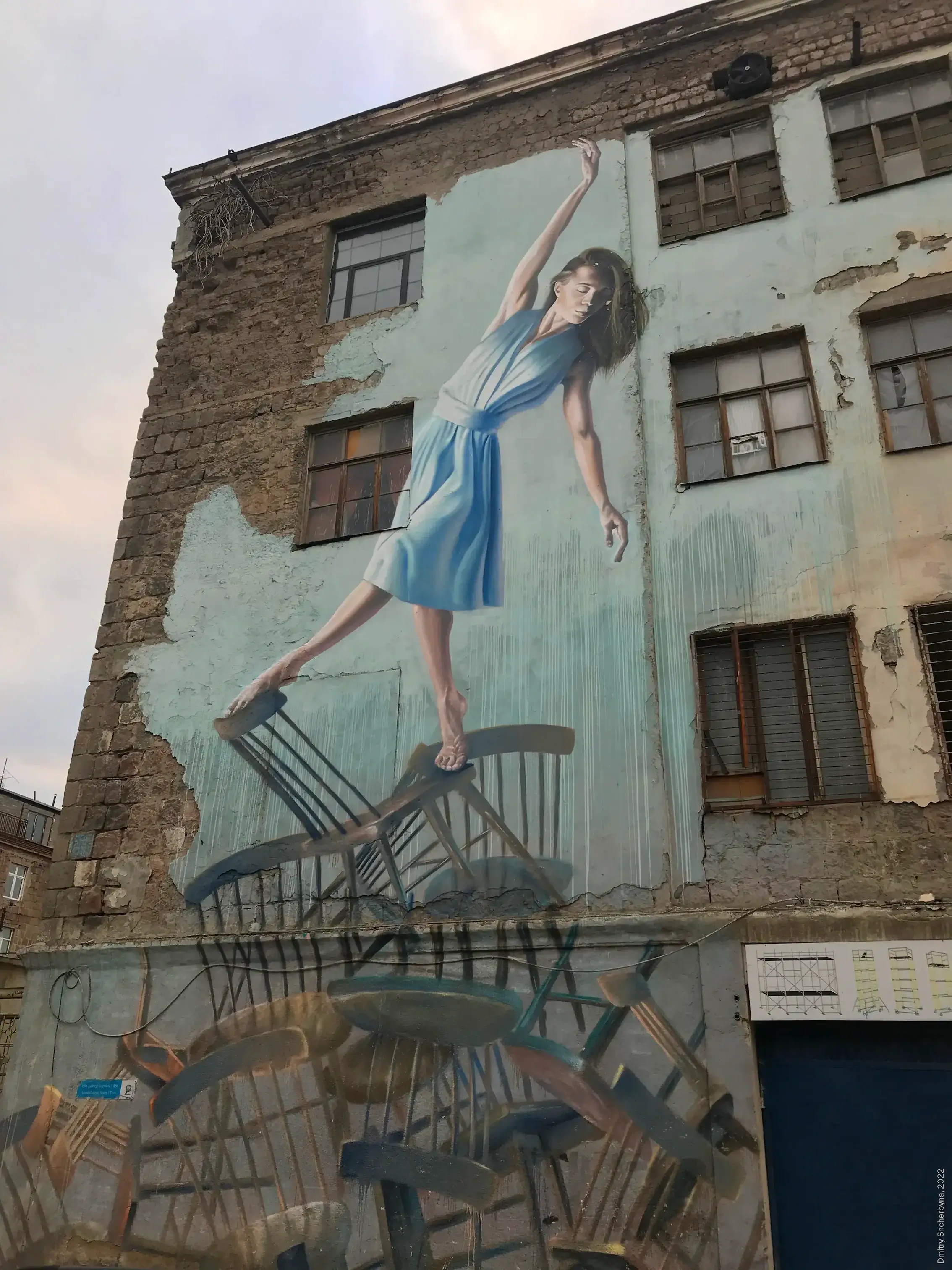
Photorealistic mural of a young woman in a light blue dress balancing gracefully on a toppling pile of wooden chairs and tables, painted on a weathered brick building facade.
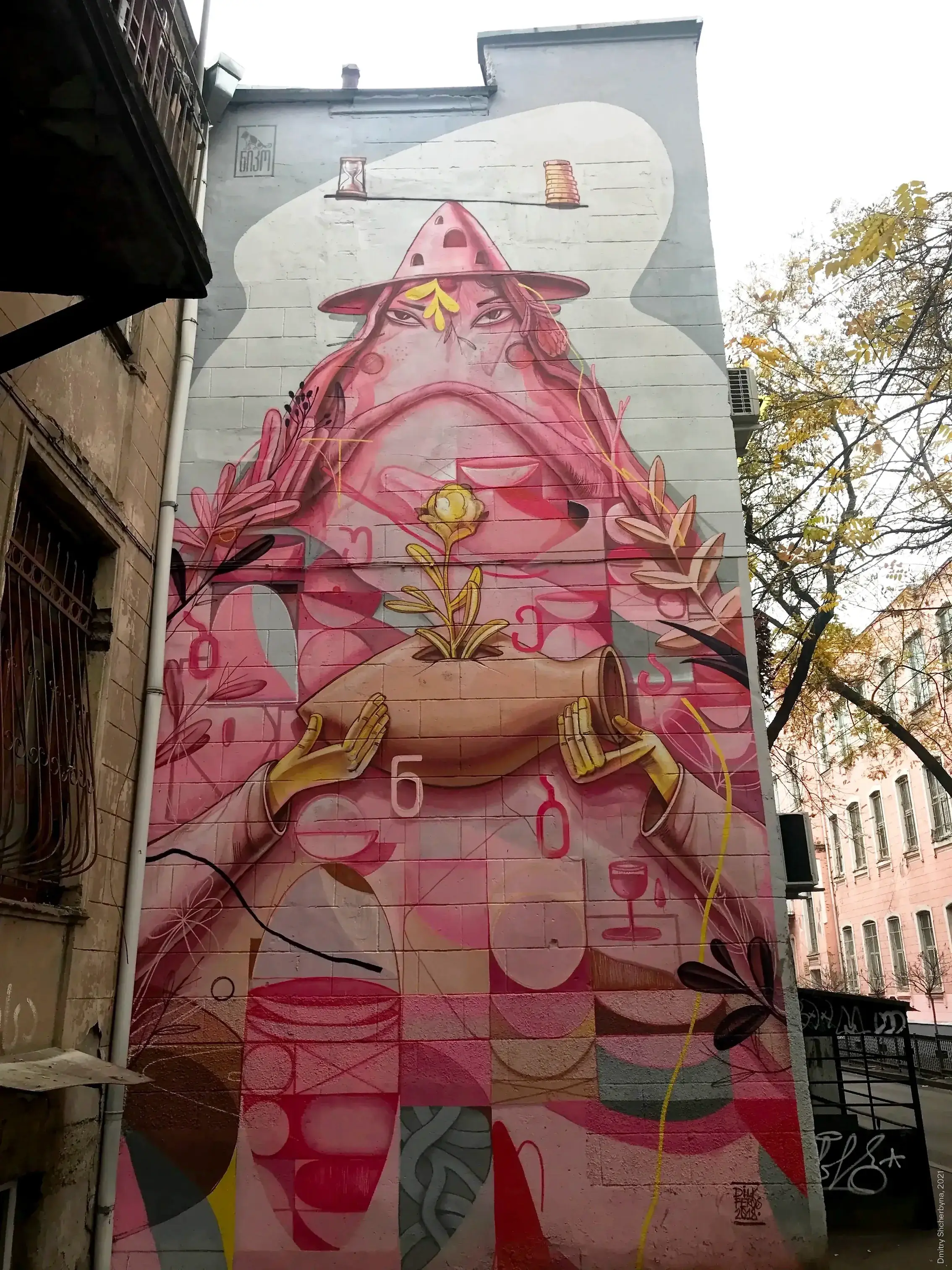
A large pink-toned mural depicting a stout figure wearing a pointed hat and holding a clay vessel containing a sprouting golden plant. Georgian alphabet letters and symbols related to wine are scattered throughout the composition.
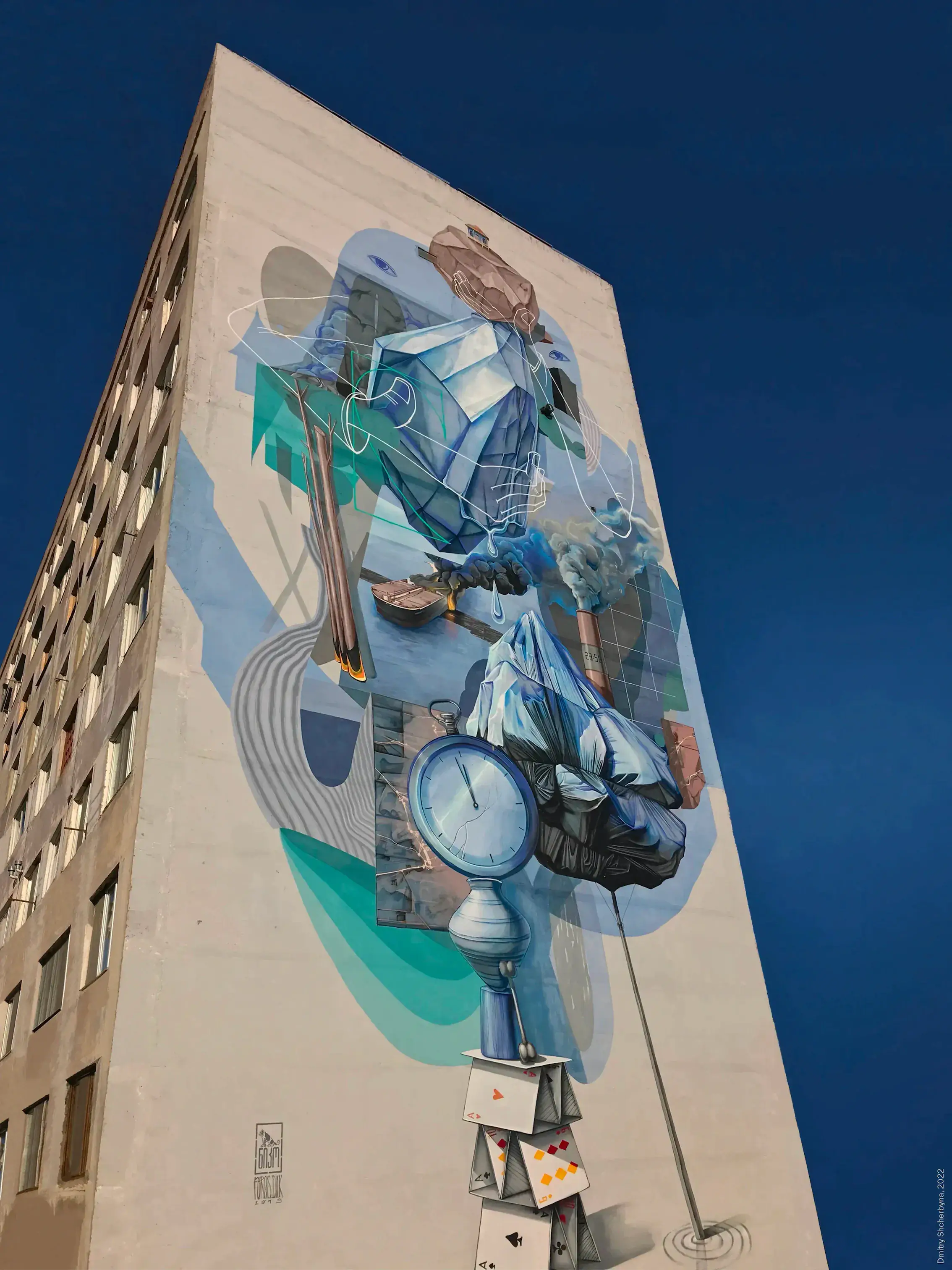
A tall surrealist mural on an apartment building consists of blue-toned objects stacked vertically - a suitcase, an ice block, a clock face, draped fabric, and a house of playing cards at the base - all connected by flowing lines against a deep blue sky.

“Fabrika” became an influential anchor of Georgian street art, proving that urban regeneration and creative culture could reinforce each other.

The street art scene is developing rapidly, with an increasing number of notable large-scale works appearing on the streets of Georgian cities.
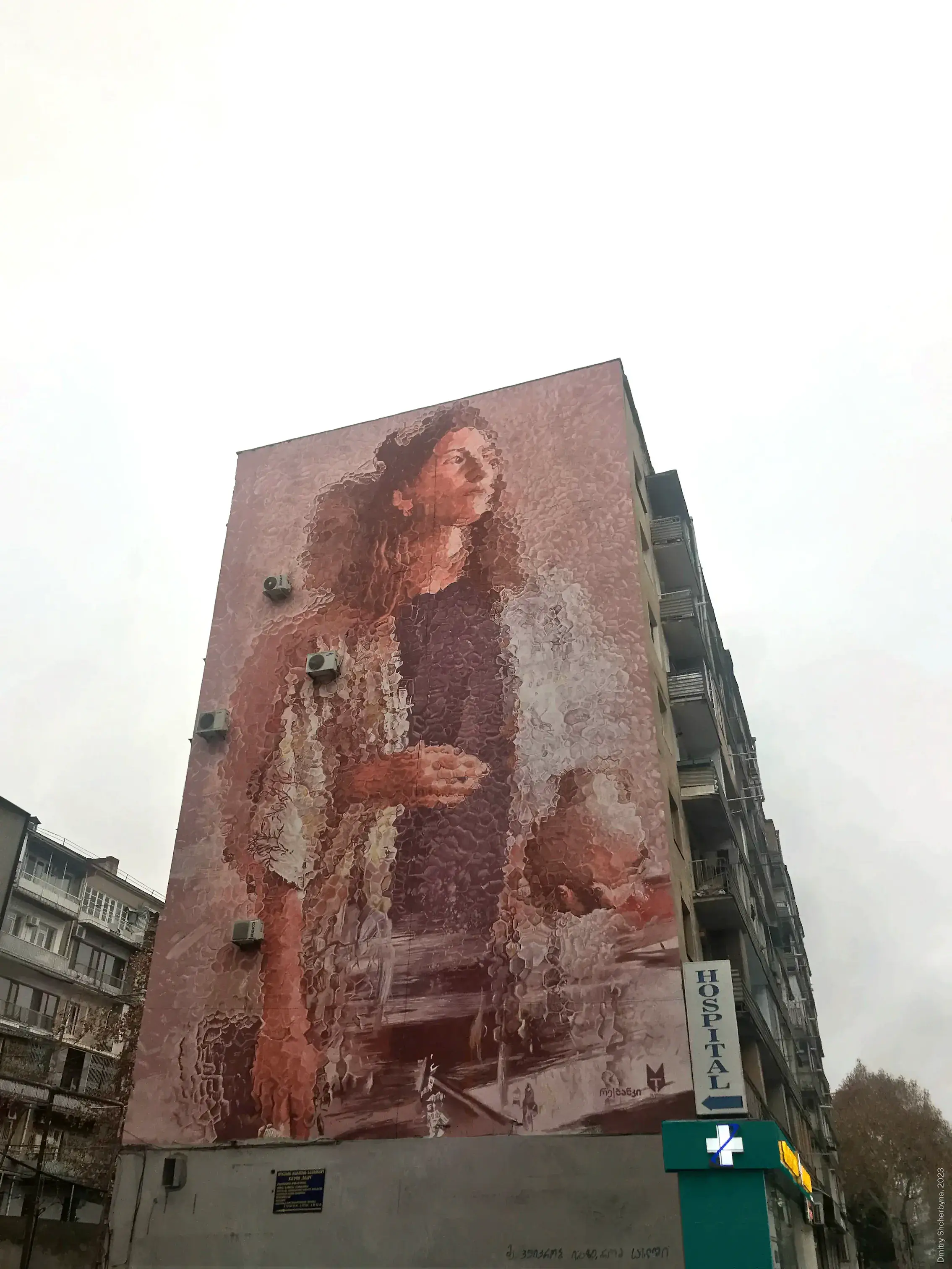
A full-building mural of a woman with long, curly hair rendered in a textured monochromatic palette of pink and mauve, looking upward with her hands gently clasped.
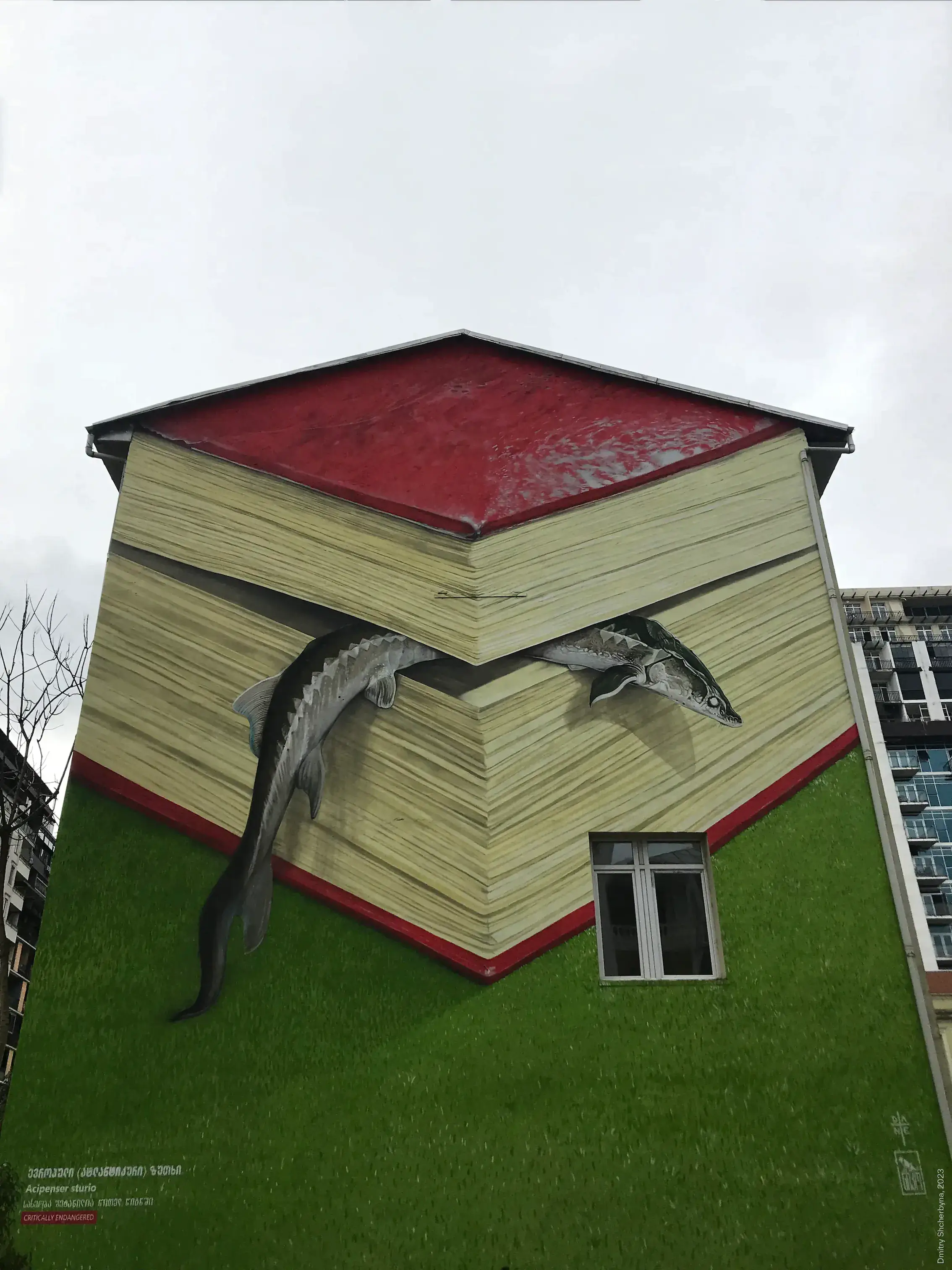
A trompe-l'oeil mural transforming a building's corner into a giant red book with yellowed pages, with a sturgeon fish emerging from between the pages. Text in Georgian and English identifies the species as "Acipenser sturio" and labels it "CRITICALLY ENDANGERED."

However, any outdoor works tend to deteriorate over time. Some of the works presented in this article no longer exist. Some have been painted over, and others have been badly damaged by the elements or other factors. Within just a few years, numerous works have vanished, reflecting the trade-off of such a fast-moving scene, where new pieces emerge almost as quickly as older ones fade. The ephemeral nature of street art makes it vulnerable to urban development and subject to removal by authorities or property owners. In practice, many works are simply replaced rather than repaired. However, its impermanence does not ultimately detract from its cultural relevance or its lasting influence.

As neighborhoods improve — repainted, redeveloped, gentrified — something else inevitably gives way in the process. The gradual erasure of works from the city's landscape represents not merely a visual loss but also the disappearance of the narratives of community identity and diverse forms of artistic expression.
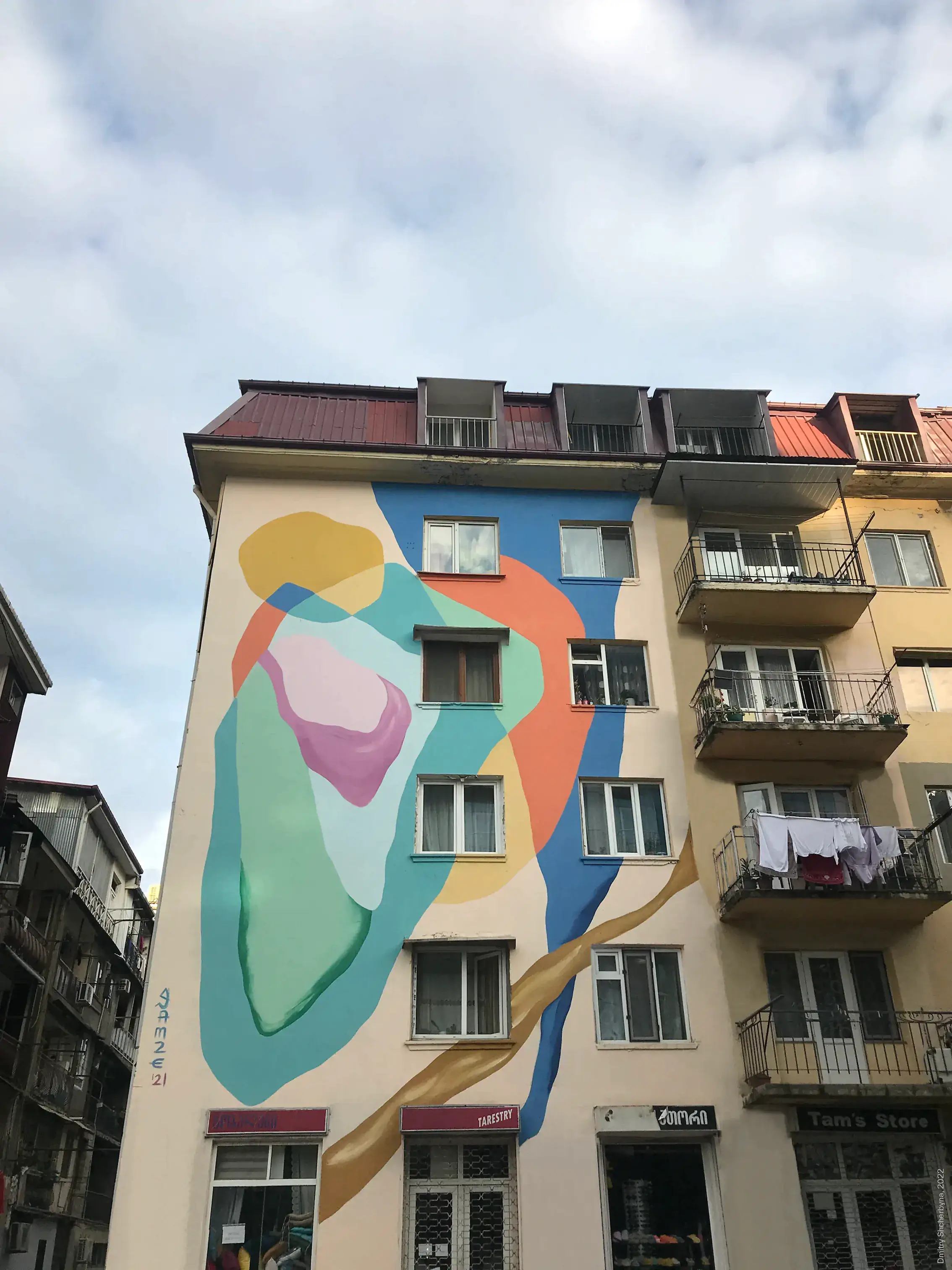
A mural on the side of an apartment building depicts two abstract figures in an embrace rendered in soft, overlapping shapes of blue, coral, mint green, yellow and pink.
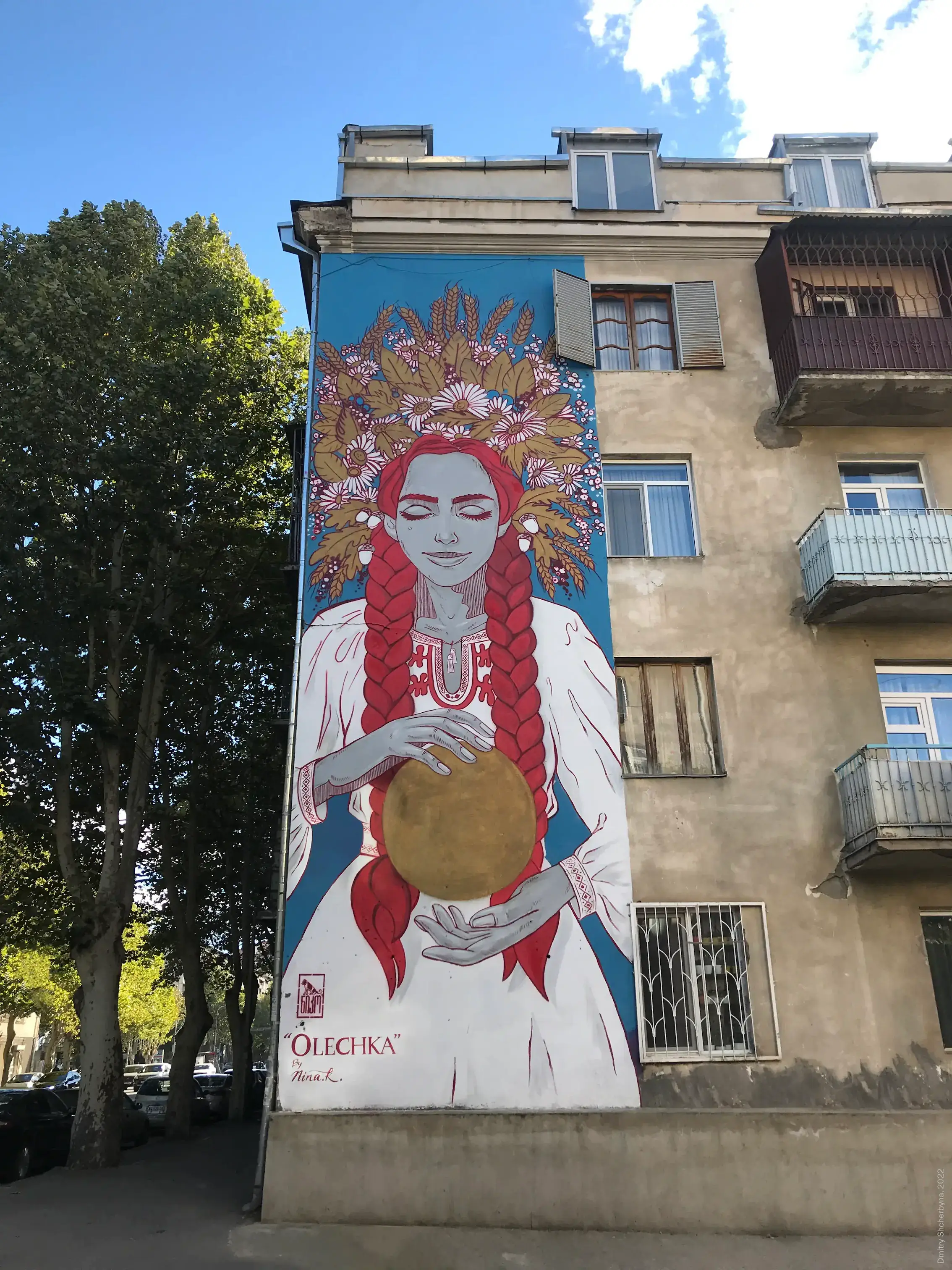
A mural on the side of an apartment building shows a serene woman with red braids, closed eyes, and an elaborate wreath of wheat, flowers, and leaves on her head. She is wearing a white embroidered blouse and holding a golden orb.
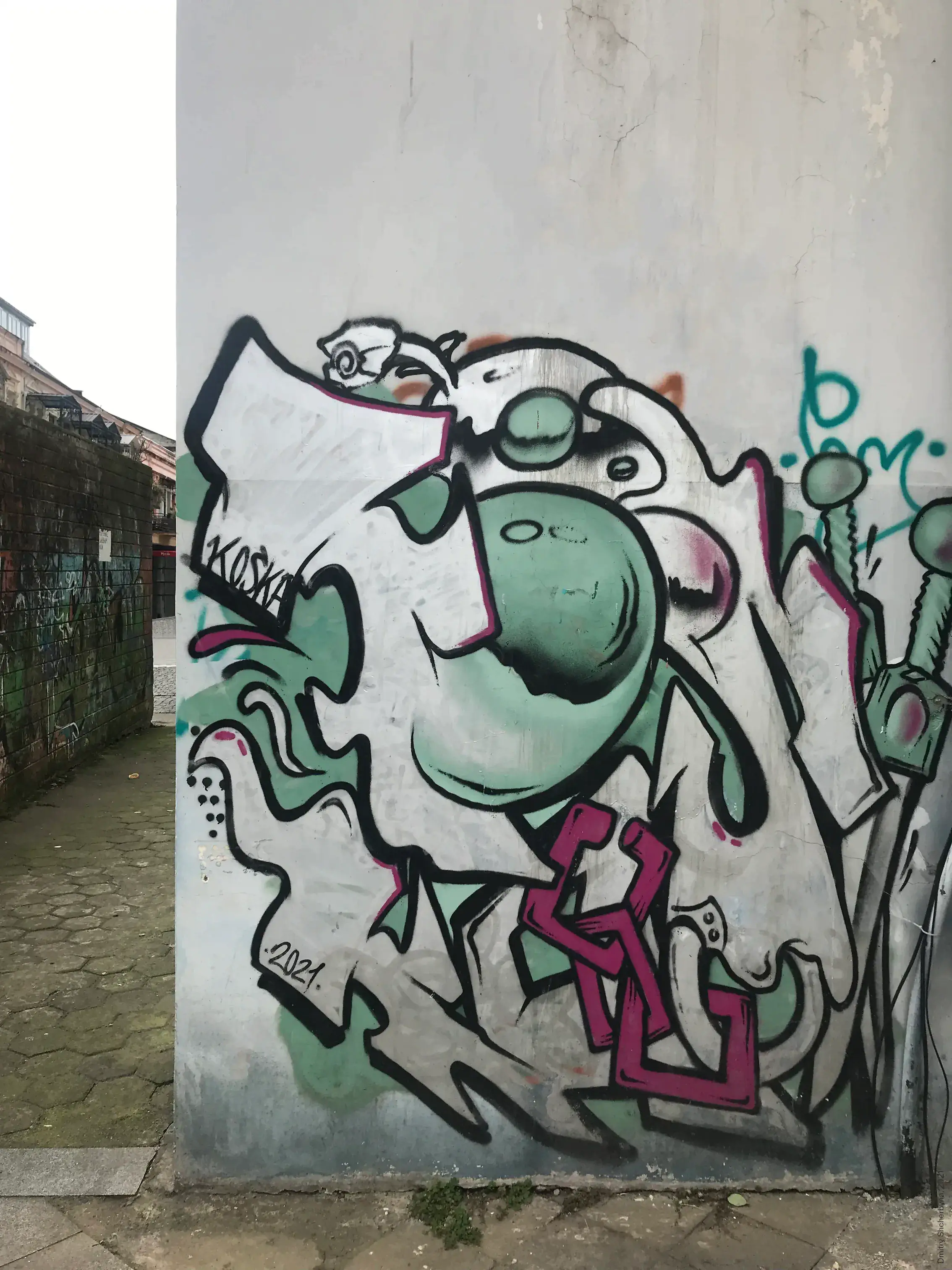
A graffiti of a weathered green wall featuring a round cartoon character with a bulbous nose and wide eyes surrounded by angular letters in mint and pink.
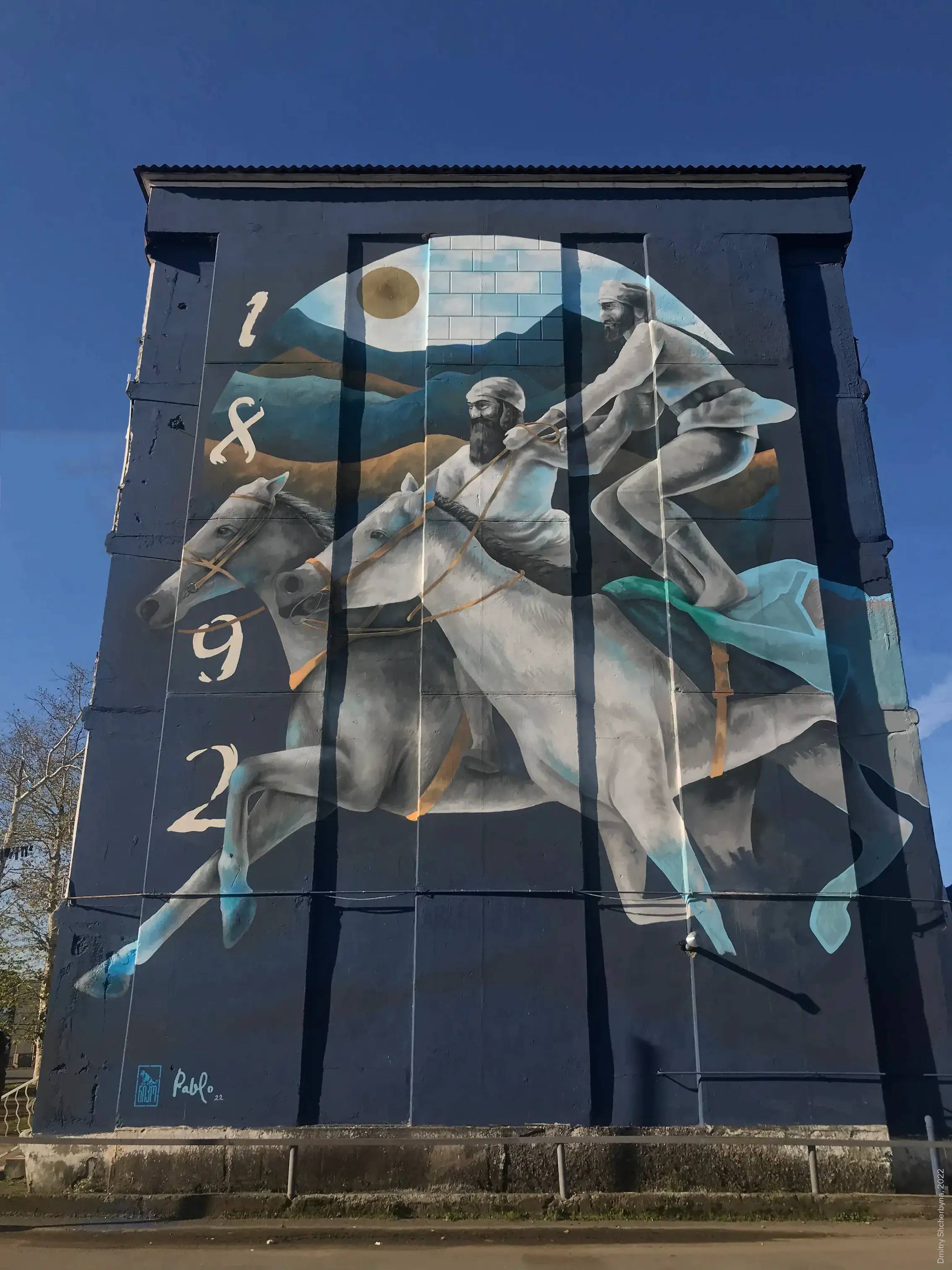
A mural on a dark blue building wall depicts two bearded horsemen in traditional Caucasian dress, galloping on grey horses, before a circular backdrop of mountains and sky.
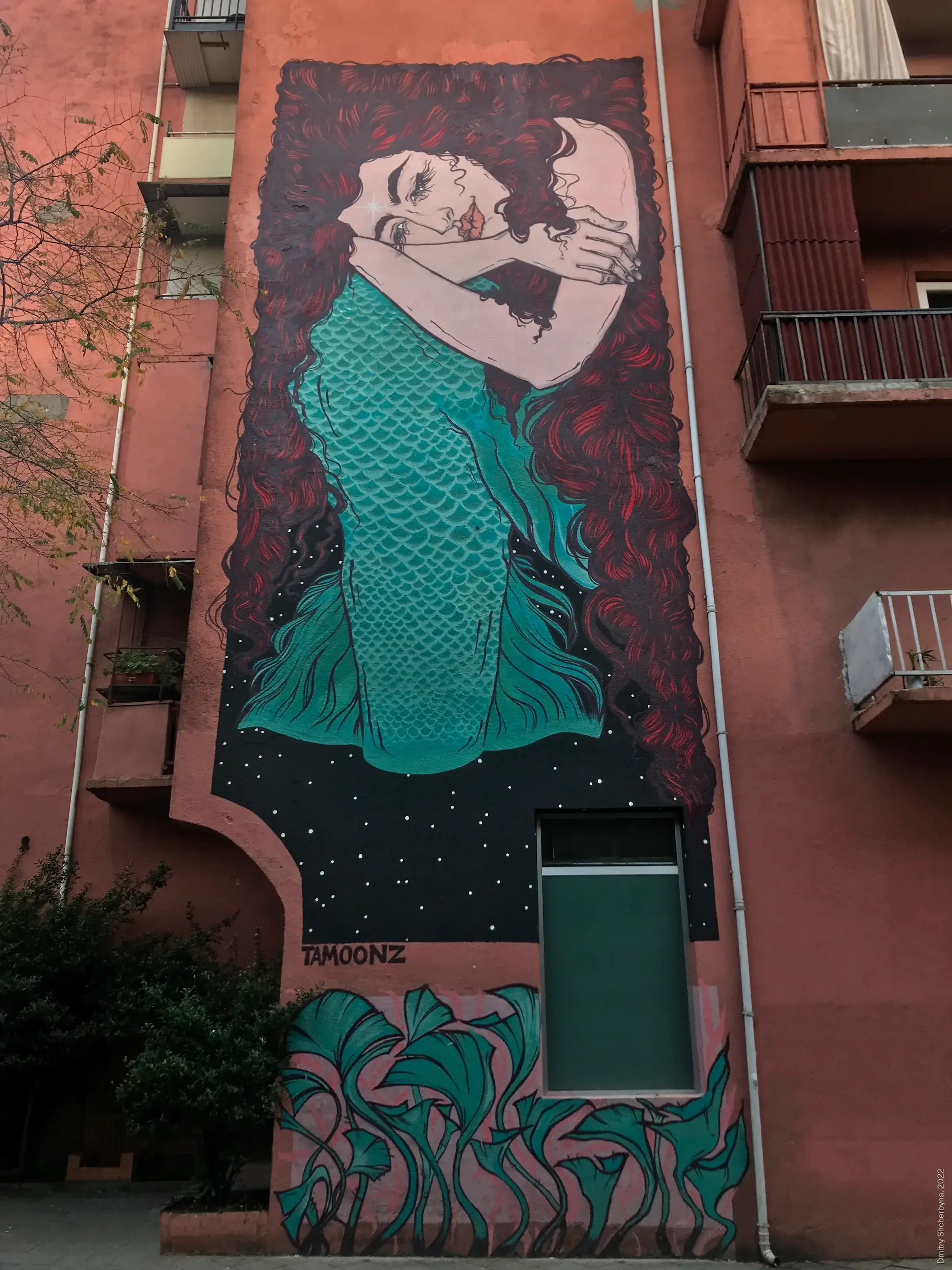
Mural on a salmon-pink apartment building: a woman with voluminous dark red hair, wearing a teal-scale patterned dress, her eyes closed and her hand resting near her face. She is surrounded by a starry night sky and green foliage.
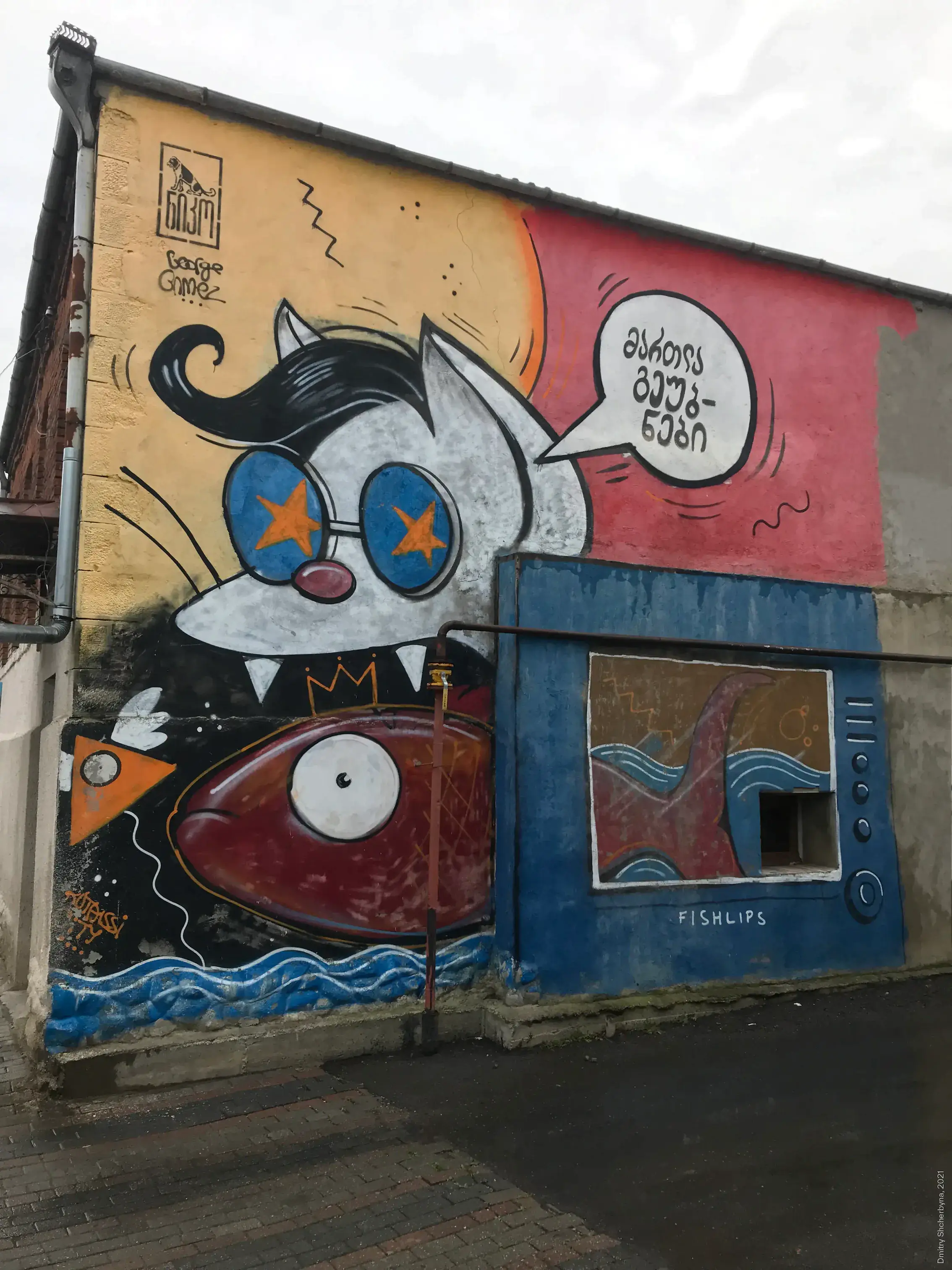
A playful mural featuring a wide-eyed cartoon cat wearing star-shaped glasses and sharp fangs, looming over a red fish crowned with a crown, next to a blue TV set labeled "FISH-LIPS" showing a fishtail.

Through their works, Georgian artists — those just beginning and those long established — continue to document the history of the country's rising modern street art scene.
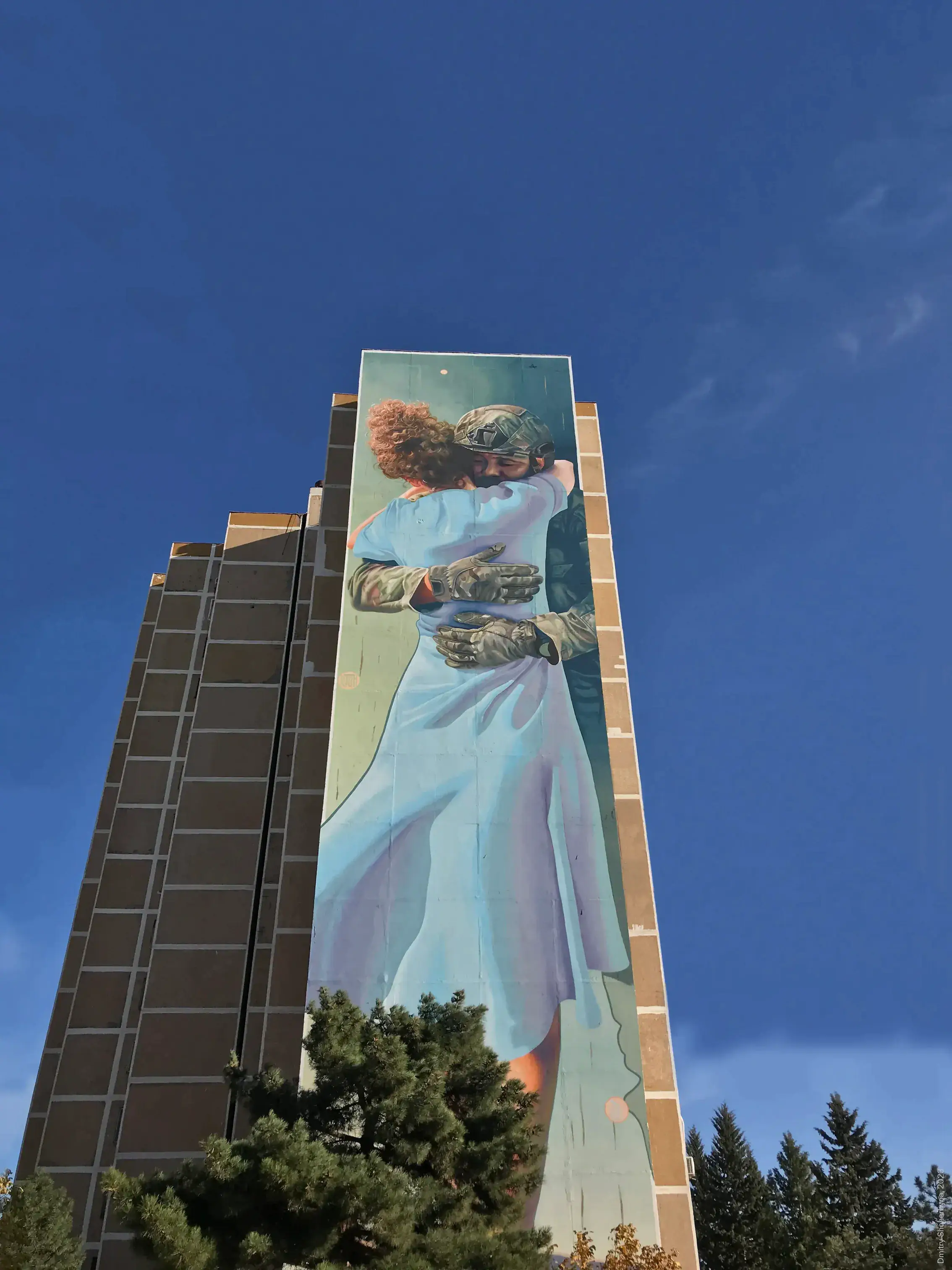
A tall mural on a high-rise building shows a soldier in combat gear and a helmet tenderly embracing a woman in a flowing light blue dress against a muted teal background.

Like in the case of jazz in the recent past, social recognition through increased broader public attention to the topic was one of the key stages in the process of legitimization.
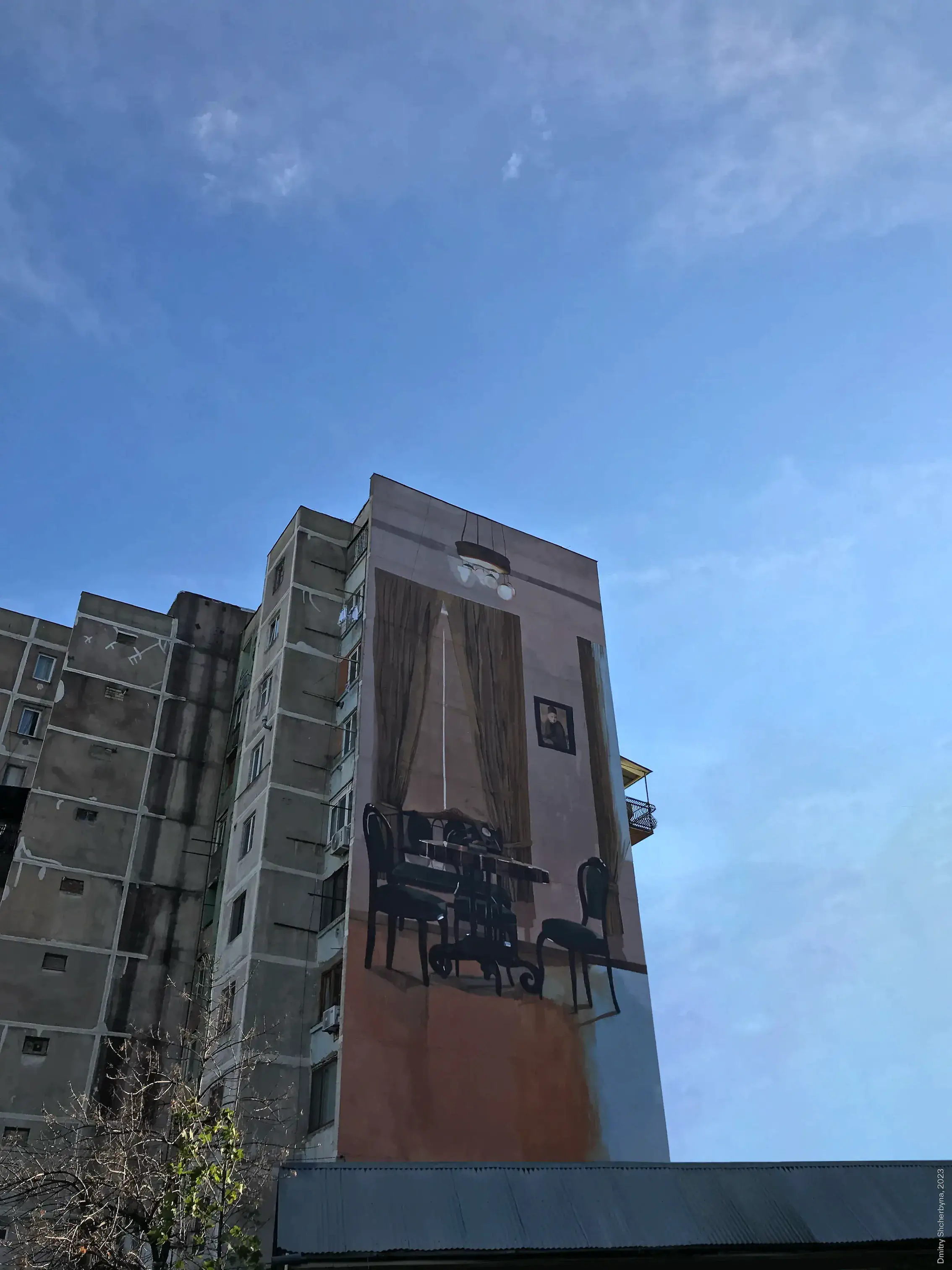
A mural on the side of a high-rise apartment building depicts a traditional interior room with dark wooden furniture, a table with chairs, long curtains flanking a bright window, a framed portrait on the wall, and a hanging light fixture. The painting creates the illusion of a room on the building's exterior.
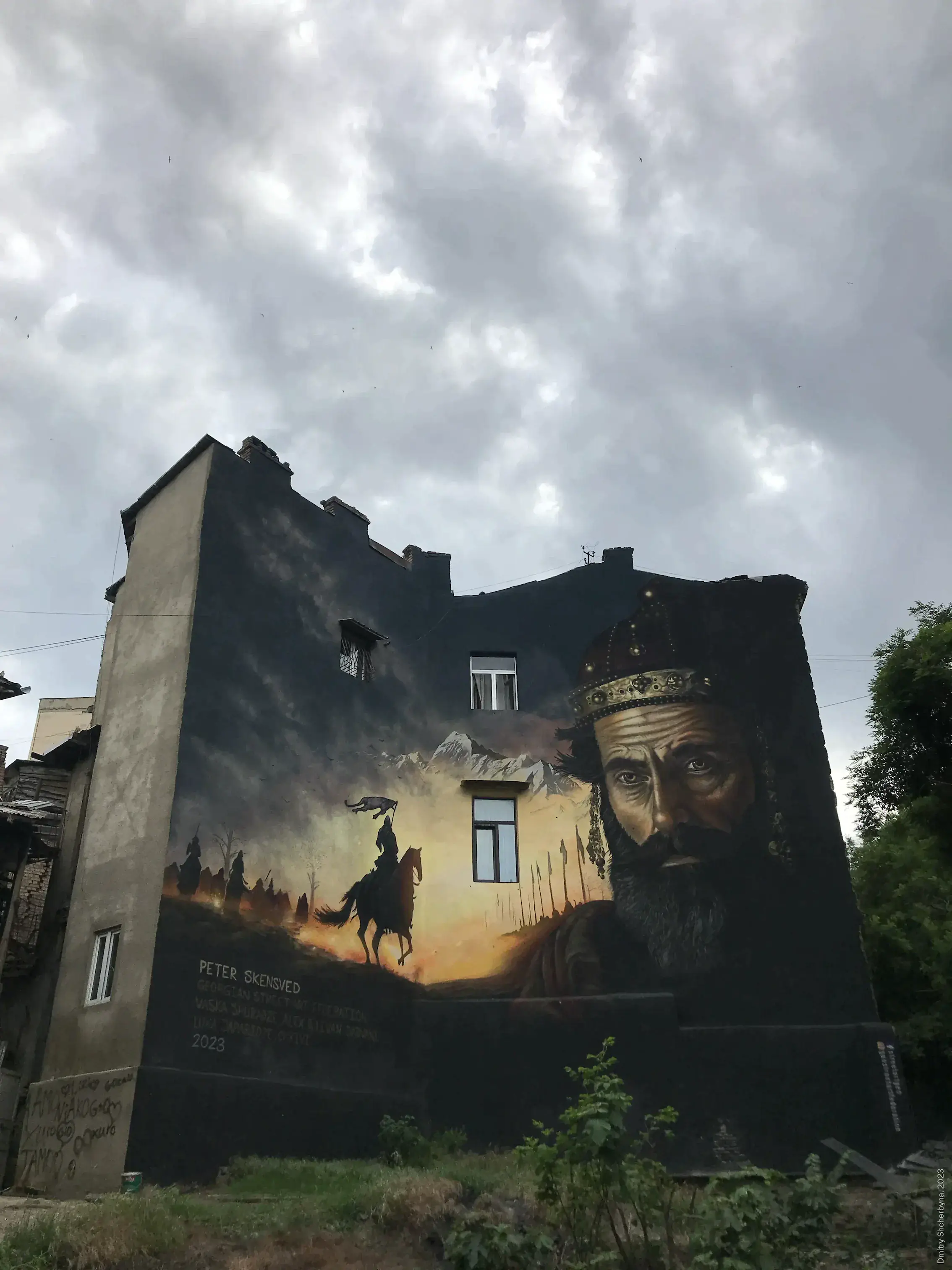
A mural covering the side of an old building shows the close-up face of a bearded king wearing an ornate crown. Next to him is a scene of a horseman carrying a banner in front of snow-capped mountains, with an army of soldiers bearing spears at sunset.

Index_Georgia

Close

We use cookies for analytics and site improvement. Privacy policy.

We use cookies for analytics and site improvement.

Decline

|

Accept